
It’s sure been awhile since I posted here!
Today’s post has three pieces of art. All come from the 1984 “G.I. Joe Briefing Book” a thick three-ring binder of photocopies and memos that some folks writing for the Sunbow cartoon had. It was reference for all the character and vehicle names and looks, a page or two for each. Many entries start with a high-contrast black and white photocopy of some Hasbro package art, followed by a black and white photocopy of a Marvel Productions color model cel.
In the case of the 1985 Snow Cat, my tied-for-favorite G.I. Joe vehicle (everyone always asks “who’s your favorite Joe?” and rarely ask “What’s your favorite G.I. Joe vehicle?”), there are three photocopies.
First up is a photocopy of Wayne Luther’s Hasbro presentation art. The original was in color, and bigger than 8.5″ x 11″, and not to be seen outside of Hasbro:
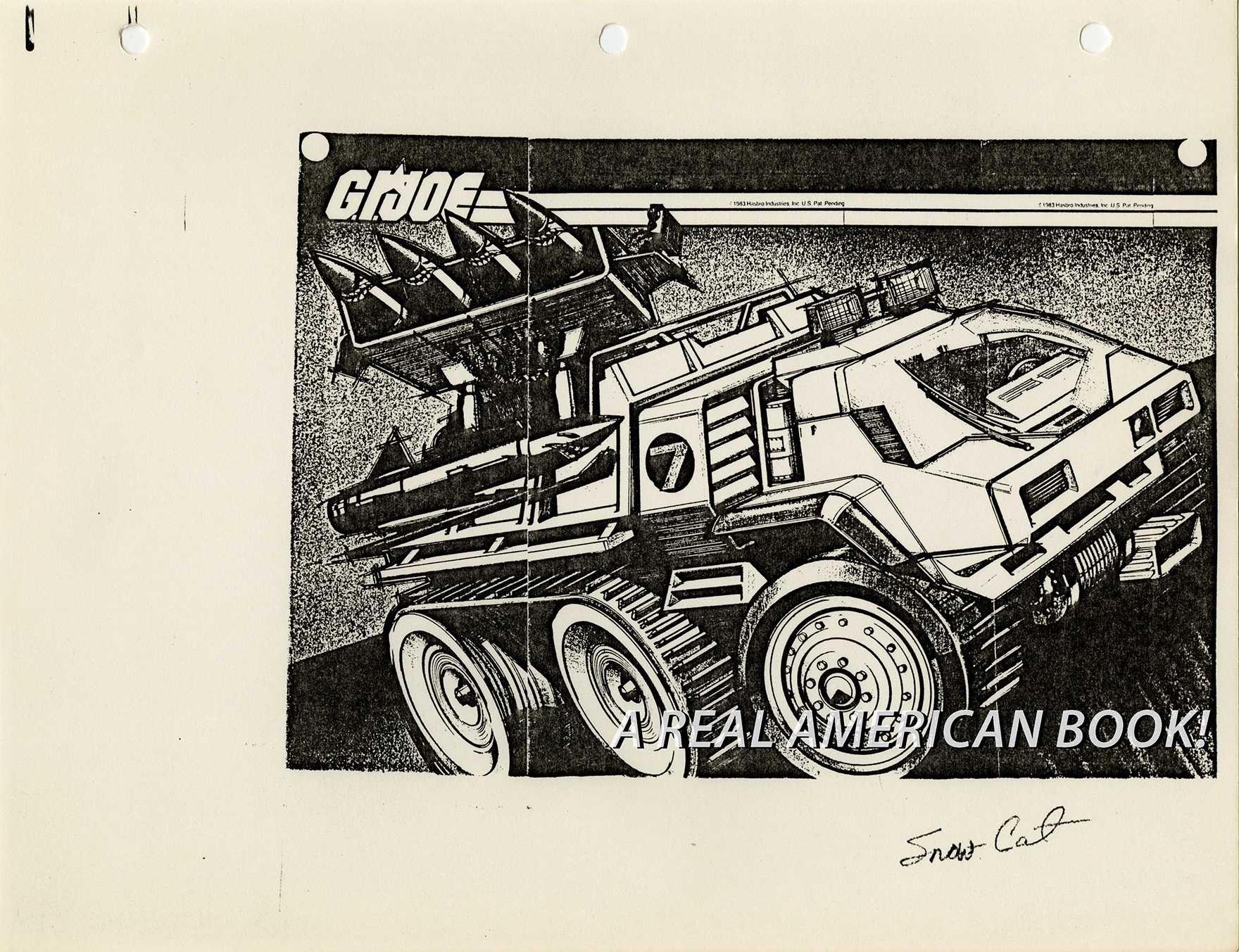
Note how tall this arctic tank is!
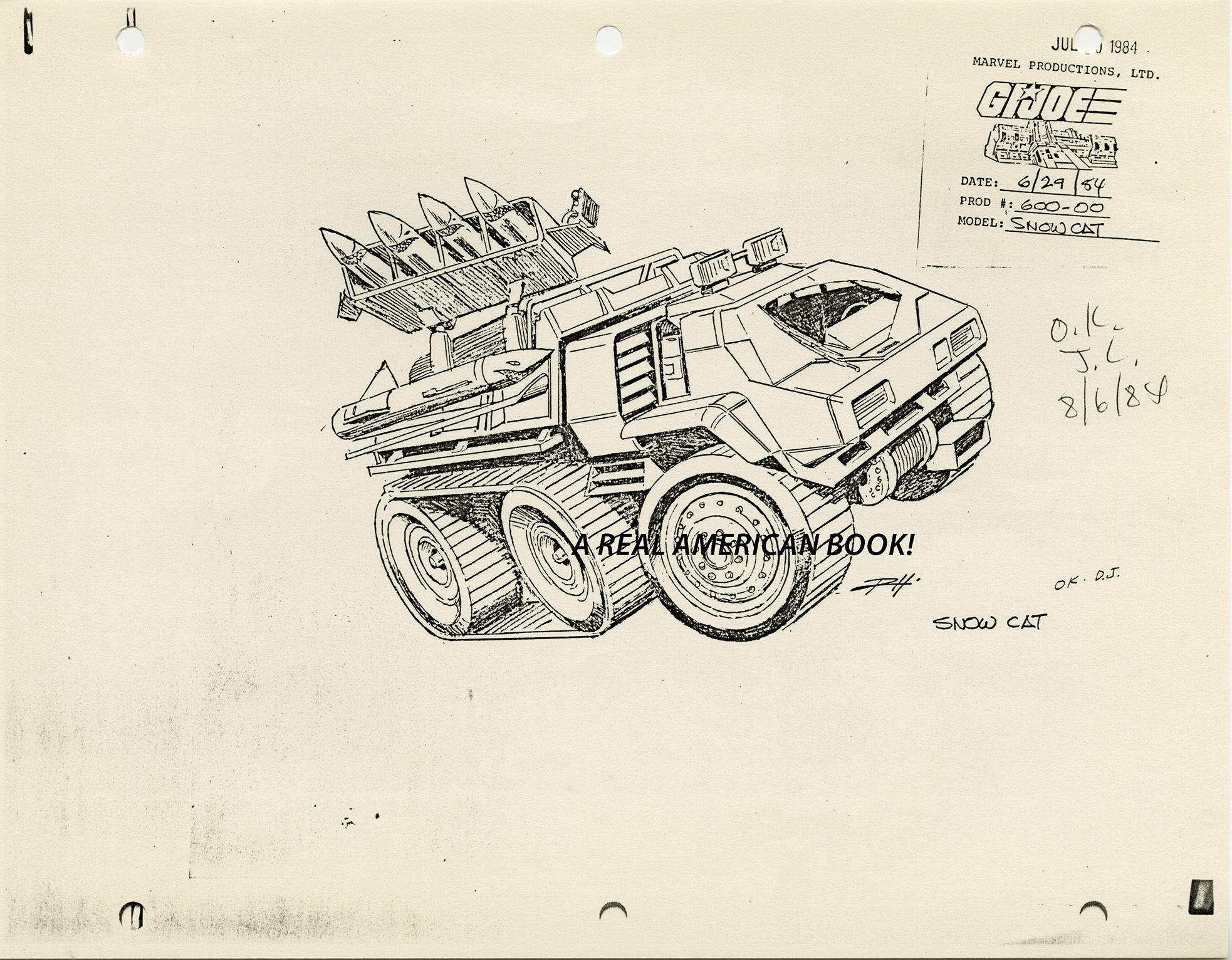
Following that is a photocopy of Russ Heath’s model drawing. Heath redraws Luther’s work, not changing the angle (why make more work?) and maintaining those not-final proportions. Ostensibly, this is the stage where much detail is pulled out of the vehicle or character, but that didn’t happen as much on G.I. Joe, so this looks more like a recreation than a reduction. Of the Snowcat’s height, it’s not a match for the final, production toy. (“Production” means the regular ones sold at stores, different from a prototype or concept.)
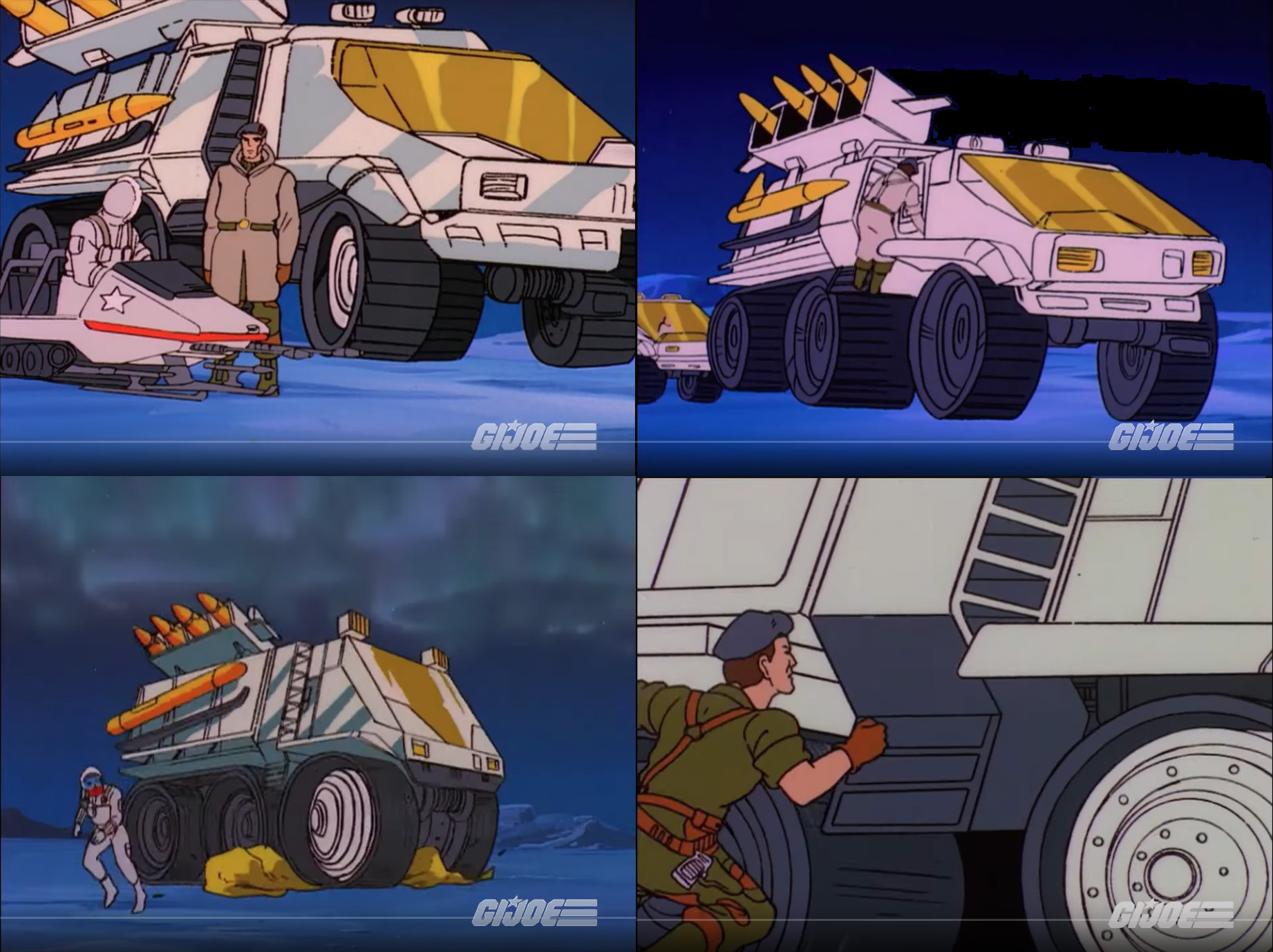
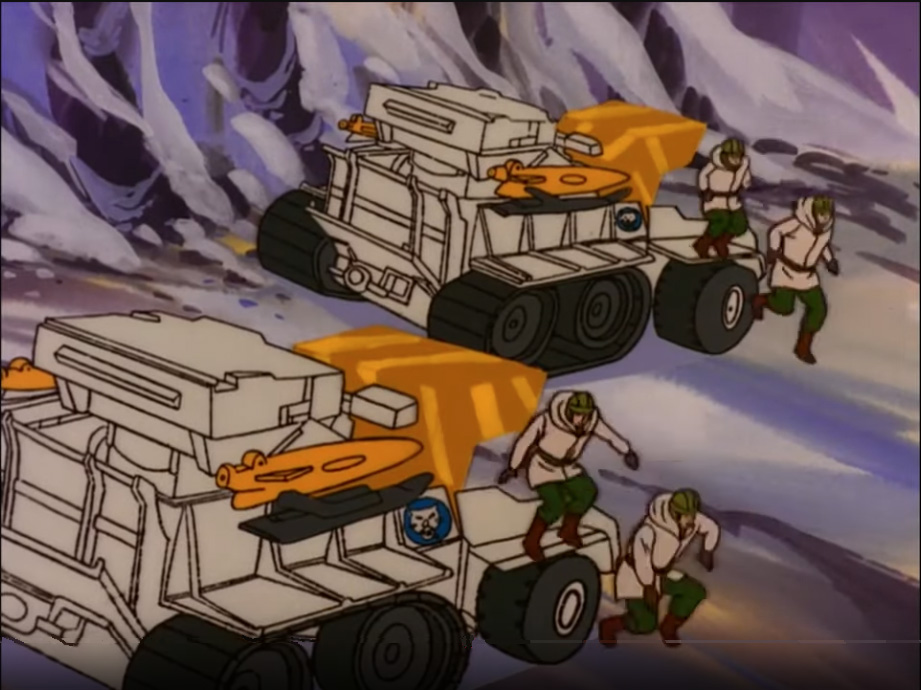
Interestingly, this too-tall Snowcat did appear in G.I. Joe once, in the 15th new episode to air when the animated series went to a full weekday season in September 1985. Here are stills from “Haul Down the Heavens.” I don’t know that as an 9-year old this jumped out as weird, but certainly a little later I thought “that’s too tall!”
Somewhere in the internal back and forth at Hasbro, or the cross-country back and forth with Hasbro and Sunbow on the East Coast, and Marvel Productions on the West Coast, someone noted that the production Snowcat toy wasn’t going to be so tall, and the model sheet needed to reflect this. Here, Heath or the other model designers on the animated G.I. Joe cartoon would then draw additional views on the proper proportions:
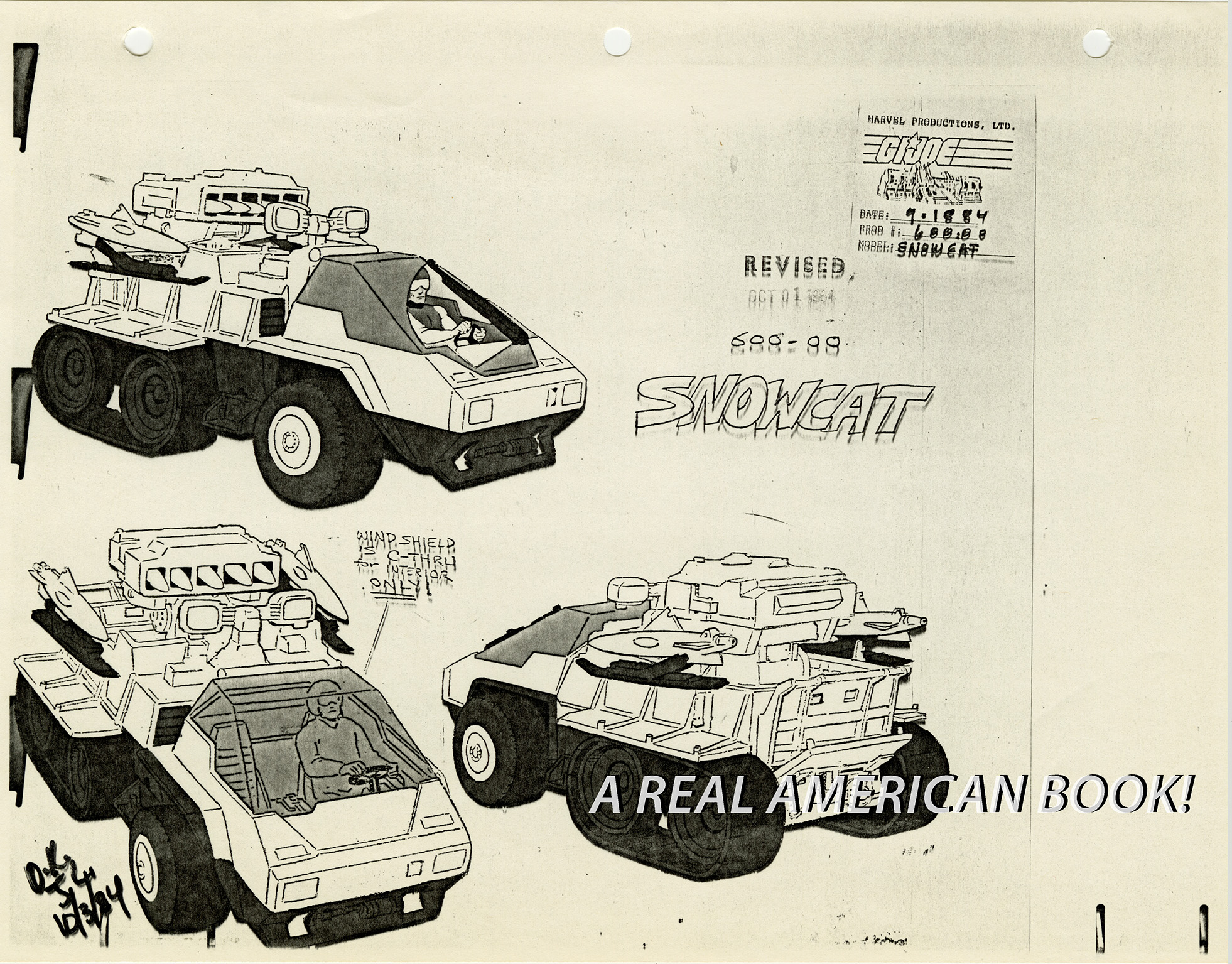
That of course isn’t the original artwork, nor is it even a photocopy of the original artwork. Rather, it’s a copy of a copy. The original artwork (pencil or ink) got photocopied onto clear celluloid, which was then painted in color. Where you are seeing a kind of shadow (the balloon letters “SNOWCAT” and text above it), that’s because the original model cel was a clear sheet, and only the Snowcat paint colors are opaque. As the light of the photocopier moves across the platen, the cel casts a little shadow onto what’s behind it, like a backing sheet of paper.
As much as I rare and original art, and note that black and white photocopies aren’t as eye-popping, I keep in mind that these photocopies do date to 1984 and 1985, and are artifacts themselves.
But if you’d like to end on some color, here’s a screencap from a later episode, “The Great Alaskan Land Rush,” where the Snowcat was animated in its proper proportions. [Thanks to Talking Joe’s Mark for spotting my error in the previous sentence, it’s now fixed, half a day after my original post.]
Run! Avalanche! No, not the other G.I. Joe arctic vehicle, a crushing flood of packed snow!
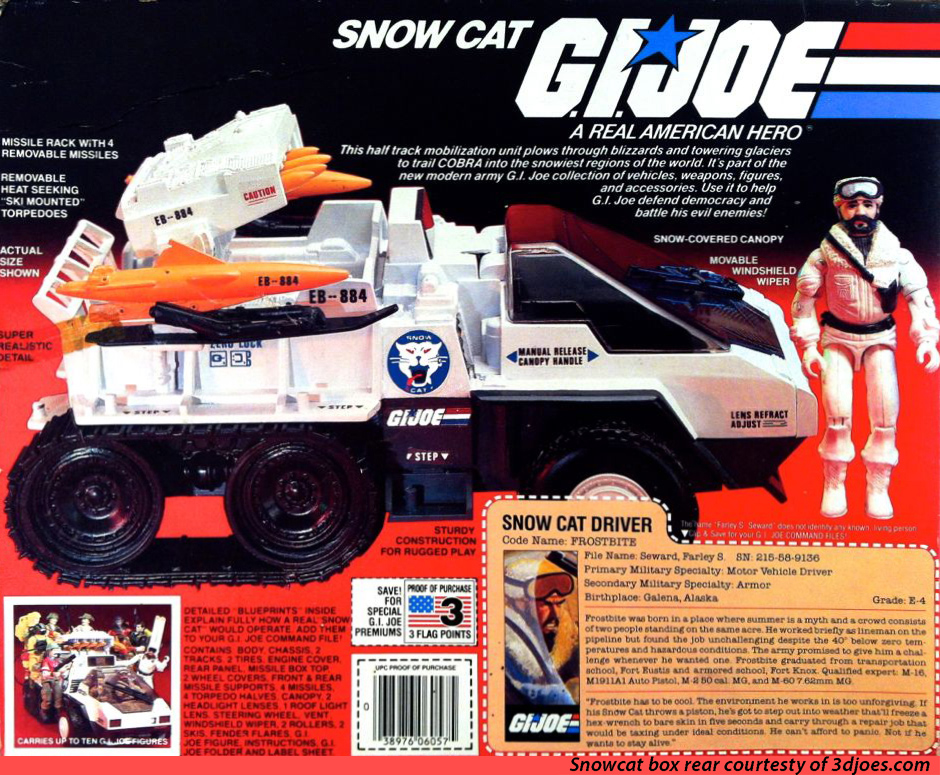
And just to put a fine point on it, here’s the Snowcat’s vehicle-to-human scale as depicted on the back of the toy box, courtesy of 3dJoes:
– – – – Footnote without an asterisk:
Looking back to the second paragraph, cel has one “L.” “Cells” are microscopic things in our bodies, and the jail holding space in G.I. Joe HQ is a cell, but “animation cel” has one “L,” though loads of newspapers, magazines, and blogs get it wrong.
[Error fixed: An early version of this post had the wrong episode listed where I note “The Great Alaskan Land Rush,” resulting in some confusion. Sorry about that, thanks to Talking Joe’s Mark for catching it.]


 A Real American Book!