Expert/pal Chris Murray lent me a one-of-a-kind G.I. Joe toy item, as well as a rare pre-production bauble, when I saw him at JoeFest in August. We had loosely worked out that I would photograph them in his hotel room, but I didn’t bring a proper camera or lights, and I’m not enough of a photographer that I could light these items properly. Chris generously let me take them with me. I offered to mail them back a few weeks later, but Chris was concerned about shipping mishaps, and said he’d take them back in person at the next G.I. Joe convention in November. I had assumed I would attend that show, but hadn’t locked it in — three months was a long ways off and it’s hard to plan your next trip during your current trip. But that settled it, I would be attending Assembly Required in November 2024. Now I had three months to photograph these two pieces of treasure. This week I did. Make that the passive voice, have them photographed.
In the past I have booked time at Glad Works, a design firm in Pawtucket, Rhode Island. But this week’s booking wouldn’t be a complicated photoshoot. We wouldn’t be finding textures or creating light patterns behind a G.I. Joe alien, nor would we be placing a vehicle in the mulch outside in the parking lot. Rather, these two photos would need single-color backdrops, and basic, unadorned lighting. It’s fun to check in with Glad Works, the site of many great meetings and photo days in the long process of writing and designing my G.I. Joe history book, but it’s also an hour-plus drive. Surely I could keep this simple and local. Surely I knew a photographer with a couple of lights here in the Boston area. Surely my commute might be just a twenty-minute subway ride. I contacted an artist and gallery manager friend for ideas — who might photograph my toys? He rattled off two people. Both are work-friends with whom spending a few hours would be easy and fun. I asked the first if she was interested and available, and she was. Easy! This would be about as short a distance as I could imagine, one subway stop or a twenty-minute walk from my home. That is less stressful than avoiding Boston or Providence rush hour traffic on I-95! With that November convention is now less than three weeks away, I was running out of time. We agreed on a day. And our story picks up last week…
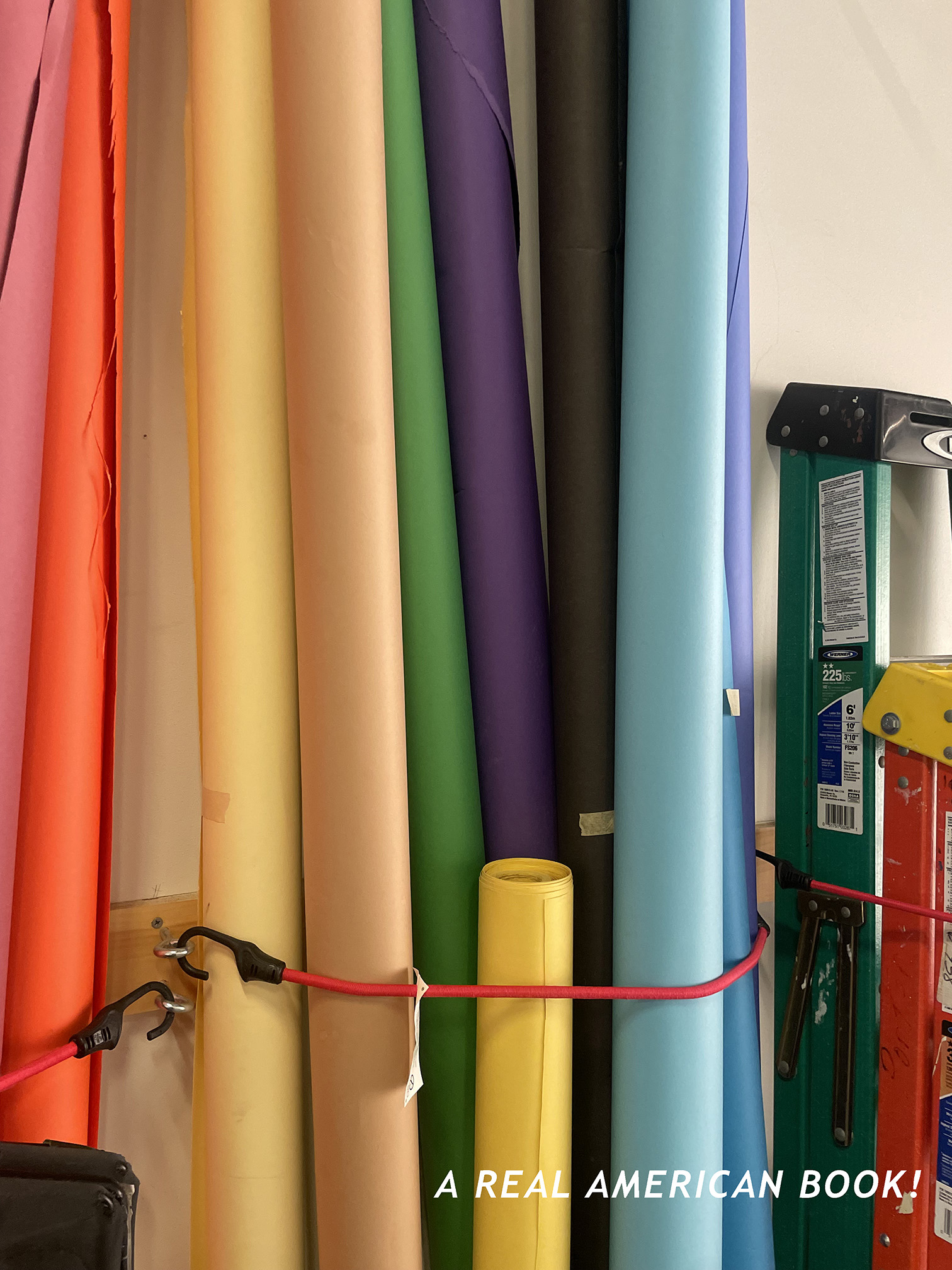
Photographer, educator, and gallery owner Jen Barrows hadn’t previously taken pictures of toys, much less rare and fragile ones, so she asked for some examples of previous photos logged for my book. I culled a few from my hard drive, and typed up an eight-paragraph email about the four different kinds of photos I’ve needed. I also included a behind-the-scenes shot of Andre Blais at the home of a former Hasbro sculptor in (yikes!) 2009 shooting some toys on that gent’s coffee table. But you’d never know because Andre set up a neutral backdrop and lit the scene so well — it could have been at any photography studio. (And indeed, a photo from that day is in Chapter 3.) I explained to Barrows that these wanted basic three-point lighting (if I have my term correct), with key, fill, and highlight (if I have my specs correct), and that options for different background colors would be helpful. If you’re shooting a green action figure, you’re not going to put it in front of a green background, but that still leaves a lot of colors to choose from. Barrows assured me that the studio where we’d be meeting had options. She sent a few shots like this:
Barrows thought this would take two hours, I thought three. She had a three-hour block set aside. This past Monday I arrived with the pre-production items, as well as a few production toys (that’s the term for regularly produced items that were sold at toy stores). These regular, normal 1982 and ’85 action figures, some from my childhood and others acquired for previous photoshoots, were for size comparison. One of these items I’d borrowed from Chris is at the 2-up scale — it’s twice the size of normal — and if you’re not holding it in-hand, the effect of how big and weird it is doesn’t properly transmit without a 1-up, three-and three-quarter inch figure nearby. I was pleased to see that in addition to Jen’s fancy camera and two different lenses, two softbox lights were already set up, and we’d be shooting not on a table with a makeshift cyc, but an actual photographer’s cyc. (Pronounced “sike,” with a long I.”)
That’s a funny word that might need defining. When you see indoor photos of models or objects in magazines or catalogs that have no seam behind them where the floor meets the wall, such photos were shot in front of a cyclorama. (As a film history teacher, “cyclorama” means something slightly different to me.) Here, the wall curves to become the floor. One part of the studio was so constructed, but we didn’t need that large of a scale. Against a different wall was a table cyc, a little larger than a really big upholstered high-back chair. It sat on four legs, so this was for products and objects, not people.
For the first item, we figured no color for the background, and so Barrows shot against the white plexiglas of the curve itself. Barrows changed the lights and bracketed her shots, and I rotated the item for side and rear angles that I won’t use, but thought we should get anyway. Then we tried similar shots with a pale yellow backdrop, cut from a giant roll of paper and clamped onto the plexi. For the second item, I tried to balance what would look good behind a green-grey toy-item, as well as to perhaps not repeat a color I’d previously used. That might be a fool’s errand, as a repeated color may be no big deal — a reader who sees a toy in front of a red background on page 20 won’t feel bored or cheated if a different toy appears in front of another red background on page 350. But I still like the idea of as much variety as possible. We chose orange.
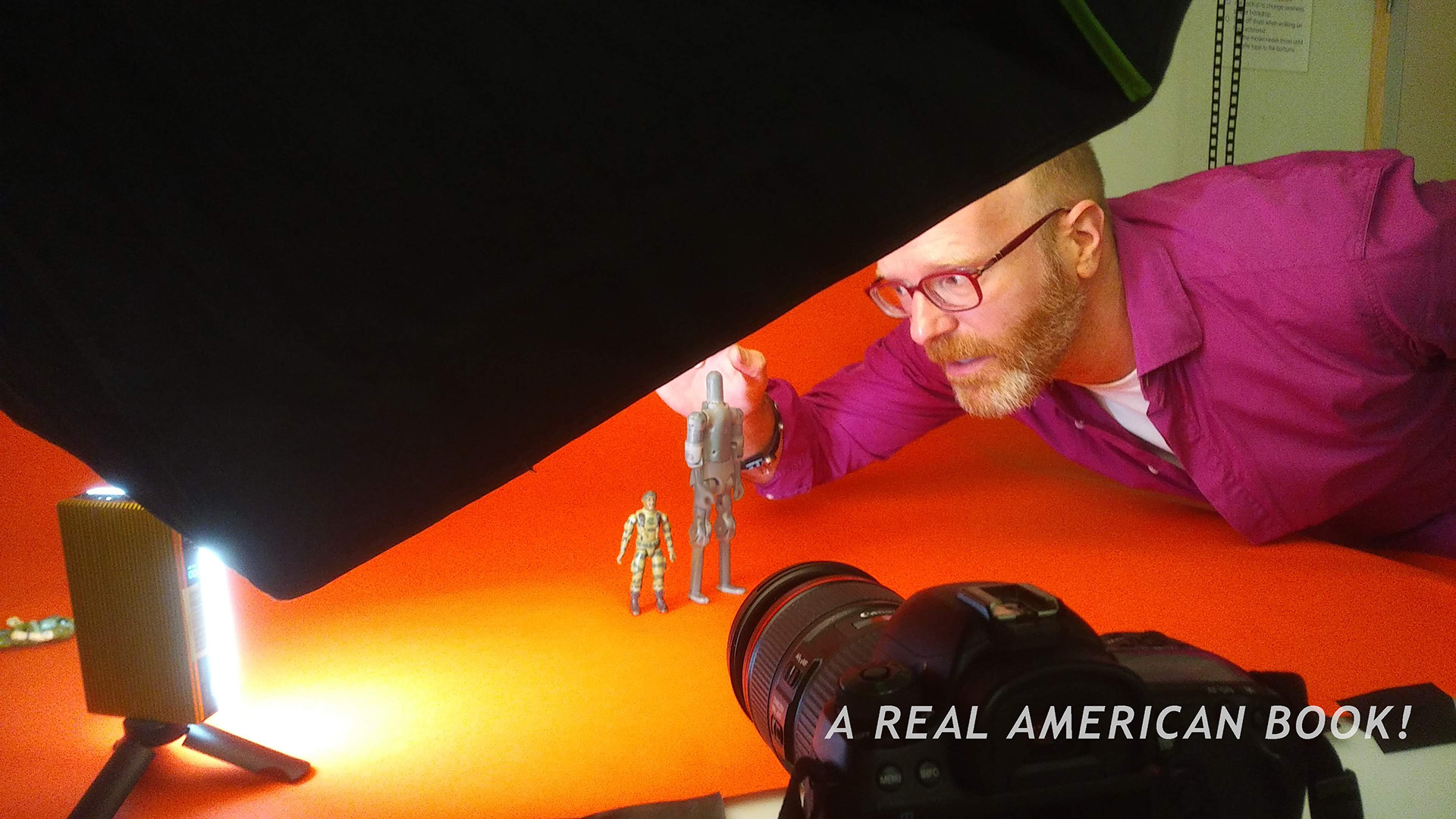
We also caught up. While we were standing in a basement in Cambridge, MA, Barrows splits her time, and told me about life in Maine and her gallery there, which is open seasonally from Memorial Day to Veterans Day. We also talked about school and teaching. I was an adjunct professor starting in 2005, and she arrived at the same school three years later, but has long juggled teaching there along with her duties in Academic Computing, making sure Macs and PCs and peripherals run, that software licenses are up to date, and that video and animation equipment for check-out works. And how that job has changed over the years. We also talked about family, and home renovation. Barrows and her partner are do-it-yourselfers, and I’m definitely not, but I’ve had a lot of contractors in and out of my home and store and rental units in the last decade.
At the two-hour and forty-five-minute mark, we were done, and cleaned up. Photoshoot #18 was easy and relatively fast. I look forward to getting a contact sheet in a few weeks and picking the winners to go into Chapter 2 and 3-or-maybe-5. Thanks, Jen!
And I have a trio of action figures — samples of unproduced Sgt. Savage characters — that could use a similarly plain treatment, so maybe we’ll do this again soon. Here’s a dramatic sliver of color to denote that this blog post is over.

Next up: Maybe some Ron Rudat pencil artwork before the inevitable Assembly Required ’24 Report.


 A Real American Book!