Category Archives: Prehistory

The Comic That Changed Everything – Part Five

Part OneTwo Three Four – Five – SixSevenEightNine

In our last episode, Tim and his brother Kevin ordered G. I. Joe back issues by mail!

Exactly 7 days later, Betty (our housekeeper/nanny/second mom) was taking Kevin and I miniature golfing.  It was a perfect early summer day.  Blue sky, bright sun, green grass, low humidity.  On our way out, I noticed a light, slim, cardboard parcel wedged between our heavy front door and the screen door.  It had my name on it, which was odd since 10-year olds don’t get mail, but putt-putt beckoned, so whatever this was could wait.  On our return I opened the box.  Kevin and I were thrilled.  It was the mail order!  East Coast Comics was real!  Inside were our 11 comic books, all in pristine condition, along with a giant, updated fold-out order form, and three coupons!  One was for a free “grab bag” of 15 comics for a purchase of $30 or more.  (Again with these terms we didn’t understand!  What was a grab bag?)

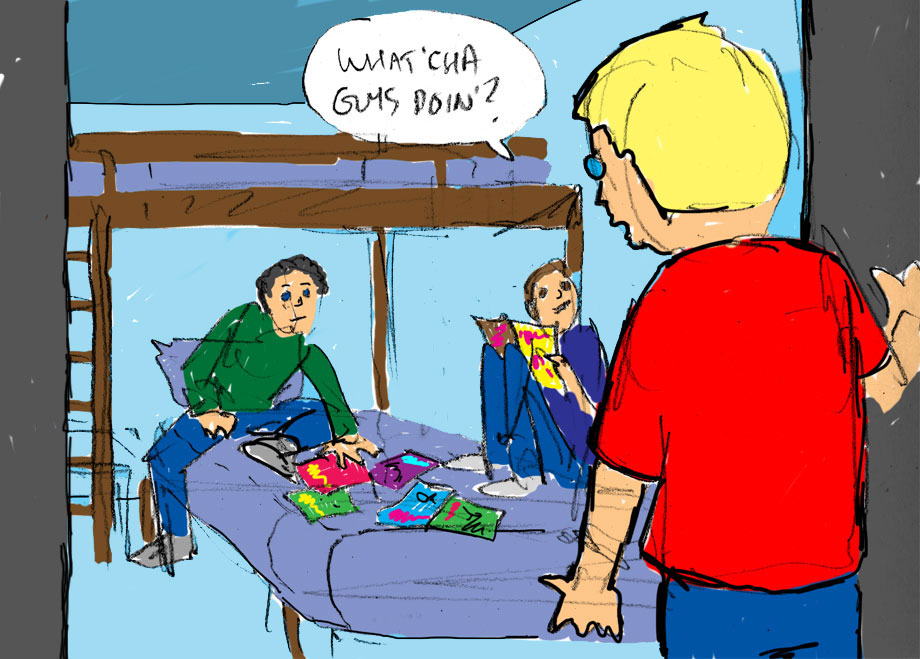
Kevin and I spread out our booty over our yellow shag carpet, ah-ing and gawking at the saturated colors and compelling cover art.  (Betty sat in her chair, watching soap operas or folding laundry.  We had played with our action figures, sound effects and all, in front of her for years, so she paid us no mind.)  Overnight the two of us had gone from owning the one newest issue of a comic book to having ten times that amount in back issues.  We were now collecting a series.  We were on our way to having a run.  Someday, somehow, a complete run!  (That was a daunting task since East Coast didn’t even have about 15 issues in stock, and we would soon learn that issues #1 and #2 were valued at over $40 each.)

Reading these comics piecemeal, #54, #77, #84, was tantalizing.  No consecutive issues to link story threads together.  We had to do that ourselves, or live with the pleasant anxiety of not knowing the whole story.  This is an anxiety I miss in the age of graphic novels reprinting whole comic book arcs and DVD box sets (or Hulu) laying out for me everything start to finish.  Before on-demand and MySpace Music, if you didn’t own an album you only heard a song when it played on the radio.  Before home video transformed itself from just top movies to everything ever, you only caught an episode when it premiered on TV, when it reran later in the season, or if you were lucky, when it was syndicated.  But half that was random.  It’s a topic for another blog post, but the serendipity of hearing/seeing just what you need when you least expect it is a tremendous feeling, and a rarer one when you can watch or listen to anything anytime you’re near any electronic device.  And that carries over to sequential storytelling.  To get those G.I. Joe issues we didn’t have, we’d have to save up and order again from East Coast Comics.  But to track down the ones East Coast didn’t have… we’d have to… Well, we didn’t know.

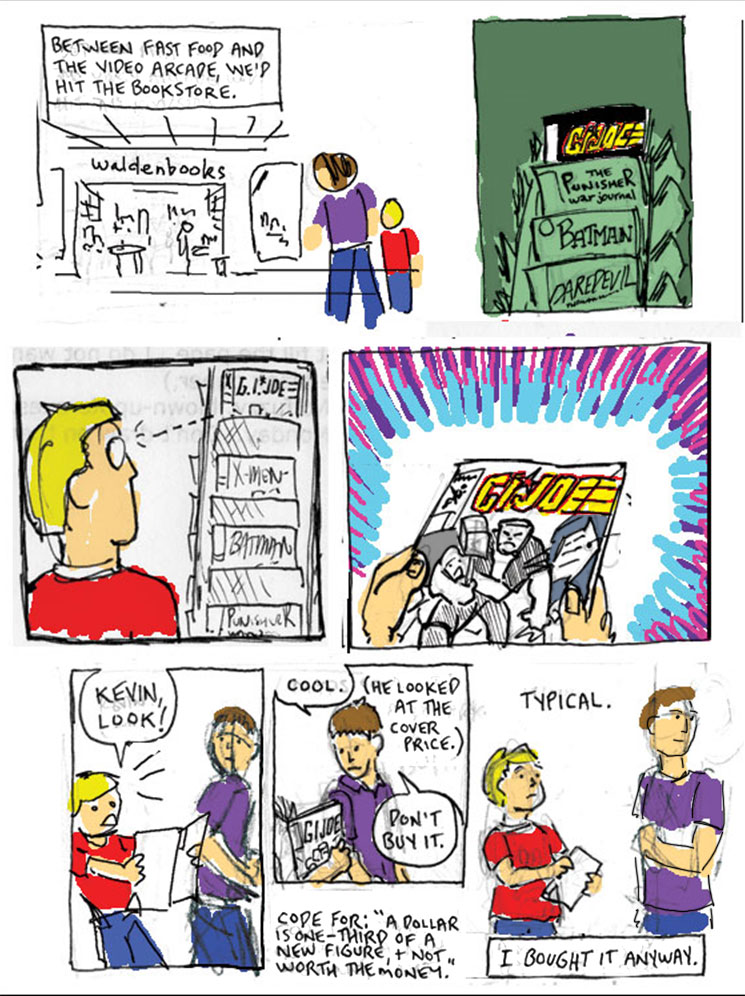
After issue #90, it would be safe to assume Kevin and I returned to Waldenbooks the following month to pick up issue #91.  (And that was a weekly trip anyway, so we were on the lookout.)  But summer camp happened instead.  My budding interest in comic books was frozen, pushed aside by four weeks in the woods of Cedar Mountain, North Carolina.  Besides regular outdoor camp stuff, I drew, and read prose books, but didn’t ask my parents to mail me care packages of comic books, and didn’t know anyone at camp who had brought any.  This wasn’t a hobby or an obsession yet.  It was still just an engaging lark.    Kevin and I would get the next issue of G.I. Joe when we could, but we had no concept that five years later we’d own 10,000 comics and I would work in a comic book store.  For now, it was just a G.I. Joe thing.

(I did draw a comic at camp, but I believe it was actually the summer before, and it feels as disconnected from me being a lifelong comics maker as much as those first two Yearbooks feel disconnected from me being a lifelong comics reader.  Like a prehistory thing, and not a part of a changed mindset.  It was called “Thorax the Ant,” and is about an ant on a quest.  But it’s more connected to me reading newspaper comics and occasionally illustrating story drawings than wanting to draw comics.  So it was also a lark.  Which is to say that after I finished drawing it, I didn’t have strong feeling to make more comics.)

But when we returned to suburban Maryland, and made our Wednesday rounds at Montgomery Mall, issue #91 was nowhere to be found!

What did we do?  Tune in next week to find out!

Part OneTwo Three Four – Five – SixSevenEightNine

Leave a comment

Filed under Prehistory

The Comic That Changed Everything – Part Four

Part OneTwo Three – Four – FiveSixSevenEightNine

In our last episode…

Tim Finn buys his first comic book, "G.I. Joe" #90

In addition to all those other thrilling attributes of G.I. Joe issue #90, there was also this:

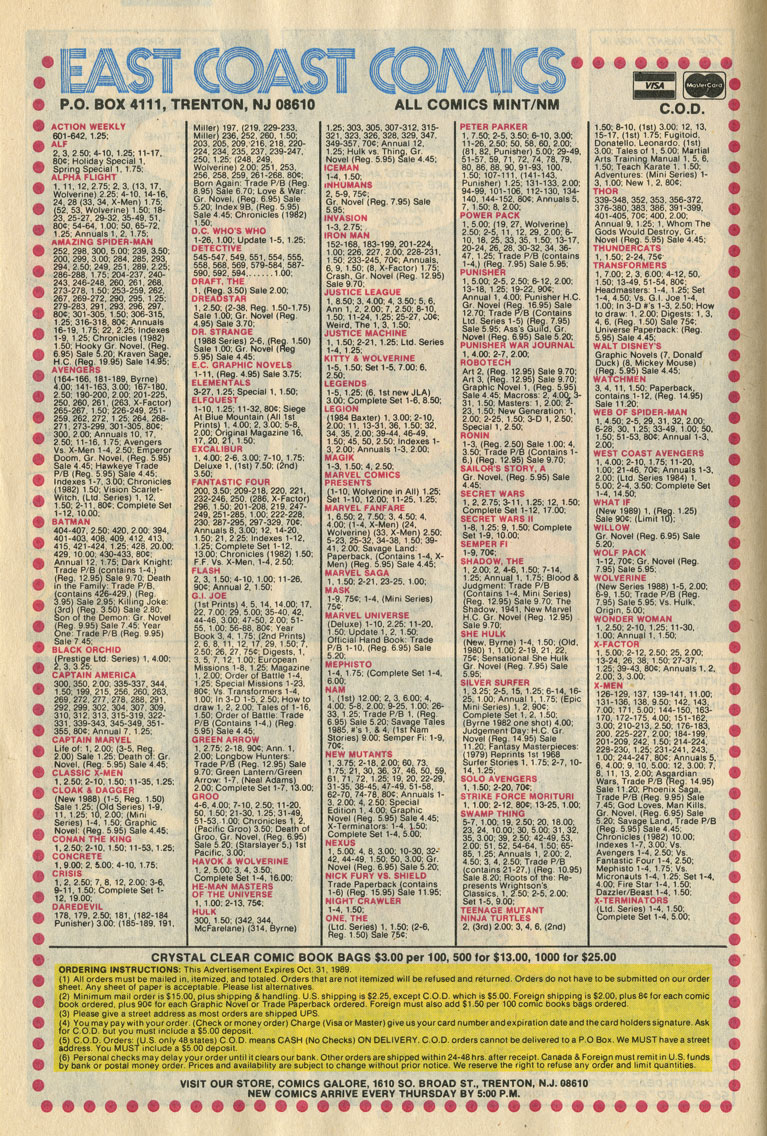
G.I. Joe #90 East Coast Comics ad

A full-page ad for a mail order comics retailer.  My brother and I were a little confused – comics by mail?  Or anything by mail, really.  How did we know this operation was trustworthy?  So, what, we just send them money and they send us comics?  What if they ran off with the money?  My 11-year old brain tried to reconcile the risks.  I had subscribed to a magazine or two, but that was direct.  Mad Magazine sent Mad Magazine.  (Not really, but play along.)  This third-party could be anyone.  My mom, who had done her fair share of mail order shopping (and whose father had owned a department store), didn’t see a problem.  My brother and I would give her our money, and she would write a check or provide her credit card information with our order.  But again, what if our letter was intercepted?  Or what was stopping this company from racking up excess charges on Mom’s Mastercard?  It’s funny to me that compared to today’s world of internet banking, online credit card purchases, and PayPal, I was so hostile to this by-then already old-fashioned mail order concept.  It seemed like a step was missing, like they should tell us they’d received our order, or we should call and confirm our wants were in stock.

Also, there was no individual’s name on the ad.  And no phone number.  Just the company moniker and a PO Box.  I only ever had positive experiences with East Coast Comics in the ten or so years I ordered from them, but at the start it looked entirely shifty.  I mean, Trenton, New Jersey?  Come on!

G.I. Joe #90 East Coast Comics ad

The first thing Kevin and I noticed was that the prices were low for the most recent thirty issues.  But there was much that didn’t make sense.  What was “Tales of G.I. Joe”?  What was “G.I. Joe Digest”?  What were “2nd prints?”  What were “alternates,” and why did we need to list them?  Instead we focused on what we did know, that we couldn’t get all of the regular back issues, so we’d have to pick and choose.  We retrieved Yearbooks #3 and #4.  What I didn’t mention earlier was that those Yearbooks had cover galleries showing thumbnails of a year’s worth of the monthly G.I. Joe.  At the time we first read the Yearbooks, those galleries didn’t mean much, but now they offered a roadmap.  We picked the issues with the most compelling covers, the ones with favorite characters or dire situations, and added on the one cited in issue #90’s footnote.  All tallied it was 22 comics for $11.  I typed a letter in Word Perfect, but I didn’t know how to frame the order, so I awkwardly wrote “Dear East Coast Comics, I would like to ask you to send me the following issues.”

I had sent away for a few premiums in my young life – t-shirts and pencils from cereal boxes, G.I. Joe toys from Hasbro Direct Mail, and the aforementioned subscription to Mad.  And everything took 4-6 weeks.  It was as if all the mail order retailers, warehouse workers, and courier and postal delivery people of America had united to make the nation’s kids wait in agony.  No matter the distance or the complexity, no matter the item, you wouldn’t see it for at least a month.  So after Mom fired off our order to East Coast Comics (from the office, by phone, with credit card – probably early in the morning before anyone else arrived, when she was most productive), I put it out of my mind.  It was summer vacation!  That meant bike rides and Slurpees and gameshows on TV.

But something arrived exactly seven days later.

What was it?  Tune in next week to find out!

Part OneTwo Three – Four – FiveSixSevenEightNine

1 Comment

Filed under Prehistory

The Comic That Changed Everything – Part Three

Part OneTwo – Three – FourFiveSixSevenEightNine

In our last episode, young Tim paid a whole dollar for G.I. Joe issue #90!

There was much to love about this comic:

-Page one was a splash, that is, a single illustration taking up the whole page.  Modern comics eschew this in favor of text recaps or several smaller panels that lead to a page two splash or a page 2-and-3 double splash, but for my oddly tuned aesthetics, comics should start with a splash on page 1.  And this particular splash page showed two characters I’d never seen bicker – Zaranna and the Baroness, screaming and grappling with each other while almost falling out of a Cobra transport helicopter over Manhattan.  Once again, several things rare or unheard of in the Joe cartoon: Villains fighting, more than one female villain in the same scene, and more than one female villain fighting.

-There was something “open” about the art.  It would be another year before I decided Mark D. Bright, the pencil artist who drew G.I. Joe #90 (and the following 15 issues or so) was my favorite artist in all of comics.  And it would be another two years before I decided I would buy any comic he drew once his G.I. Joe run had ended.  But for now, there was a strong sense of spotted blacks (a term in illustration that denotes where significant shapes filled with black ink help provide a sense of form and depth to anatomy, props, and backgrounds  — something you don’t see in the line-only styles of, say, the Garfield newspaper strip or Herge’s Tintin) that didn’t overpower the artwork, and that let the color breathe more than that first comic I’d ever looked at and rejected.  (That would be G.I. Joe #54, drawn by the wonderful Ron Wagner, whose work I quickly came to love.)  There were also more colors by now – Marvel had upped its palette in the intervening years, and slightly improved its paper stock.

-An entire scene comprising of the Cobra brass – Cobra Commander, Destro, Voltar, Zaranna, the Baroness, Dr. Mindbender, and Darklon arguing about the power balance of their organization.  But the meeting is led by Destro, not Cobra Commander!  This made my head spin, but in a good way.  And insults are hurled:

“This throwback wears a monocle and a cape and he’s casting aspersions on my character.”  (Darklon to Destro)

And they’re funny!

I had briefly seen Destro take over Cobra during the first TV miniseries six years earlier, and Serpentor (the Cobra Emperor) had permanently wrested power from  Cobra Commander within seconds of first appearing, but this was more involved, humorous, and pleasantly disorienting.  (And where was Serpentor, anyway?)

-Joe prisoners and Brain Wave Scanner.  At last, the promise of the cover art fulfilled!  Worse, Cobra agents travel into the Joes’ memories and plant false information!  As a fan, my heart went out to these fictional characters.

-Old Joes and new Joes.  Conspicuously each new season of the G.I. Joe TV cartoon would leave out older characters as newer ones appeared.  There were debut toys to sell, after all, despite the challenge this unending stream of characters caused the show’s writers.  And when it came time to populate a crowd scene, rather than place “retired” Joes in the background, it was the nonsensical “greenshirts,” anonymous, generic Joes that would fill that role.  I even have a memo from 1985 where a Sunbow producer spells out for the writers which characters to no longer include for that year.  It was that purposeful.  But here in this Marvel comic book were the aforementioned new characters, as well as Breaker, Cover Girl, Mutt, and Bazooka from ’82, ’83, ’84, and ‘85.

-Serpentor’s corpse!  I cannot overstate what an odd surprise this was.  On TV, no one ever died.  (My brother and I didn’t know that Duke was supposed to have died in the 1987 animated G.I. Joe: The Movie.  So convinced were we by the clunky audio patches that place him merely in a coma after taking a poisoned staff to the heart that we believed the small eruption of red liquid from said wound was in fact blood-colored poison.  Of course it was a coma, because no one died in kids’ cartoons.)  Here, not only were Destro and Dr. Mindbender talking about hiding Serpentor’s corpse, they alluded to having plans for it.  So not only had I missed his death, and any ensuing power struggle, now I had to keep reading to see what would happen to Serpentor’s body.

-Also, the B.A.T.S talked.  On the cartoon, Cobra’s Battle Android Trooper robots didn’t speak.  Zombie-like, they merely walked and fired their machine guns.  Here they talked and piloted helicopters.

-Also importantly, one bit a dialogue in issue #90 had a footnote.  Destro refers to the “Cobra Civil War,” giving me that heart-bending tingling feeling I get when a story hits a cliffhanger or I realize I’ve missed some revelation.  That certainly explained him trying to sort out the chain of command and Serpentor’s body being preserved in ice.  That footnote pointed us to issue #77, which could now be a likely next comic book to track down.  (Footnotes, like sound effects, have most unfortunately fallen out of favor in monthly mainstream comic books, but at the time they were all the rage.)  This will be important later on in the story of my brother and I starting out in comics as we bought our next issue of G.I. Joe at Waldenbooks a month later – but shockingly, it wasn’t #91!

What issue was it?  Tune in next week!

Part OneTwo – Three – FourFiveSixSevenEightNine

Leave a comment

Filed under Prehistory

My First Comic Book Ever Was “G.I. Joe Yearbook” #3 – Part Three

Note for last week’s readers:  The part two chicken scratch doodle of Another World has been partially updated.

In our last episode, Tim bought his first comic book ever, G.I. Joe Yearbook #3…

G.I.Joe Yearbook #4 cover art by Mike Zeck

G.I.Joe Yearbook #4 cover art by Mike Zeck, 1988.

Then, what I believe is one year later, but could have been only half that, we returned to Another World.  I bought G.I. Joe Yearbook #4, looked at but passed on another Mad, and Kevin bought two back issues: G.I. Joe #61 and #62.  (Or maybe he’d bought them on that first visit?  Memory’s funny that way.)  At home he promptly put them on a high shelf in his room where I couldn’t reach them.  He never offered them to me, and I never snuck a peak when he was elsewhere.  I didn’t even touch them until later when we were regular comics readers and those two issues were incorporated into our burgeoning G.I. Joe collection.  This should demonstrate the strange disinterest I had in comic books at that initial point.  (It is also indicative of our overly strong sense of personal ownership.  My toys were mine, Kevin’s were his.  We didn’t share, and we didn’t much trade.  This is not meant to sound mean, it’s just how our personalities worked.  We played with our G.I. Joe toys side-by-side, my characters and vehicles interacting with his, but him only holding and role-playing with his, and me with mine.  Weird, I know.  It’s worth an entire blog post, how we played with our toys.)  By then we had found D&D wares at the Waldenbooks at our mall (an important location that I’ll come back to in a later blog post), and rarely returned to Another World.  In fact, I don’t think Kevin ever went back.  I did go every year or three — it was friend and future editor Nick Nadel‘s local shop once he entered the picture, but until I had a driver’s license there was no point in shopping at this third-closest store.  It did move and renovate, and finally closed when parent company/comics mail order giant American Entertainment went belly up a decade later.)

But back to those two issues–

G.I. Joe #61 and #62 covers by Mike Zeck

G.I. Joe #61 and #62 covers by Mike Zeck, 1987.

Before Kevin whisked them away I do recall seeing these two covers, which by themselves form a kind of contained story, and being worried for the protagonists.  This is a point I’ll come back to at a later date on the blog — the power of the cover image — but for now you can likely acknowledge that even if you’re not a G.I. Joe fan or a comics reader, these guys are in trouble.  The barbed wire, the handcuffs, the menacing weapons.  Trouble!

As with the first comic I’d bought, Yearbook #4 did not turn me into a lifelong reader.  I just recall thinking there weren’t enough Joes in the lead Oktober Guard story, being confused by the recap pages that mixed narration with word balloons, and wishing the Joes in the back-up yarn wore their regular costumes and not their civvies.  Years later Tony Salmons would give me some original art from that story.

G.I.Joe Yearbook #4 pg 4 panel 4, art by Tony Salmons

G.I.Joe Yearbook #4 original art by Tony Salmons

So here’s where the biography stands:  Kevin and I have been buying G.I. Joe toys and watching the G.I. Joe cartoon for four years — half a lifetime.  For me it vies with Transformers as my favorite thing ever, for Kevin it’s no contest.  We read books and newspaper comics, and now own four actual G.I. Joe comic books.  But we’re still not readers!  What’s missing?

Tune in next week!

1 Comment

Filed under Back issues, Prehistory

My First Comic Book Ever Was “G.I. Joe Yearbook” #3 – Part Two

In our last episode, Tim’s parents took him and his brother to their first comic book store…

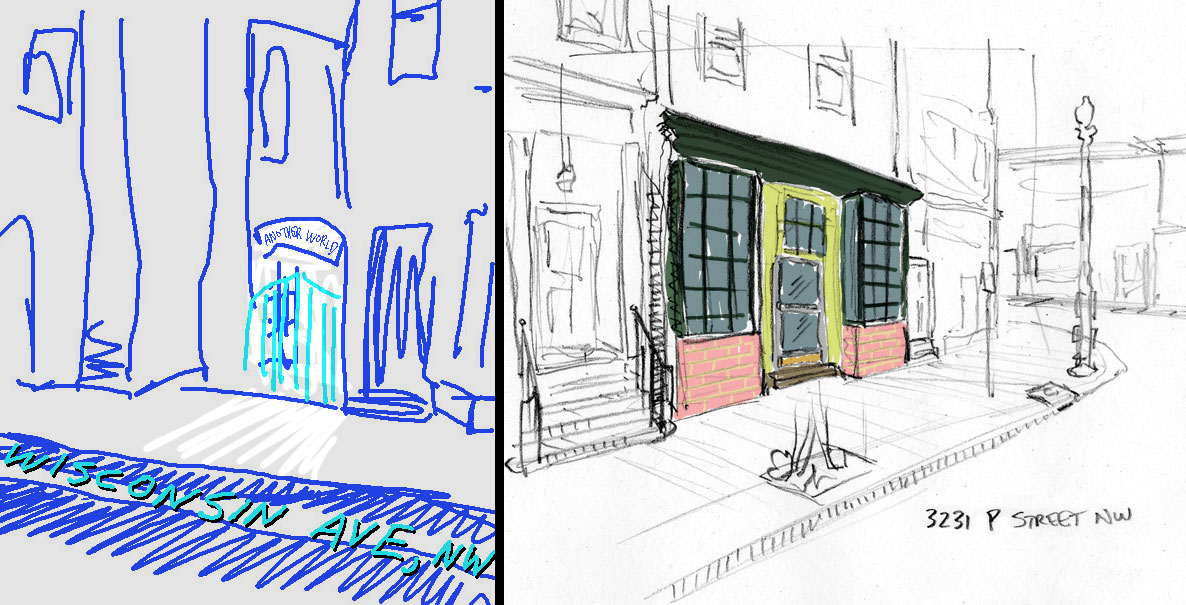
29 July 2011 - Still updating this art. At left, Another World's back entrance, not open to foot traffic, on Wisconsin Ave. On right, the front entrance on P Street. Wisconsin is visible in the background.

But this is where my memory gets fuzzy.  I believe we went to Another World one more time, six months or a full year later.  As best as I can piece it together, on the first visit, in addition to the Dungeons & Dragons set, I bought two periodicals:  I saw an issue of Mad Magazine and had to have it.  Mad was still a kind of forbidden fruit, and we had just gotten into it a few months earlier, but our subscription hadn’t kicked in.  For now it was the serendipity of seeing one on a newsstand, having the money, and getting the parental permission.  My other buy was G.I. Joe Yearbook #3.  (I should here define the series “G.I. Joe Yearbook” as an annual run of double-sized specials that complemented the regular, monthly G.I. Joe series.)  Interesting, Kevin also bought a copy.  Why did it grab us?  Probably because the cover showed favorite characters in distress, a scenario I was intrigued to see to its resolution.

G.I. Joe Yearbook 3 cover by Mike Zeck

Art by Mike Zeck.

I don’t want to undersell that point.  The cover made me worried about the characters.  Snake-Eyes is in trouble!  Scarlett defends him!  Storm Shadow — a villain — is also helping?  (This is a stark contrast to many comic book covers nowadays that feature glamor poses with little drama or story content.)

So Kevin bought Yearbook #3 as well – we were occasionally selfish and territorial about our possessions, and didn’t consistently share everything. 

Yearbook #3 was just a curiosity.  It did not turn me into a lifelong comics reader.  That would happen two years later.  But it was still an entertaining book, with a wordless story told only in pictures and pantomime that did in fact follow up on the cover image. My aversion to newsprint was abating.  (I can’t reconcile how newspaper comics were fine but comic books printed with the same palette on the same stock were not.  It might be that I was used to higher quality color and printing from glossy magazines like Hotdog and Dynamite, that I was already picky and fetishizing the bound periodical as a keepsake.)  (I mean “festishizing” in the general, non-sexual sense of the word.)  But as much neat content as it had, like a fun “Kitchen Viper” joke, and an article on the TV show, Yearbook #3 was still this weird… thing I didn’t entirely love.  It’s like an album you don’t appreciate until months or years later, but in this analogy, it wasn’t a single album, it was the entire pastime of listening to music.  I liked prose books, I liked magazines, I liked Garfield collections, I liked cartoons, but comics still hadn’t clicked.

I recall pulling Yearbook #3 off my shelf and reading it a few times afterwards, one time lying on my brother’s bedroom floor.  But it sparked no storylines for our G.I. Joe toy games, and no discussion of buying additional comic books.

What was the comic that changed Tim’s life forever?  Tune in next week to find out!

Leave a comment

Filed under Back issues, Prehistory

My First Comic Book Ever Was “G.I. Joe Yearbook” #3 – Part One

I should have become a comic book reader two years before I did.

Another World, Georgetown, Washington, DC, c. 1988

Another World's closed-off back alley entrance. I think it's outdoor seating for a cafe now.

I was reading newspaper comics in the Washington Post for years before I picked up my first Marvel or DC.  And in those two years, the only parts of Mad Magazine that mattered were the comics – the movie and TV parodies, Spy Vs. Spy, The Lighter Side, and A Mad Look At.  I even scanned through a few comic books one day probably in 1987 – and a G.I. Joe issue to boot! – but put it down with disinterest:  Whereas the TV cartoon was saturated full color, the comic was limited four-color printing, and it looked dull on beige newsprint.  This was at the house of a friend from school, and I believe my brother read several of his G.I. Joe comic books.  But not me.

Friend Taylor and my brother reading comics.

Soon after, my brother Kevin immersed himself in Dungeons and Dragons, and brought me with him.  While we could potentially play with friends using their materials, and even though this board game without a board mostly took place in our minds, we knew we had to buy a few essentials – dice, a rulebook, perhaps a module.  I think what happened was that our mom looked up “gaming” in the yellow pages, and found a store in Washington, D.C.  It was half-hour drive in the “wrong” direction since we always drove north and west to shop at our local mall, and parking in Georgetown (that particular section of D.C.) was difficult, but Mom and Dad were up for it .  And so we visited Another World, a comic book shop with a large back issue selection (whatever that was – it smelled old), new comics, and some gaming.

Another World, Georgetown, Washington, DC, c. 1988

Imperfect recollection of Another World's first store layout

We procured the red boxed Advanced Dungeons and Dragons starter set.  Georgetown wasn’t going to be a weekly trek like our mall (or downtown Bethesda, two miles from our house) were.  And it wasn’t going to be monthly.  Perhaps Mom and Dad liked to stay out of D.C. on weekends since they were there Monday to Friday for work.  Or perhaps they were willing, but Kevin and I didn’t realize we merely needed to ask.  Whatever the case, my sense was that this was a special trip, not the start of something.  Adding to my disorientation was that Another World had two entrances and a quirky layout.  The store straddled two sides of an acute street corner without having the corner itself, was small and cramped, had two different “rooms,” and was on two different levels, one a few steps higher than the other.  And again, it was filled with comic books, which I didn’t understand or like, even if I had been seeing Griffin Bacal’s wonderful animated television commercials for Marvel’s monthly G.I. Joe series for years.

But we went back months later and Kevin actually bought some G.I. Joe comic books.

What happened at Another World?  Find out next week…

2 Comments

Filed under Back issues, Prehistory

That First Time I Wrote a G.I. Joe Book – Part Three

In our last episode, Tim wrote an entire issue of the RISD student newspaper!

All that’s left of the original print run

When the print run was delivered the following Monday – The kickoff day of G.I. Joe Week! – I was giddy.  3000 copies were waiting at the mailroom, and I spent my lunch hour placing them in student mailboxes.  (RISD had 2000 students, so naturally I figured I would take the remainder.)  Regular editor Andy Dill helped, which I wasn’t expecting, but greatly appreciated.

I got great feedback from friends and acquaintances.  Some specifically loved the issue.  Others were just impressed by the commitment to take on the project.  And others still had different reactions.  Giant trash cans and round metal recycling bins lined the mailroom, overflowing each night with the day’s junk mail from 1800 undergraduates and 200 grads – catalogs, opened envelopes, memos from school.  After I disseminated Mixed Media, I hovered to see a few random reactions from people opening their mailboxes.  What was this green thing inside, anyway?  I also rescued about 30 copies from the trash.  I had plans to mail the issue to family and friends far and wide, and a vague notion to take a few hundred up the road to Hasbro, in Pawtucket.  (That never came to be.)

I was standing next to a trash can while two young women sorted through their mail.  They were in a hurry since lunch time was short.  “Bill, bill, junk, junk,” complained one, “What the fuck is this?!” she demanded of no one, looking at my masterpiece.  She threw it in the trash can and walked off in a huff.  Her friend finished her own sorting, tossed a few papers and her Mixed Media, and then noticed me standing right there, looking back at her and the trashcan.  In my arms were 40 copies.  She paused, looked in the direction of her friend, looked back at me, looked in the trash can, slowly pulled out her copy, and darted after her friend.

The issue turned out better than I expected, and I floated through the rest of my boring Wintersession short term class.  Designer Sean Deyoe had smartly separated the main article and the episode guide through margins and differing font sizes.  He had cropped and zoomed in wherever he wanted, and with me sitting quietly next to him, had slaved away on that killer back cover.  Two small production errors appear in the final edition – on the front cover and back cover, no less! — but I’m still so giddy with the end product that they don’t bother me.  Either because he was ready to move on or because my issue had broken him, Deyoe quit one issue later.  Andy Dill hung on as editor for a bit until some movement at the Office of Student Life installed two friends, Cory Mitchell and Mark Hoffmann, as new editors before the year was out.  They stayed on through our senior year and nicely revitalized the newspaper.  I would go on to write another article and submit a comic or two, but they were school related.  My ‘80s pop culture intrusions on Mixed Media were over.

Leave a comment

Filed under Prehistory

That First Time I Wrote a G.I. Joe Book – Part Two

In our last episode, Tim decided to write an entire issue of the RISD student newspaper.

Mixed Media had its own office next to the Tap Room, which served alcohol before my time (hence the name), and is famous for being the site of an early, if not the first, Talking Heads performance.  When I was at RISD, this was a seldom-used space for music and drama, and tucked away next to it was a claustrophobic closet with a scanner, a Mac, and two desks.  The Mixed Media office.  Weekly meetings took place there, but no one attended besides editor Andy Dill, designer Sean Deyoe, and calendar organizer James Holland.  I had joked to Andy that he could take off for the issue, that me writing the whole thing was tantamount to guest editing it, and he was fine with that.  I sat down with Deyoe and explained that I wanted to have a lot of images.  Deyoe was a talented graphic designer, and had used MM as a place to experiment and play.  Because no one cared about it, the stakes weren’t high, but since it was a “real” publication, printed by a press on newsprint, it was a worthwhile project.

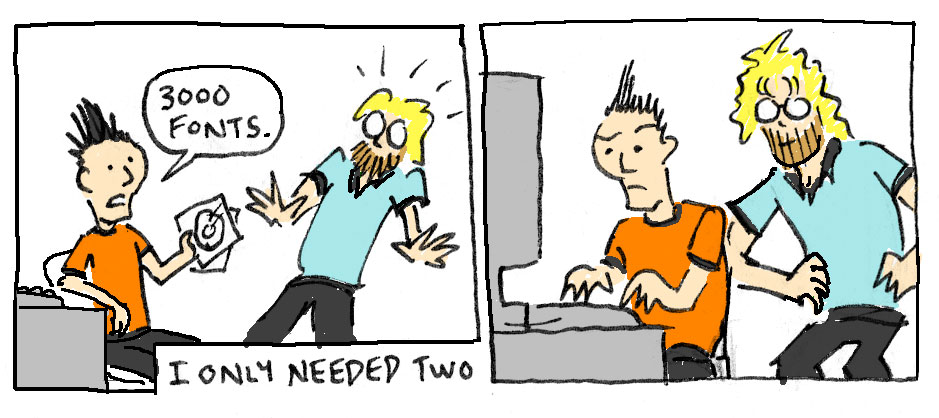
Deyoe was impressed (and later, probably bothered) at how many images I had ready.  This meant extra work for him.  Again, MM was dying of attrition.  The issue prior to mine had 16 pages (one of them blank) and 7 images, and the issue before that ran a paltry 8 pages (one of them blank) and featured three images.  Three!

Mine was a return to form:  32 pages with 64 images.

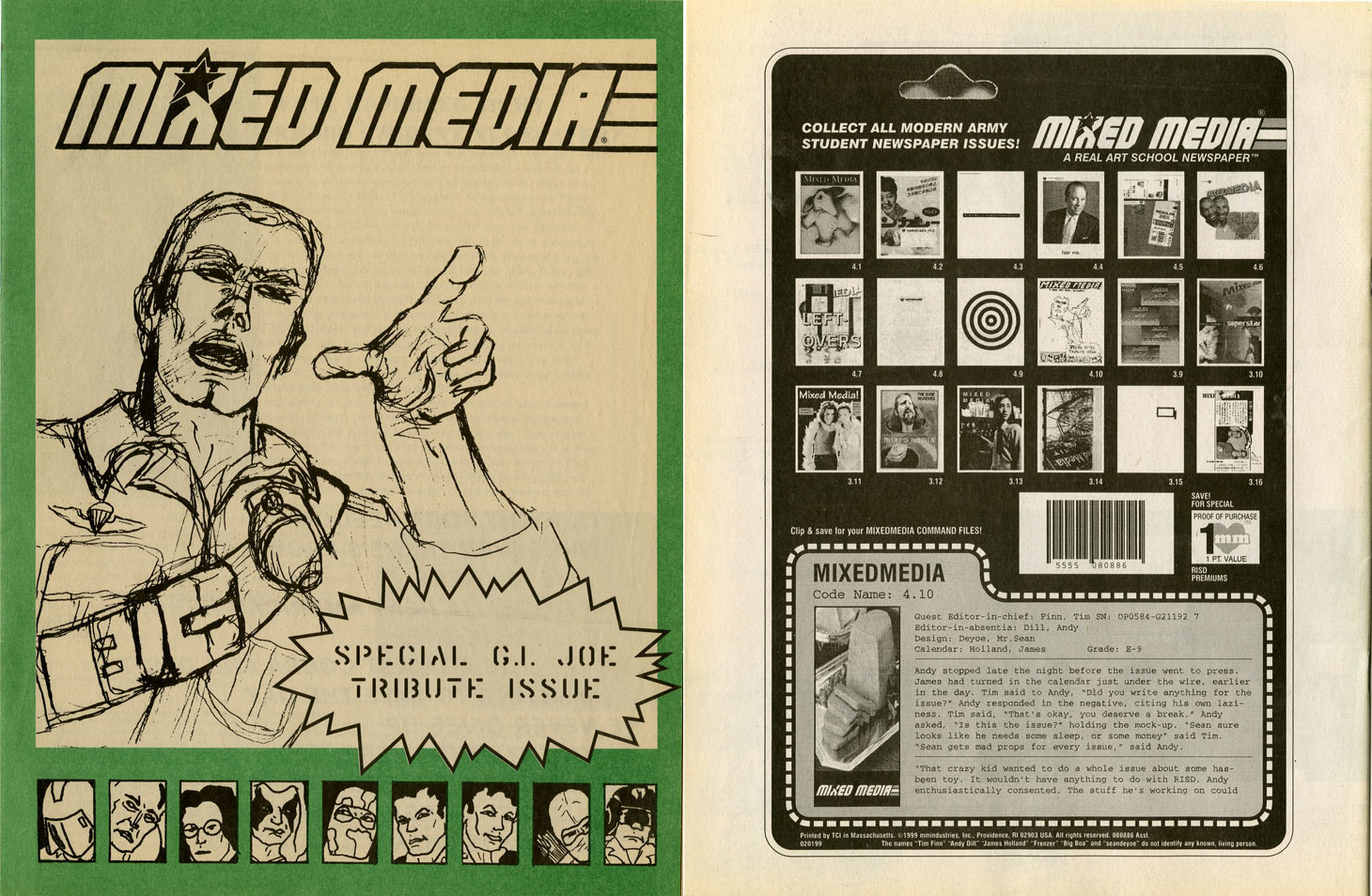
The contrast was clear.  I knew that even if people didn’t care for my content, they would notice this hefty issue, four times as big as the issue before the issue before.  Even better, Dill reasoned that since we had left over printing money from the previous few issues, we could splurge on mine, and offered a single color ink, something to go with the black.   The choice could only be a military green.  I solicited articles and art, and got three comics from friends, and polished my giant history and episode guide.  Holland brought in the calendar and I beefed it up with several fake G.I. Joe-themed events on and around campus, including a five-day Cobra invasion of Providence.   Deyoe scanned all my photos and comics, picked fonts, redrew the Cobra logo in Illustrator (for someone’s t-shirt design, not MM), and didn’t mind when I pitched him a back cover concept that would take longer to lay out than entire issues – a MM version of the 1980s Real American Hero toy card backs.  I also drew the cover, badly, which my roommate Peter Demarest, posed for.

"Tim Finn" "Sean Deyoe" RISD

Front cover/back cover, art by Tim Finn, design by Sean Deyoe

What happened when the print run arrived the following Monday?

Check back Friday to find out.  Next week kicks off my new posting schedule:  Mondays for small bits of art or commentary, Thursdays for these articles on the making of the book.

2 Comments

Filed under Prehistory

That First Time I Wrote a G.I. Joe Book – Part One

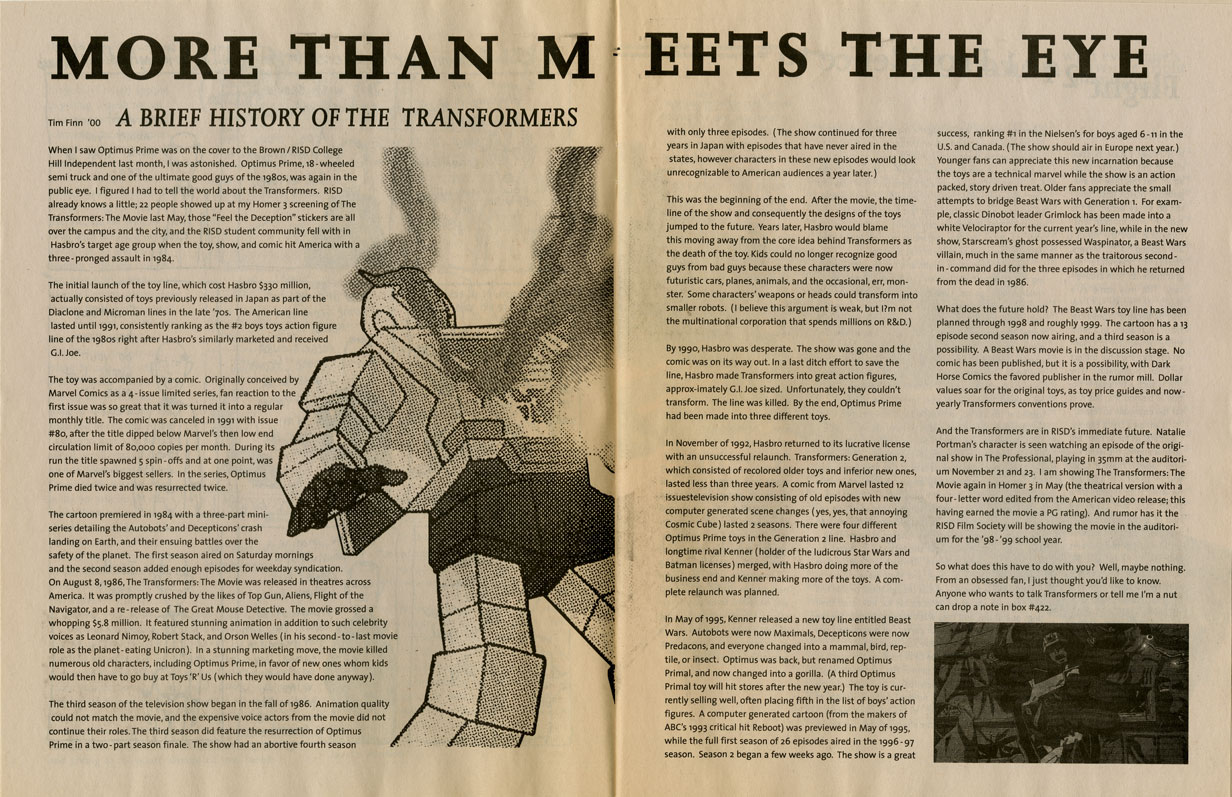
April 1998 covers by Bryan Konietzko and uncredited.

During my time at RISD the student-run newspaper was called Mixed Media.  At 8.5 by 11 inches and with very little news, “newspaper” might not be the best descriptor, but it was printed on newsprint.  It also floundered for several years.  You would think that with all these talented students there might be great artwork or reviews, but students were too busy to contribute.  The calendar was helpful, and a few interesting articles got people to write in, but this biweekly rag didn’t contribute much to the social and artistic life of the school.

There was also a Brown-RISD newspaper, but RISD students had little to do with it.  Whereas Mixed Media was ignored, The College Hill Independent was widely read on at least one of those two campuses and it contained actual news.  In fall 1997 a cover illustration featured several 1980s personalities and pop culture characters.  One was Optimus Prime.  I was peaking in my unreasonable Transformers fandom – watching the old show on VHS, rising at six in the morning to catch the new one, attending the annual convention to sell my Transformers comic fanzine, and hiding Hasbro’s robots in my homework whenever I could.  (Or not actually hiding them.)  Since it didn’t really matter what was in Mixed Media, and the editor was always asking for submissions, inspired by that Independent cover I figured that an article on the history of Transformers wouldn’t get rejected.

It did not, and several friends responded favorably.  I was pleased to see my name in print and to spread the good word about my favorite fictional characters and their conquest of television airwaves, toy store shelves, and comic book sales charts.  And I noted that Mixed Media’s designers blew up one of the two images I provided, breaking up the staid column layout of the 2-page article.  I couldn’t help think that I had gotten away with something, that this publication that was supposed to be about RISD, and the issues facing its student artists and designers, had bent some rule in running a fluff feature on something so off-topic.

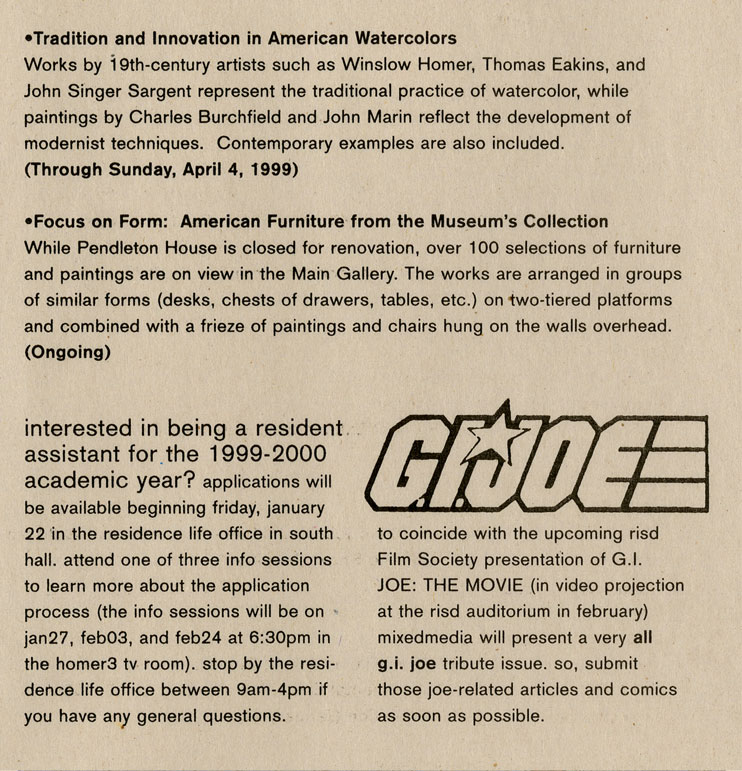
Announcements from Mixed Media v4 issue 8

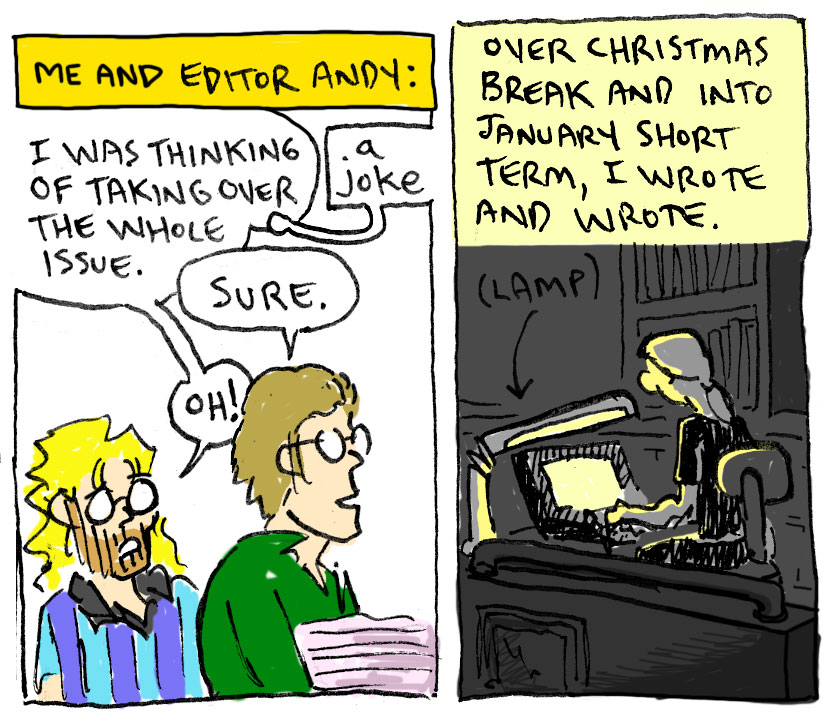
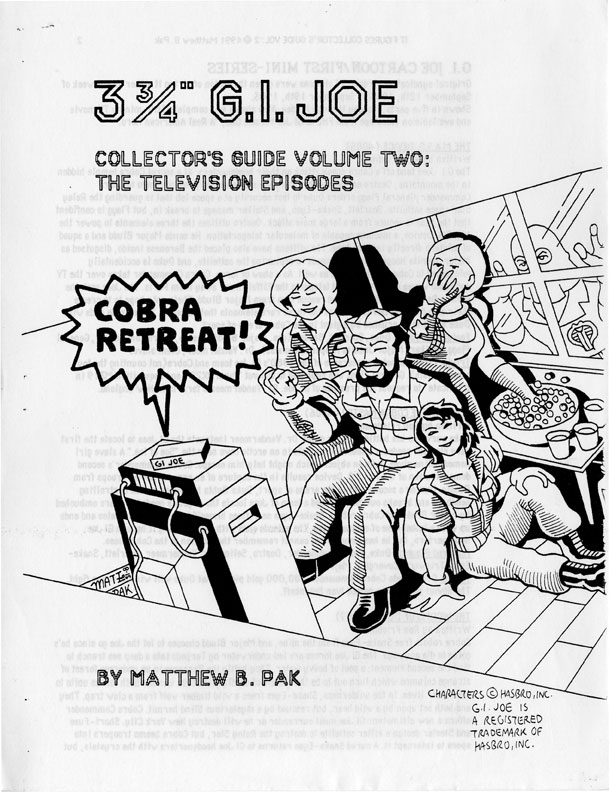
A year later, the newspaper had sunk to its lowest point.  Issues were short, content was light, and no one talked about it.  (To Mixed Media’s credit, it always looked great.  Graphic Designer Sean Deyoe used it as an ongoing experiment in layout, and started calling the publication mixedmedia or MM to refresh its identity.)  I was a junior, and I would skim each issue hoping for comics or anything spicy in the text.  This was still years before free news migrated to the internet and just as the school administration started communicating to students through e-mail.  Each student still received photocopied fliers and reminders in his or her regular postal mail box.  A senior in Film Animation Video named Andy Dill was editing Mixed Media by now, and was either distracted by his workload or losing interest in this dying rag.  Or both.  A few students thought Mixed Media had become an extension of Dill’s ego, a soapbox for him to stand on, even if no one gathered to listen.  We were friendly, but I didn’t know him well.  In November I mentioned that I was considering writing a G.I. Joe history as a companion to the previous year’s Transformers piece, and Dill was amenable.  I had seen entire issues of Entertainment Weekly given over to a single topic (like a Seinfeld episode guide), pushing out all the regular articles until the following week, and as a joke said that I might just write the whole Mixed Media.  Unphased, Dill said that was fine.  I typed all winter break, and into January, while my short-term class (the six-week one between fall and spring) bored me.  Instead of reading about Leonardo’s sketchbooks, I typed – mostly from memory and with little research – the entire history of G.I. Joe, borrowing liberally from Matthew B. Pak’s 1980s episode guide and cribbing a few bits from John Michlig’s wonderful GI Joe: The Complete Story of America’s Favorite Man of Action since I knew little about the 1960s Joe.

Matthew B. Pak’s episode guide cover. I’ve never ackowledged I cribbed from this for “Mixed Media” until now.

And this prose was building towards something else.

Sean Deyoe’s covers to the two issues preceeding my G.I. Joe one, January 1999

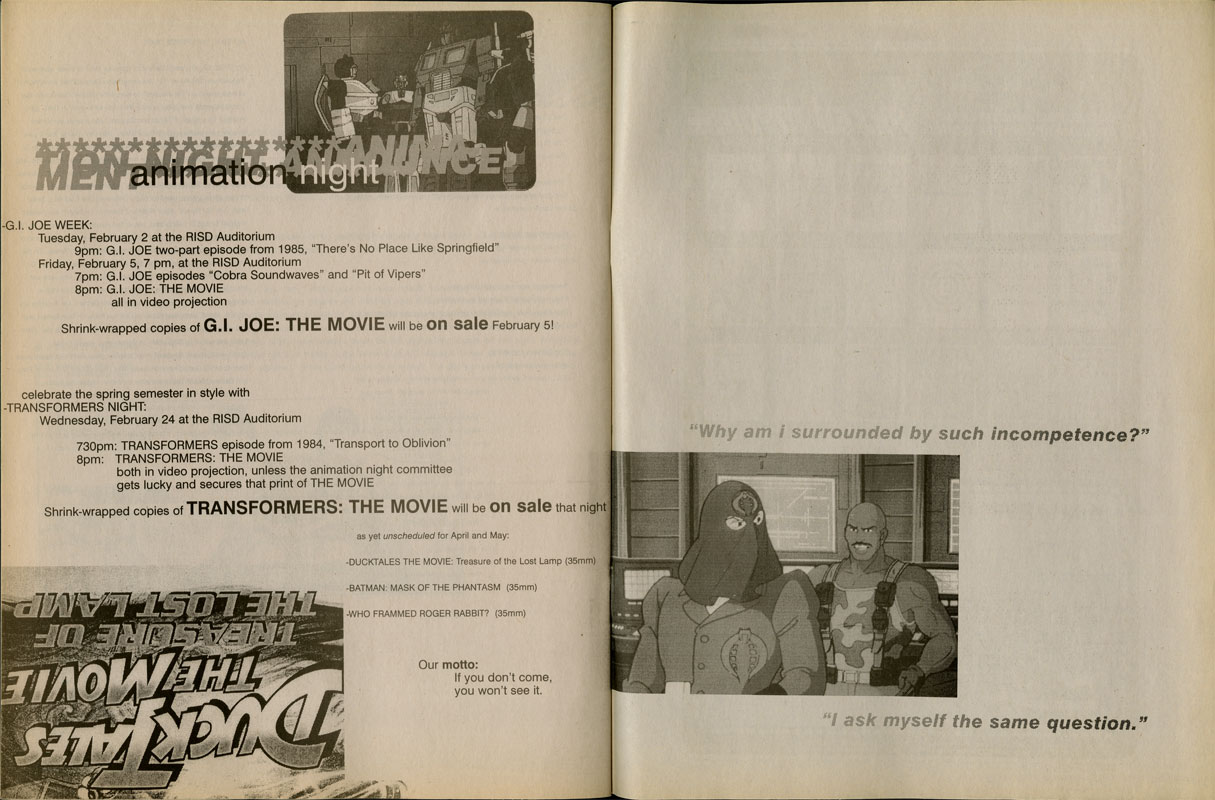
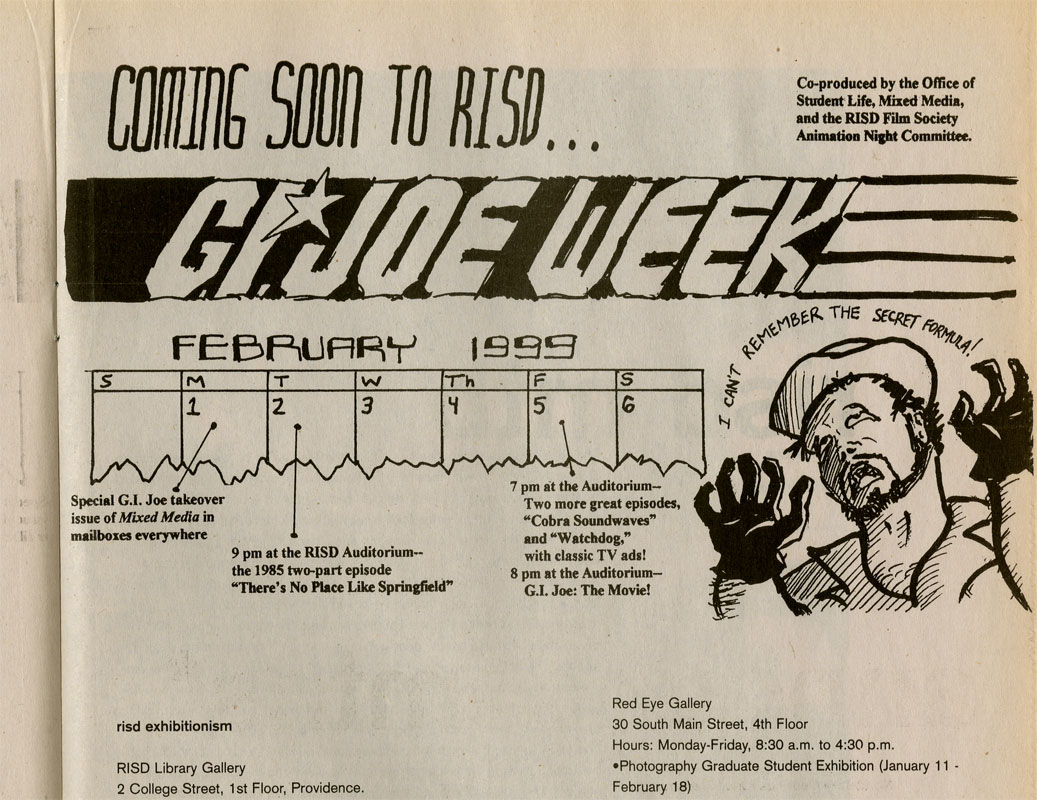
As a junior I ran Animation Night for the RISD Film Society.  This was a way to stretch our budget, as renting film prints from studios and distributors and paying projectionists all cost money.  But video projecting VHS tapes from my personal library cost nothing (public screening rights be damned).  That February I was organizing “G.I. Joe Week,” consisting of three nights of Joe-related screenings at the RISD Auditorium.  Mixed Media went to student mailboxes on Mondays, so this would be a great way to kick off this event that was really only an event in my mind.

Half-page ad in Mixed Media 4.9

How did it all go?  Check back next time to find out.

4 Comments

Filed under Prehistory

Why a book?

Welcome to the blog.  For ten years I’ve been quietly researching and writing the definitive “art of” and “making of” book on G.I. Joe: A Real American Hero.  I didn’t want to announce it because it was in process, and I didn’t want to act prematurely.  It is still in process, but now it’s time to start building up an audience and get people interested.  So a little background is in order.

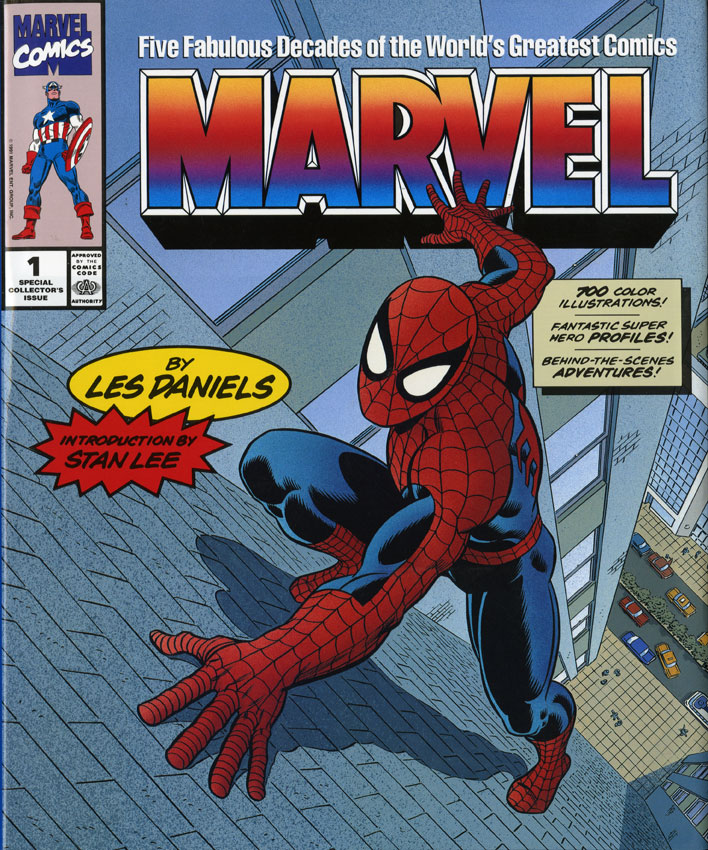
My brother and I received our first coffee table book as a Christmas present in 1991.  This was Abrams’ “Marvel: Five Fabulous Decades,” written by Les Daniels.  If you can take yourself back to a time before there were TVs for every airplane seat, movies on your phone, and instant video communication around the world, this was a big deal.  It was big, colorful, and bursting with information.  It was heavy.  I was just a kid, so sitting with the book was a physical investment.  Daniels broke down the history, characters, and personalities of Marvel Comics in an accessible way, and besides the text and the photographs, the book also reprinted four comics stories.  We were predisposed to Marvel, as we were already reading several monthlies from The House of Ideas before we met our first DC one.

Coffee table books had been on my mind even before then.  My father was (and is) a book collector, and our whole family read.  At the top of our staircase was my father’s collection of war and history paperbacks and aviation journals.  In the living room were two imposing bookshelves of his non-fiction and historical hardbacks.  On my mom’s night stand were her current run of fiction bestsellers, paperbacks that leaned towards drama, suspense, and a bit of romance.  In the guest room was the 1977 Encyclopedia Britannica.  And most importantly, on the coffee table in our family room, the room where we spent most of our time, were car and airplane magazines, and at all times, one coffee table book.  I never looked at them because I wasn’t interested in Vietnam, Korea, or WWII.  But the size and beauty of these tomes was not lost on me.

After Kevin (my brother) and I got that first book, one or two followed every year for Christmas and birthdays.  Daniels’ analogous history for DC Comics, the Reeves-Stevens’The Art of Star Trek.”  And on.

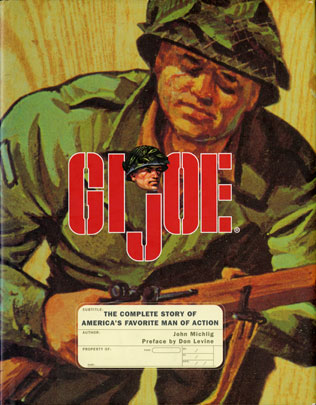
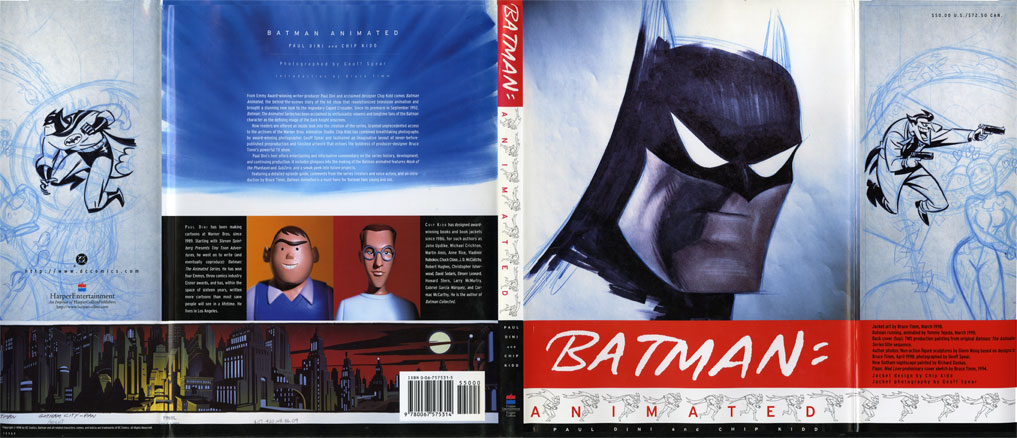
Kevin and I were playing with G.I. Joe figures and vehicles, watching the weekday cartoon, and a little later, reading the monthly comic book.  We were less involved with G.I. Joe in September 1992 when Warner Bros. and FOX teamed up for the eye-catching “Batman: The Animated Series.”  This show looked like nothing else on television – and the look is often all that gets recognition – but the writing and pacing were novel as well.  As I moved from middle school to high school, and then to college, my toy-playing turned into toy collecting.  And it was in college that a pair of books were published that would change everything:  John Michlig’sGI Joe: The Complete Story of America’s Favorite Man of Action,” and Paul Dini and Chip Kidd’sBatman Animated.”

Michlig’s is the definitive history of the 1960s and ’70 GI Joe action figures, the 12-inch ones that later made famous the term “Kung Fu Grip.”  These figures meant nothing to me, but Michlig’s book made me a fan.  With first-hand accounts and documents, eye-catching photos of production art and sculpts, plus historical context, this book makes the 12-inch Joe come alive.  And more importantly, makes me appreciate what went into creating an entirely new toy category – the action figure.  The writing is taut, and Michlig’s enthusiasm shows through without feeling cloying.

full dust jacket to "Batman Animated"

The Dini/Kidd book is striking for its design.  This could have happened even with a less aggressively laid out book since the source material is so visually novel, but “Batman: Animated” becomes its own art object for its alternating black text on white and white text on black, its arrangement of pictures and text in changing columns and grids, and the photography of Geoff Spear, who makes even a tame Kenner action figure feel like a monumental sculpture.  The only drawback is that the book leans too heavily on one artist who contributed to the TV series, but I overlook that because all the included drawings, paintings, and ephemera are so strong.

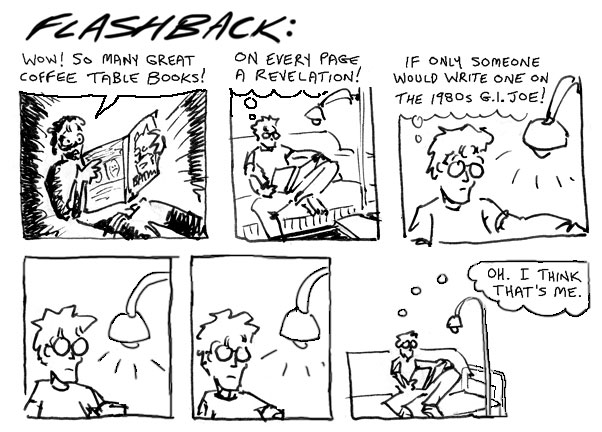
So there I was in the winter of 2000-2001, catching up on the reading for pleasure I hadn’t done in college.  I plowed through Michlig and Kidd, and thinking back to the other coffee table art books on my bookshelves still in Maryland, wondered when either of these authors might make such a book on the 1980s and ‘90s G.I. Joe.  My G.I. Joe.

But these men were a generation removed.  They wouldn’t write that book because this G.I. Joe wasn’t theirs.

And so I realized that I would have to.  Fortunately, I already had, in a fashion.  More on that next time.

6 Comments

Filed under Coffee Table Book Inspiration, Prehistory