The Comic That Changed Everything – Part Seven

Part OneTwo Three FourFiveSix – Seven – EightNine

In our last episode, after returning home from summer camp and buying G.I. Joe issue #92, Tim went with his family to Ocean City, Maryland.

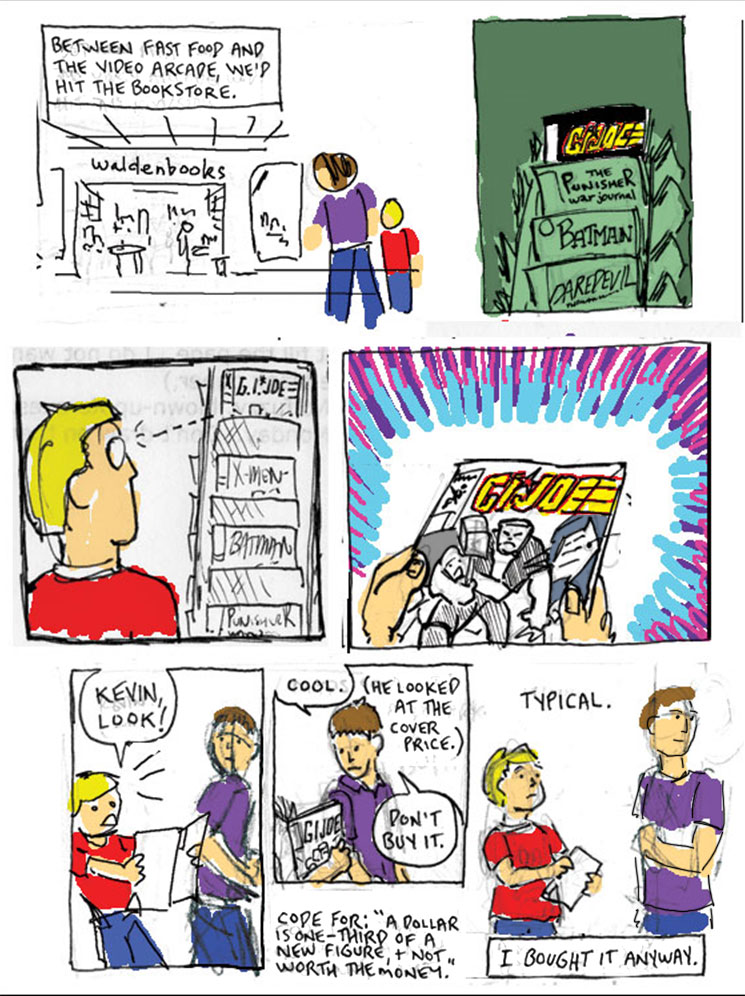
One of OC’s two malls, Ocean Plaza Mall, had a toy store near a bookstore next to a video arcade in front of a food court with my favorite pizza, so it was a destination.  And one afternoon in the August before 6th grade I wandered into Harriet’s Books, which was a small shop with (I want to say) a green sign with yellow letters.  Kevin had gotten into Dungeons and Dragons novels, and I might’ve had to pick up a summer reading book.  Just inside on the right was a newsstand with magazines and – COMIC BOOKS!  Comic books?  Why, if those had been there in years past I certainly hadn’t noticed.  But my eyes worked differently.  Now I was on the lookout.  And there on the bottom shelf was a bright yellow logo that spelled one my favorite words:  “G.I. JOE.”  It was issue #93!  Confusing!  Hadn’t we just bought issue #92?  Was Waldenbooks behind?  Was Harriet’s Books ahead?  It didn’t matter, all I knew was that I now had three comics to read over and over on the trip (we had brought G.I. Joe #92 and the Batman adaptation).

For some reason Kevin had stayed in the car – I guess my jaunt inside was going to be quick?  Mom or Dad must have been there, or both?  Maybe they were in the Super Fresh (grocery store) and I had enough time to kill to run in the mall?  Anyway, I opened the car door and excitedly showed Kevin.  “Awesome!” was probably his reply.  Contrary to his mild reaction two months earlier regarding issue #90, Kevin was now fully onboard and we were splitting all comics purchases 50/50.

The cover to #93 teased big revelations regarding Snake-Eyes, the masked ninja commando clothed in all black.  It’s important to properly set the scene of how mysterious and cool this character was:  We’d never seen his face, he never spoke, his action figure came with a sword, an Uzi, and a wolf, AND HE WAS A NINJA COMMANDO.  I also liked grenades, and his action figure had three molded onto his chest.  Very cool.  Since he didn’t speak, the writers on the TV show seemed not to know what to do with him, and besides three or so episodes, Snake-Eyes rarely appeared.  It fell to Larry Hama, who had created the character’s entire back story, to flesh out him in the pages of the monthly comic book.  Even though we only owned less than 15 G.I. Joe comics by this point, Kevin and I knew that portions of Snake-Eyes’ origin and motivations had been doled out over time – issues #21, 26, 27, 43, 84 – but we didn’t have most of those yet.  We were in the dark.

I got in the car and started reading.  The issue was great, starting with a compelling splash page of the Baroness and Zarana (two villains) grappling with each other in the open doorway of a transport helicopter over Manhattan.  At the top, the title “Taking the Plunge” only added to the drama.  In the story, threads from issue #90 continue and new story beats develop: Destro asserts his leadership over Cobra; the Dreadnoks brainwash Clutch and drive an ice cream truck; Flint, Lady-Jaye, and Roadblock (three series regulars from season 2 of the TV show) drive G.I. Joe’s Tiger Force-recolored vehicles; and seemingly innocuously, Snake-Eyes and Scarlett see a plastic surgeon in Switzerland.  Tantalizingly, Dr. Hundtkinder removes the ninja commando’s mask (the one that looks like a normal face for going about in public, not the black costume one) and rattles off anatomical mumbo-jumbo.  (Actually Hama being diligent and accurate.)  But we weren’t going to see Snake-Eyes’s real face because that was a permanent part of G.I. Joe lore.  Since early 1982, Hasbro, Marvel, and Sunbow had held back what masked characters Destro, Cobra Commander, and Snake-Eyes looked like.  It was embedded in the mythology.  Those visages would forever be mysterious and unknown.  The comic book had previously gone to some lengths to show Snake-Eyes without his mask, but always in shadow, cropped, or from behind.

And then I turned the page.

What did Tim see?  Tune in next week to find out!

Part OneTwo Three FourFiveSix – Seven – EightNine

Leave a comment

Filed under Prehistory

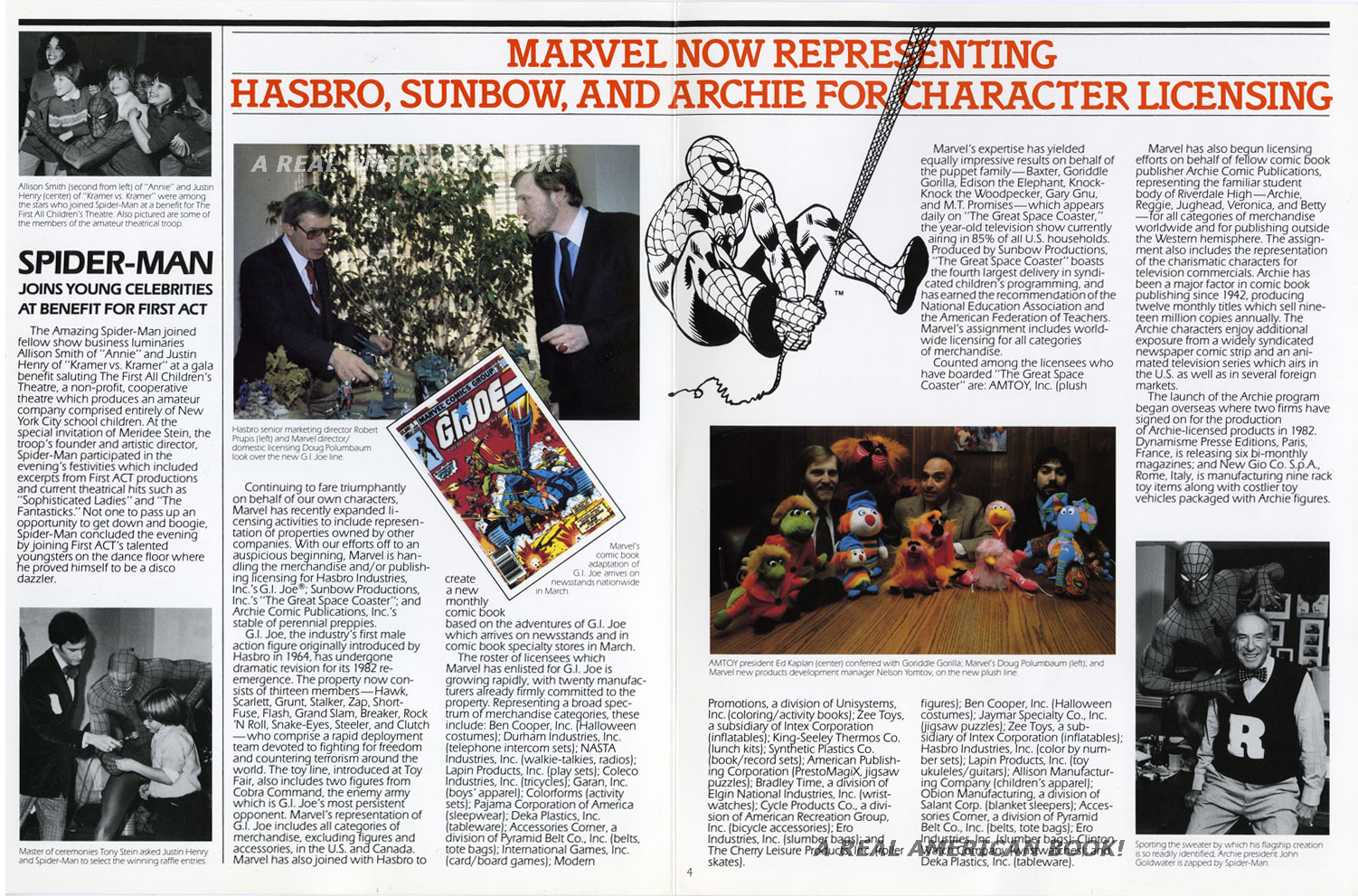
Behind the scenes of G.I. Joe – Marvel Licensing


Bob Prupis points to early G.I. Joe product in this spring 1982 "Marvel Update"

Here’s a fun bit of paperwork.  When Hasbro relaunched G.I. Joe in 1982, the company rolled out the new toys with an impressive list of licensed products.  This is common today, but was not then.  As Marvel Comics was already handling the biggest license — a comic book — and had a licensing division, it made sense to partner in this way, so that Marvel could line up all those third-party companies wanting to put G.I. Joe on their consumer products.  Here’s a slick trumpeting that fact.  Only pages 3-4 are germane, but I’ve reproduced 1 and 2 as well since they’re fun, and since Spider-Man and His Amazing Friends is a cousin to the G.I. Joe cartoon.  (Pages 5-8 of this catalog are not reproduced here.)

"Marvel Update" spring 1982 pg1"Marvel Update" spring 1982 pg 2

"Marvel Update" spring 1982 pgs 3 & 4


Leave a comment

Filed under G.I. Joe Behind the Scenes

The Comic That Changed Everything – Part Six

Part OneTwo Three FourFive – Six – SevenEightNine

In our last episode, Tim and his brother Kevin returned home from summer camp and had missed an issue of G. I. Joe!

This timing has long amused and puzzled me.  In the four weeks we were away, G.I. Joe issue #91 managed to debut and complete its full sales cycle, so when we at last checked back in we were greeted by issue #92.  But how unlikely was it that the very four weeks we were away were the same four weeks that issue #91 was available?  Pretty unlikely, but it happened nonetheless, and we had to make do with #92.  On the one hand, we were excited to be reading any new G.I. Joe comic book.  On the other hand, it was disappointing that we had missed an issue.  Yes, there had been those two visits to a comic book store (with a full selection of back issues), but it was a small ordeal to mount a trip there (not really), so for the time being, we had no way of getting #91.  Fortunately #92 was excellent.

It’s actually the resolution of a storyline started a month earlier in the spin-off book G.I. Joe Special Missions (a fact that mostly eluded us, despite the footnote saying so).  #92 is a great action comic book with many moving parts – different factions of good guys, a rescue from hostile territory, corrupt politicians, a chase, and the series regulars Cobra.  And it zips along at a swift clip, and is funny, too.  Plus, to refer back to one of my initial reasons for the Marvel series hooking me in, this new issue spotlighted an obscure character, the vehicle driver Long-Range.  In fact, he (and his vehicle) get the entire cover to #92.  Whenever I lament modern action comic book writing with its poor pacing or lack of visual action, I hold this up as an example.  (Also, issue #50.  Great action comics both.)

I suspect that Waldenbooks received some of its comics late, because two weeks later the family took its annual trip to the beach, where Kevin and I found – much to our surprise, as we had only just bought #92 – G.I. Joe #93!  More on that in a moment, as something else important happened in this summer before 6th grade:

Batman Movie Comics Adaptation

Batmania.

It’s hard to adequately explain how big Tim Burton’s first Batman film was.  Everyone was talking about it, everyone loved it, and merchandise was everywhere.  I saw more than one Batman t-shirt every day that summer.  Montgomery Mall had a keyosk devoted entirely to Batman shirts and memorabilia.  I saw the film three times, daydreamed that my school would stage it as a live play and I’d be cast as Jack Nicholson’s Joker, bought the Topps trading cards with their alternatively dry and lurid captions (“Plunge Into Toxic Oblivion!”), and rolled my eyes at the high prices in the special catalog of toys and merchandise that Warner Bros. had printed for movie theatres.

Just a few days before we left for Ocean City, MD, Kevin and I were at the other bookstore at Montgomery Mall, B. Dalton Booksellers.  (Yes, the rival chains had names that rhymed – Walden/Dalton.)  We rarely shopped “Dalton,” as we inaccurately called it, since it was in a dead corner of the mall, but B. Dalton did carry graphic novels (important later) and that first week of August it did have the deluxe edition of the official DC Comics adaptation of the live-action Batman movie.  It was perfect bound, a term meaning rather than paper folded in half and stapled at the centerfold (comics, magazines), this book was printed like a book – glued, trimmed pages, and a square, though skinny, spine.  It was $5.00, a huge step up from the dollar we had spent on our G.I. Joe comics, but it was also A) generally fancy – glossy paper, increased color palette, higher quality printing, B) superbly illustrated, and C) BATMAN.  I couldn’t get this movie out of my mind, so to be able to read it over and over was exciting.  And read it over and over I did.  Every day at the beach for two weeks.

On this yearly trip I OD’ed on cable TV, Kevin and I splurged on video games (Mom saved quarters in advance of the trip), we played in the water and built sand castles, Mom and Dad read books, Kevin and I checked off summer reading, we ate out, and Dad took us miniature golfing.  And at one of two malls there, we stumbled upon the greatest revelation in all of G.I. Joe history.

What was it?  Tune in next week to find out! 

Part OneTwo Three FourFive – Six – SevenEightNine

Leave a comment

Filed under Prehistory

The Comic That Changed Everything – Part Five

Part OneTwo Three Four – Five – SixSevenEightNine

In our last episode, Tim and his brother Kevin ordered G. I. Joe back issues by mail!

Exactly 7 days later, Betty (our housekeeper/nanny/second mom) was taking Kevin and I miniature golfing.  It was a perfect early summer day.  Blue sky, bright sun, green grass, low humidity.  On our way out, I noticed a light, slim, cardboard parcel wedged between our heavy front door and the screen door.  It had my name on it, which was odd since 10-year olds don’t get mail, but putt-putt beckoned, so whatever this was could wait.  On our return I opened the box.  Kevin and I were thrilled.  It was the mail order!  East Coast Comics was real!  Inside were our 11 comic books, all in pristine condition, along with a giant, updated fold-out order form, and three coupons!  One was for a free “grab bag” of 15 comics for a purchase of $30 or more.  (Again with these terms we didn’t understand!  What was a grab bag?)

Kevin and I spread out our booty over our yellow shag carpet, ah-ing and gawking at the saturated colors and compelling cover art.  (Betty sat in her chair, watching soap operas or folding laundry.  We had played with our action figures, sound effects and all, in front of her for years, so she paid us no mind.)  Overnight the two of us had gone from owning the one newest issue of a comic book to having ten times that amount in back issues.  We were now collecting a series.  We were on our way to having a run.  Someday, somehow, a complete run!  (That was a daunting task since East Coast didn’t even have about 15 issues in stock, and we would soon learn that issues #1 and #2 were valued at over $40 each.)

Reading these comics piecemeal, #54, #77, #84, was tantalizing.  No consecutive issues to link story threads together.  We had to do that ourselves, or live with the pleasant anxiety of not knowing the whole story.  This is an anxiety I miss in the age of graphic novels reprinting whole comic book arcs and DVD box sets (or Hulu) laying out for me everything start to finish.  Before on-demand and MySpace Music, if you didn’t own an album you only heard a song when it played on the radio.  Before home video transformed itself from just top movies to everything ever, you only caught an episode when it premiered on TV, when it reran later in the season, or if you were lucky, when it was syndicated.  But half that was random.  It’s a topic for another blog post, but the serendipity of hearing/seeing just what you need when you least expect it is a tremendous feeling, and a rarer one when you can watch or listen to anything anytime you’re near any electronic device.  And that carries over to sequential storytelling.  To get those G.I. Joe issues we didn’t have, we’d have to save up and order again from East Coast Comics.  But to track down the ones East Coast didn’t have… we’d have to… Well, we didn’t know.

After issue #90, it would be safe to assume Kevin and I returned to Waldenbooks the following month to pick up issue #91.  (And that was a weekly trip anyway, so we were on the lookout.)  But summer camp happened instead.  My budding interest in comic books was frozen, pushed aside by four weeks in the woods of Cedar Mountain, North Carolina.  Besides regular outdoor camp stuff, I drew, and read prose books, but didn’t ask my parents to mail me care packages of comic books, and didn’t know anyone at camp who had brought any.  This wasn’t a hobby or an obsession yet.  It was still just an engaging lark.    Kevin and I would get the next issue of G.I. Joe when we could, but we had no concept that five years later we’d own 10,000 comics and I would work in a comic book store.  For now, it was just a G.I. Joe thing.

(I did draw a comic at camp, but I believe it was actually the summer before, and it feels as disconnected from me being a lifelong comics maker as much as those first two Yearbooks feel disconnected from me being a lifelong comics reader.  Like a prehistory thing, and not a part of a changed mindset.  It was called “Thorax the Ant,” and is about an ant on a quest.  But it’s more connected to me reading newspaper comics and occasionally illustrating story drawings than wanting to draw comics.  So it was also a lark.  Which is to say that after I finished drawing it, I didn’t have strong feeling to make more comics.)

But when we returned to suburban Maryland, and made our Wednesday rounds at Montgomery Mall, issue #91 was nowhere to be found!

What did we do?  Tune in next week to find out!

Part OneTwo Three Four – Five – SixSevenEightNine

Leave a comment

Filed under Prehistory

Behind the scenes of G.I. Joe – Marvel Issue #1, 1982

Sorry for the missing weeks.  Things have been crazy, but I’m back on schedule with more art, memories, and anecdotes.

Today’s post is a photocopy of Herb Trimpe’s pencils to Marvel Comics’ G.I. Joe issue #1, cover dated March 1982.  Click to enlarge.

Original pencil art by Herb Trimpe for "G.I. Joe" issue #1, March 1982

Trimpe clearly put a lot of effort into this, as evidenced by the distinct facial types, lush backgrounds, and dense spotting of blacks.

Here’s the page as printed, now with inks by Bob McLeod and colors by Glynis Oliver.  Notice how much McLeod has redrawn and softened the organic stuff.

"G.I. Joe" issue 1 pg06, as printed, March 1982, Trimpe/McLeod/Wein.

When Marvel issued its G.I. Joe Volume 1 graphic novel in 2002 (reprinted more recently by IDW Publishing as Classic G.I. Joe Volume 1), a friend re-read the issues contained therein — #s 1-10, and made an observation.  He remarked that early G.I. Joe was very much a weird Marvel ’70s-post Silver Age comic book, what with Trimpe’s Kirby faces and invented Kirby technology.  That it didn’t become the familar ’80s G.I. Joe we know until late in or after the first year.  (Issue 6 is another good example, with the Joes building a weird desert dune buggy.)  Just look at the tech framing on the top and bottom of panel 1, and the computer in panels 4 and 5.  And not that it carries through to the inks, but look at Austin’s cheekbone in panel 3 — a Kirby line! — and his eyes as well.

What other artistic influences do you see?

-Tim

3 Comments

Filed under Comic Books, G.I. Joe Behind the Scenes

The Comic That Changed Everything – Part Four

Part OneTwo Three – Four – FiveSixSevenEightNine

In our last episode…

Tim Finn buys his first comic book, "G.I. Joe" #90

In addition to all those other thrilling attributes of G.I. Joe issue #90, there was also this:

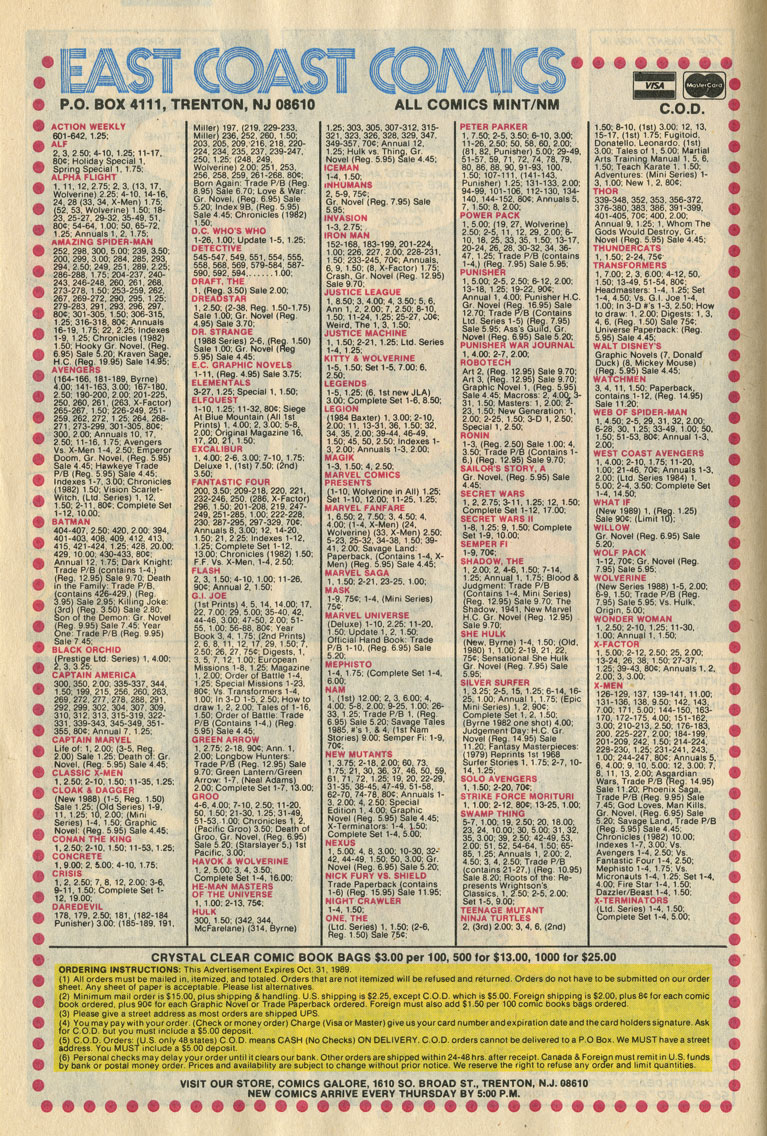
G.I. Joe #90 East Coast Comics ad

A full-page ad for a mail order comics retailer.  My brother and I were a little confused – comics by mail?  Or anything by mail, really.  How did we know this operation was trustworthy?  So, what, we just send them money and they send us comics?  What if they ran off with the money?  My 11-year old brain tried to reconcile the risks.  I had subscribed to a magazine or two, but that was direct.  Mad Magazine sent Mad Magazine.  (Not really, but play along.)  This third-party could be anyone.  My mom, who had done her fair share of mail order shopping (and whose father had owned a department store), didn’t see a problem.  My brother and I would give her our money, and she would write a check or provide her credit card information with our order.  But again, what if our letter was intercepted?  Or what was stopping this company from racking up excess charges on Mom’s Mastercard?  It’s funny to me that compared to today’s world of internet banking, online credit card purchases, and PayPal, I was so hostile to this by-then already old-fashioned mail order concept.  It seemed like a step was missing, like they should tell us they’d received our order, or we should call and confirm our wants were in stock.

Also, there was no individual’s name on the ad.  And no phone number.  Just the company moniker and a PO Box.  I only ever had positive experiences with East Coast Comics in the ten or so years I ordered from them, but at the start it looked entirely shifty.  I mean, Trenton, New Jersey?  Come on!

G.I. Joe #90 East Coast Comics ad

The first thing Kevin and I noticed was that the prices were low for the most recent thirty issues.  But there was much that didn’t make sense.  What was “Tales of G.I. Joe”?  What was “G.I. Joe Digest”?  What were “2nd prints?”  What were “alternates,” and why did we need to list them?  Instead we focused on what we did know, that we couldn’t get all of the regular back issues, so we’d have to pick and choose.  We retrieved Yearbooks #3 and #4.  What I didn’t mention earlier was that those Yearbooks had cover galleries showing thumbnails of a year’s worth of the monthly G.I. Joe.  At the time we first read the Yearbooks, those galleries didn’t mean much, but now they offered a roadmap.  We picked the issues with the most compelling covers, the ones with favorite characters or dire situations, and added on the one cited in issue #90’s footnote.  All tallied it was 22 comics for $11.  I typed a letter in Word Perfect, but I didn’t know how to frame the order, so I awkwardly wrote “Dear East Coast Comics, I would like to ask you to send me the following issues.”

I had sent away for a few premiums in my young life – t-shirts and pencils from cereal boxes, G.I. Joe toys from Hasbro Direct Mail, and the aforementioned subscription to Mad.  And everything took 4-6 weeks.  It was as if all the mail order retailers, warehouse workers, and courier and postal delivery people of America had united to make the nation’s kids wait in agony.  No matter the distance or the complexity, no matter the item, you wouldn’t see it for at least a month.  So after Mom fired off our order to East Coast Comics (from the office, by phone, with credit card – probably early in the morning before anyone else arrived, when she was most productive), I put it out of my mind.  It was summer vacation!  That meant bike rides and Slurpees and gameshows on TV.

But something arrived exactly seven days later.

What was it?  Tune in next week to find out!

Part OneTwo Three – Four – FiveSixSevenEightNine

1 Comment

Filed under Prehistory

The Other Half of the Battle: “The Funhouse”

Continuing our look at key episodes of G.I. Joe (1983), G.I. Joe (1989), and GI Joe Extreme (1995)…

“The Funhouse”
original airdate 10/01/85
Written by Steve Mitchell and Barbara Petty

The plot in one sentence: Cobra kidnaps scientists and makes six Joes run the gauntlet of a deathtrap-filled funhouse.

Personal Trivia: I own a production animation cel and background from this episode.  They’ll be in the book.

G.I. Joe Trivia: Steve Mitchell, co-writer of this episode, inked the covers to three issues of Marvel’s monthly G.I. Joe comic book.  Before he got into writing and producing, Mitchell was an inker seen on many a Marvel and DC title, notably Norm Breyfogle’s Batman and Detective Comics runs.

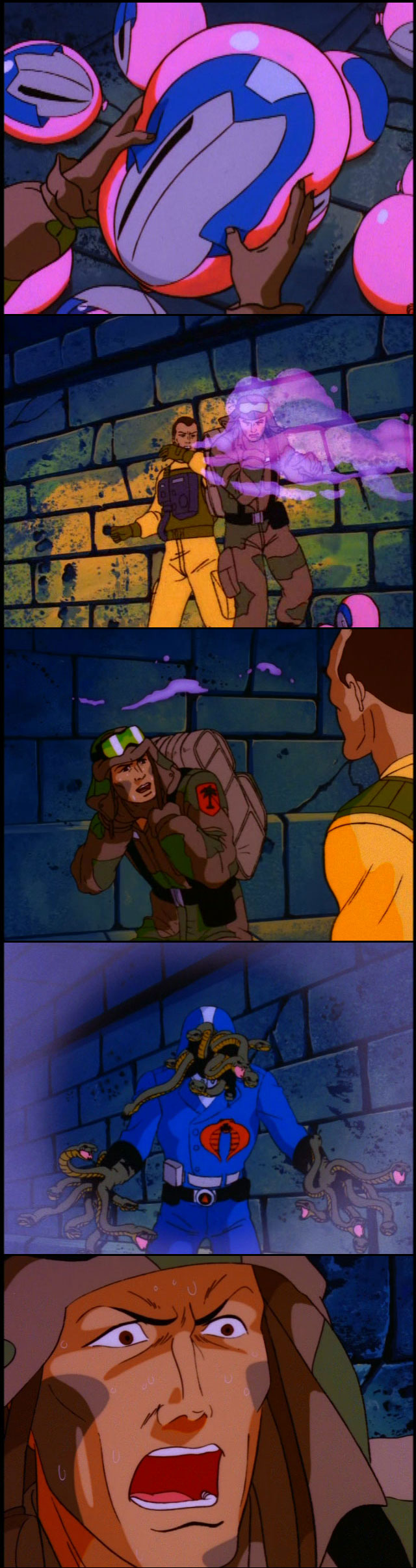
Best thing about this episode: Dusty pops a balloon filled with gas and hallucinates.  His reaction, and the character animation on this scene are great:

G.I. Joe "The Funhouse" screencap Dusty, Airtight, Cobra Commander

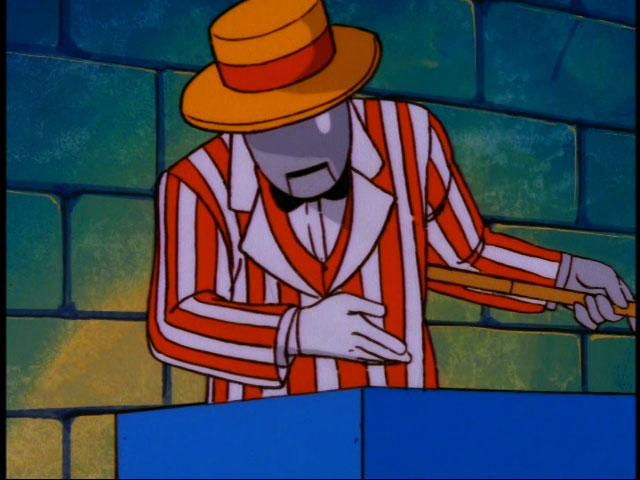
Worst thing about this episode that’s also kind of the best thing about this episode: This carnival barker Cobra Commander robot.

G.I. Joe "The Funhouse" screencap Cobra Commander robot

Best line:

Cobra Commander (from an overhead monitor): “Despite your rudeness, I offer you a sporting chance.  Three doors, three choices.  Two of them lead to dead ends.”

Flint: “What about the third one?”

Cobra Commander: “It leads to me.”

Alpine: “Then all the doors are losers.”

Worst example of one character finishing another’s sentence:

Lady Jaye: “I don’t know where we’re going–”

Air-Tight: “–But anywhere’s an improvement.”

Does it hold up? This episode is a strange one.  It’s straightforward – Cobra, scientists, Joes, deathtraps – until you look carefully.  It’s best not to think too hard about where and how Cobra comes up with its deathtraps, but the ones in “Funhouse” really beg some questions.  Who built an indoor roller coaster in a Latin American step pyramid?  Would Cobra Commander have been upset if all six Joes had taken one door and the other deathtraps had gone to waste?  On the positive side, the character animation is so great, year one character (and discontinued action figure) Zap makes an appearance, the pacing is tight and the banter snappy, and there’s an explosion that looks suspiciously like a mushroom cloud.  Not a good representation of the show at its most grounded, but definitely the pinnacle of the show’s balance of cool and zany.

Tim Finn gives this episode 5 out of 5 MacGuffins

I give it 5 out of 5 MacGuffins.

1 Comment

Filed under The Other Half of the Battle (Episode Reviews)

G.I. Joe Book Photography – More Cobra Command

Last time we looked at hooded Cobra Commander.  Today continuing with more outtakes from photoshoot #1 in March 2008 by then-Glad Works photographer Wes Rollend, we’ll look at CC in his battle mask.

G.I. Joe Cobra Commander photo by Wes Rollend

Photo by Wes Rollend

Dramatic lighting separates Cobra Commander from his two guards.  But CC’s pose doesn’t work — he’s too casually holding his pistol.  If this is HQ, it doesn’t make sense, if it’s going into battle, why the fancy backdrop?

G.I. Joe Cobra Commander photo by Wes Rollend

Photo by Wes Rollend

Change in angle adds drama, and more space between CC and his guards, but now his sigil is in shadow and the right guard’s helmet is clipped.

G.I. Joe Cobra Commander photo by Wes Rollend

Photo by Wes Rollend

The vertical here accentuates the proportions of the figures, and by cropping out one guard we’ve honed in.  There’s movement, like the two are walking toward us, so CC’s weapon now makes sense.  But in general I don’t want vertical shots in my book — just a personal preference — so a choice horizontal one is beat out by this one.

G.I. Joe Cobra Commander photo by Wes Rollend

Photo by Wes Rollend

Here we’re trying underlighting, but since we don’t have a proper set-up, with the figures on a grid or a transparent floor, the underlighting is more frontal low-angle.  This, combined with the down angle POV, makes the figures look like toys rather than living characters in a fantasy story moment, the kind of photo I’m avoiding.

But to repeat from last week, none of these shots — even the best ones (and these four are just a sample) — made the cut since the slot for a photo of Cobra Commander and two Cobra Soldiers never materialized.  But that’s fine, since the writing process is really rewriting, so I along with my editor and designer and photographer Wes and Andre are collectively keeping what works, trimming what doesn’t, and then trimming some of what does for considerations of space.

More photos from both Wes and Andre here soon!

Leave a comment

Filed under Book Behind the Scenes, Photography

“The Rotten Egg” storyboards batch 2

Sorry for the lack of posts Friday.

Pages [1-5] [6-7C] [7D-10] [11-15] [16-19]

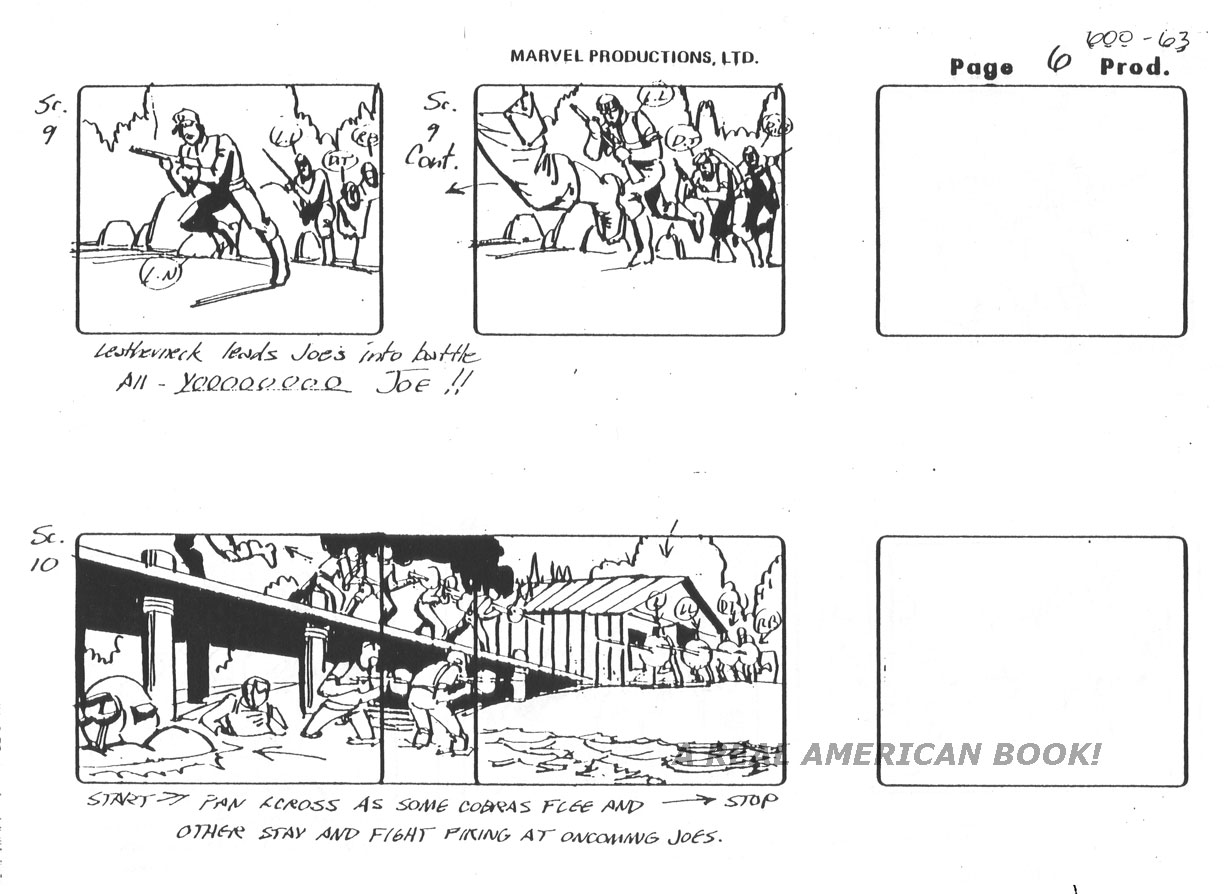
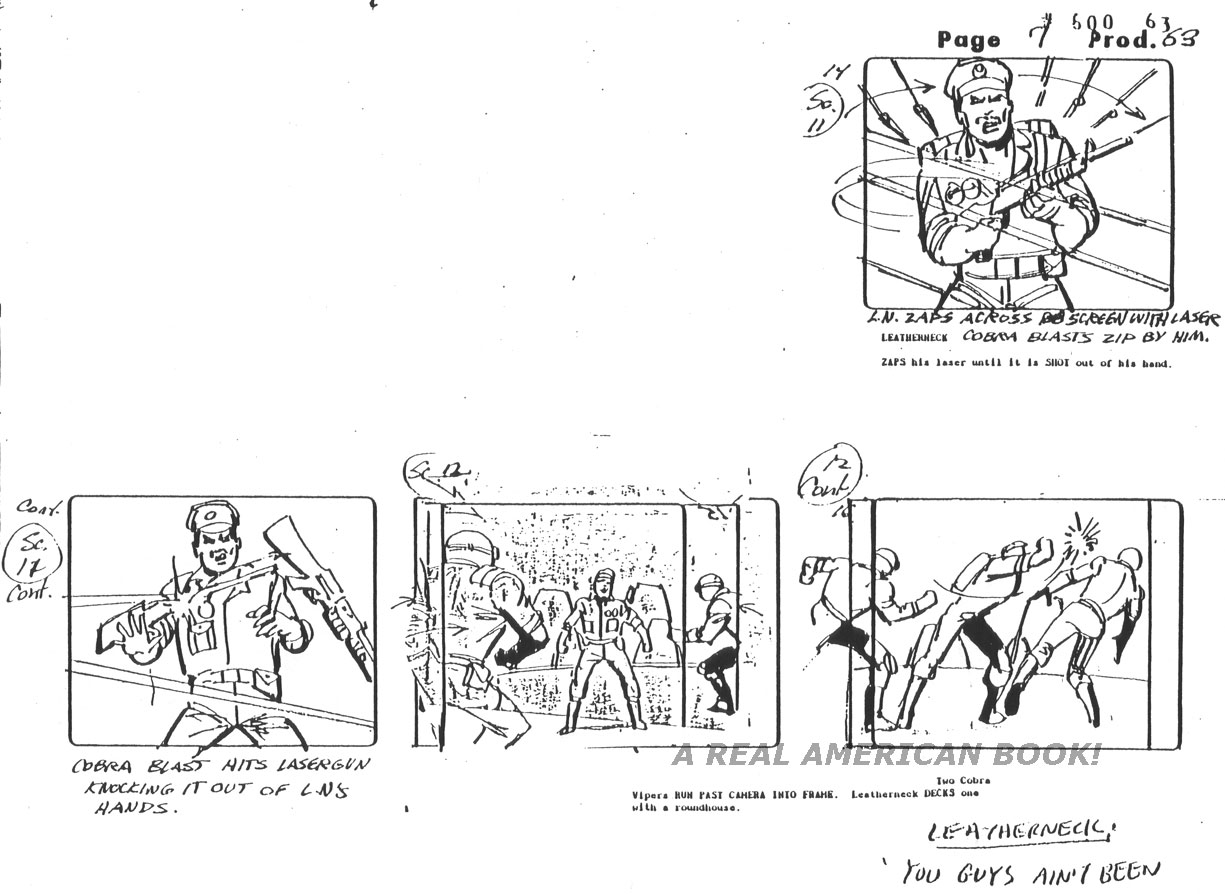
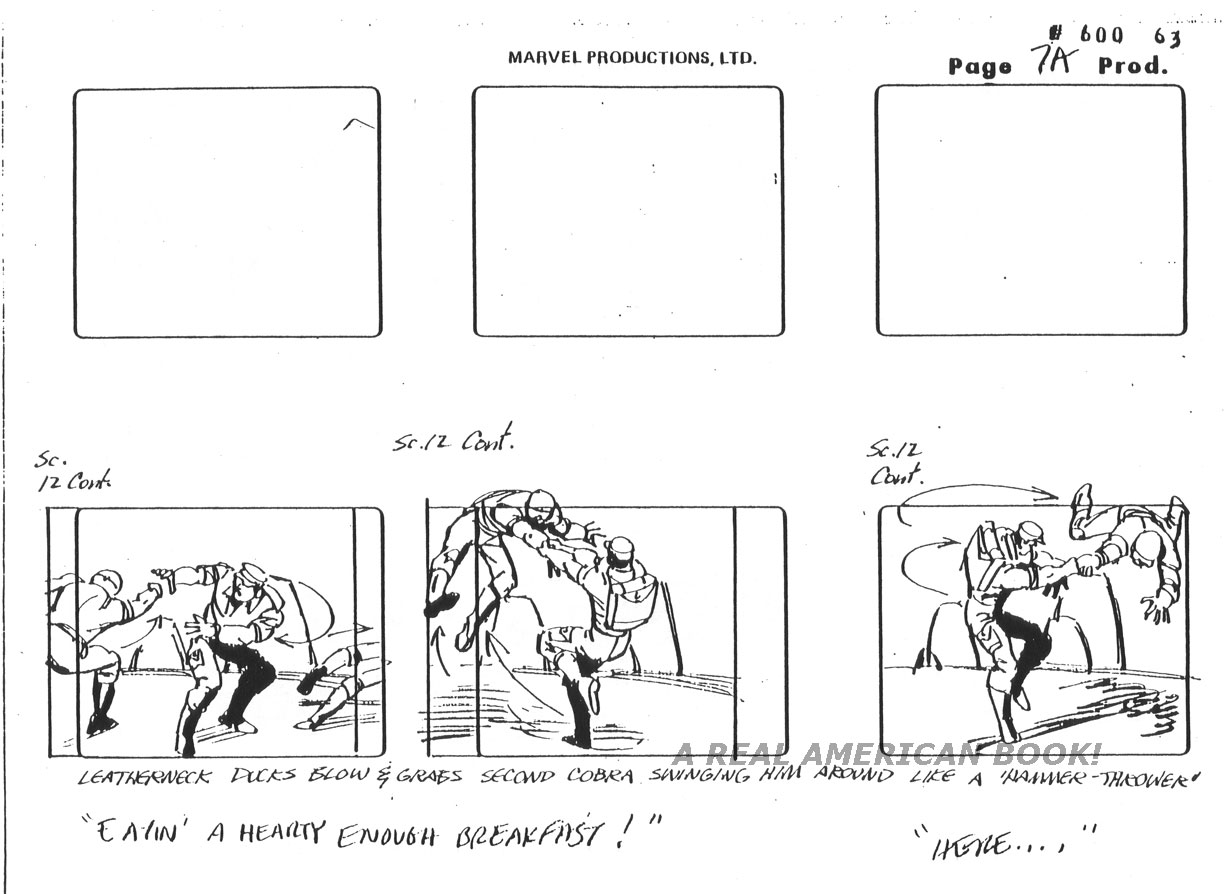
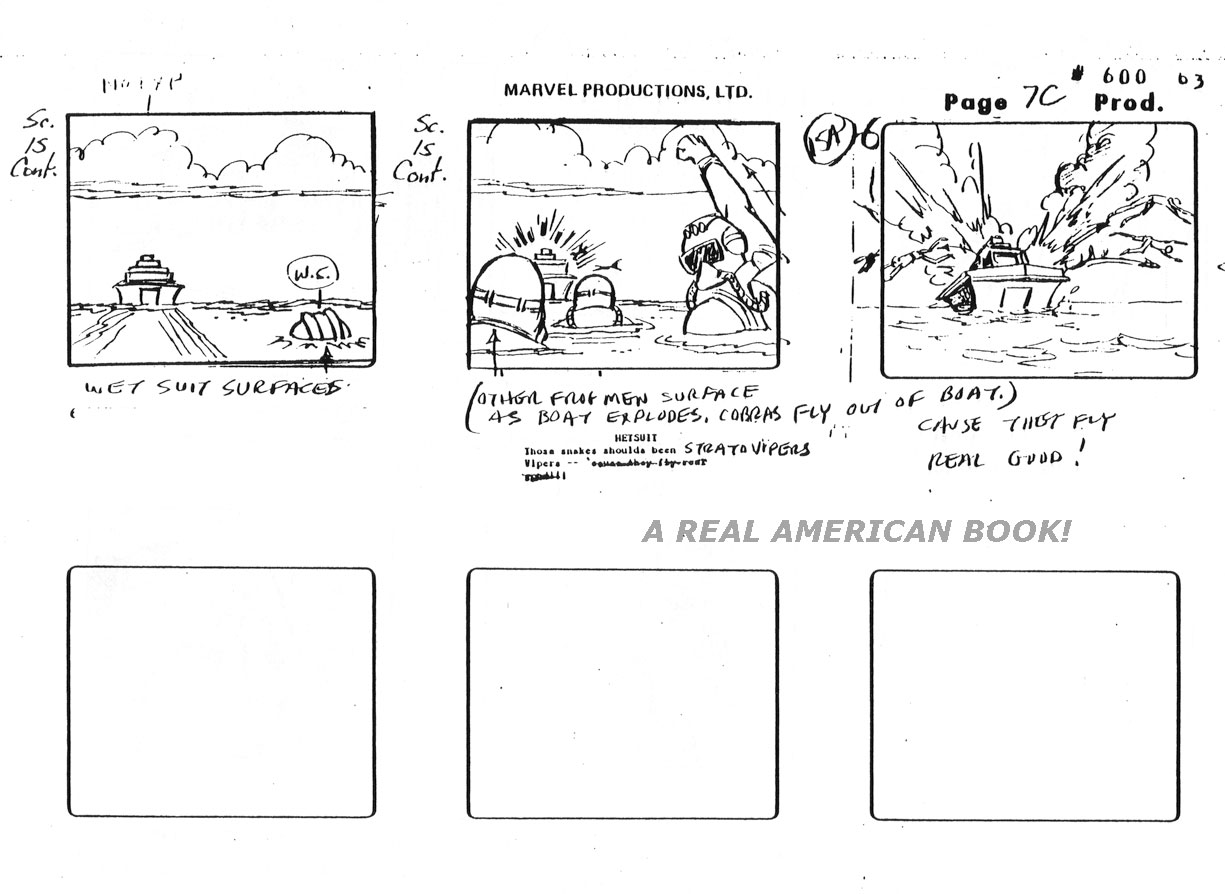
Continuing our look at the Season 2 episode “The Rotten Egg,” here are five more pages of storyboards, page 6, 7, 7A, 7B, and 7C.

G.I. Joe "The Rotten Egg" Season 2 storyboardG.I. Joe "The Rotten Egg" Season 2 storyboard page 007G.I. Joe "The Rotten Egg" Season 2 storyboard page 007AG.I. Joe "The Rotten Egg" Season 2 storyboard page 007B

G.I. Joe "The Rotten Egg" Season 2 storyboard page 007C

Next five pages!

Pages [1-5] [6-7C] [7D-10] [11-15] [16-19]

Leave a comment

Filed under Animation, G.I. Joe Behind the Scenes

G.I. Joe Book Photography – Cobra Command

G.I. Joe book Tim Finn photo by Wes Rollend

Up until now I’ve only shown artwork here at A Real American Book — pencil drawings, ink designs, offset printed four color paperboard, and such.  But no photography.  I’d have to get a few clearances to show some of the vintage G.I. Joe-related photos I’ve cataloged while researching, but what is free to show are the original photographs we’ve taken specifically for the book.  Or at least, a few that haven’t made the cut.  And so here, debuting in public for the first time ever, a couple pictures posed, lit, and shot at Glad Works’ studio in Pawtucket, RI.

The ink on the contract for graphic design services was still drying in March 2008 when we had our first photoshoot.   I posed a batch of 1983 Swivel-Arm G.I. Joe figures and photographer Wes Rollend shot for three hours, racking up 250 pictures.  At the time I wrote “I’m sure when all is said and done, only nine or ten will make the cut.”  With almost half the book laid out, that number has declined, mostly for space reasons, but also because a few shots have replaced those early ones.  All I knew then was that a) I had an entire chapter devoted to people at Hasbro making decisions — not product — and no firsthand photos or memos to go with it, and b) sooner or later amidst all the pre-production materials I’d have to show some actual production, mass-produced action figures and vehicles.  So I started with some 1982 toys, guessing at what photos we might need later on in Chapters 2 and/or 3.

The photo studio at Glad Works, a room next to the main one where designers click away on Macs, has what you’d expect: a tall ceiling, a makeshift cyc, lights and diffusion, bricks and cinder blocks for making flat surfaces taller or shorter (like a tabletop), fabric for backdrops, and more.  Wes played around with lighting (from the side, above, below), and camera angles (low, eye-level), and backdrops.  Plus we had two Cobra Commanders to choose from.

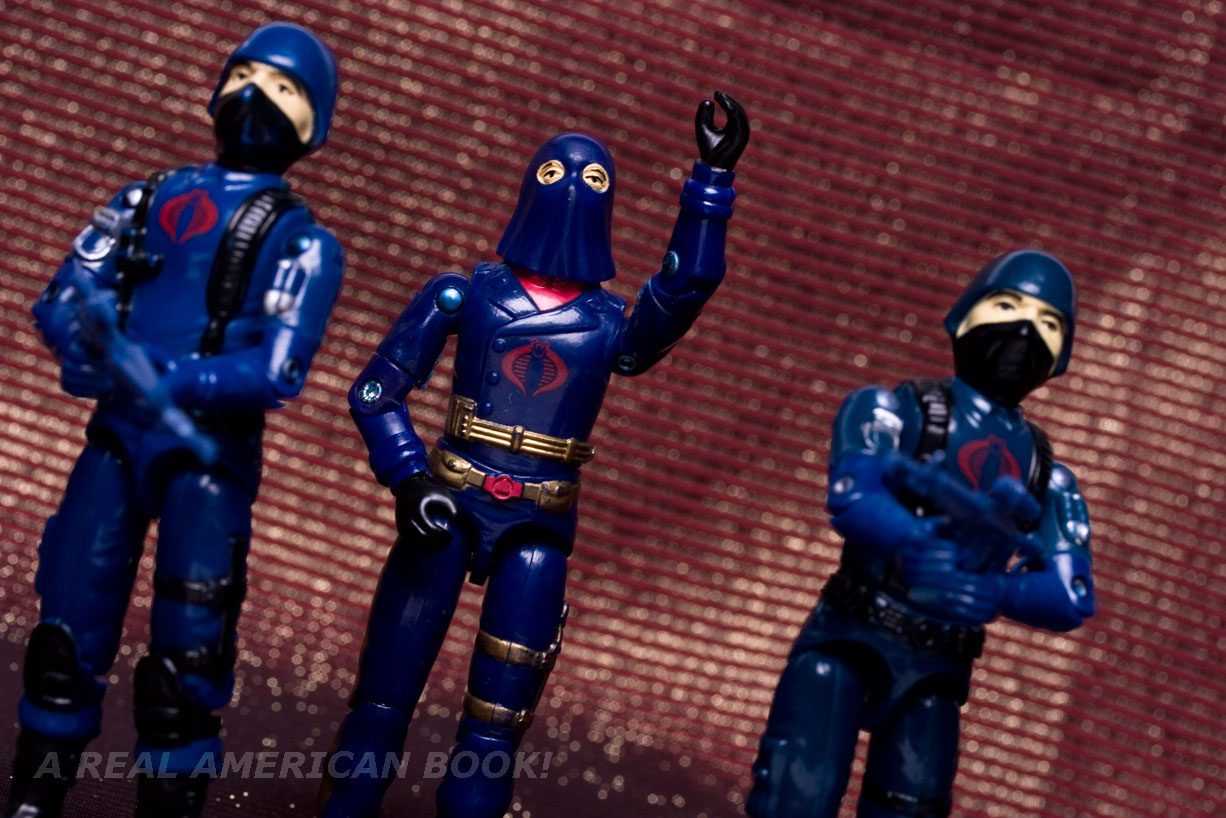
Tim Finn G.I. Joe book Cobra photo by Wes Rollend

Photo by Wes Rollend

This first one above has a great composition, depth, and a bit of menace from the foreground soldier.  The backdrop maroon nicely echoes the Cobra sigil.  But we’re cropped in too closely, so we lose the sense that the Soldier is holding a rifle.  But this does manage to be both about product — you can tell they’re plastic toys — as well as fantasy — this is a story moment during some kind of speech.  So I still like it very much.

Tim Finn G.I. Joe book Cobra photo by Wes Rollend

Photo by Wes Rollend

This second one tries the other end of the rack focus from the previous shot.  But it doesn’t work much better — there’s a clearer sense of the Cobra Soldier holding his rifle, but he’s too out of focus, and therefore too ambiguous.  The background isn’t distracting, but it’s also not adding anything.  Maybe if I’d built a little throne?

Tim Finn G.I. Joe book Cobra photo by Wes Rollend

Photo by Wes Rollend

This third one introduces the second soldier, and in a way I’m channeling the bit from 1987’s G.I. Joe: The Movie where two Crimson Guards stand in front of Serpentor.  But the composition flattens out — the distance between the two guards and the Commander is uninteresting — they’re about the same size, and they’re all in about the same pose.  And the added gap between CC and the second guard doesn’t do anything.

G.I. Joe book Tim Finn photo by Wes Rollend

Photo by Wes Rollend

Now we’re getting somewhere.  The two guards are cropped too much, as is CC’s hand, but I like this one as a balance between the dynamism of the first two and the concept of the third.

Again, none of these above made the cut, and this does not take away anything from Wes’ fine skills.  He took 35 photos of this trio, knowing I would file down the selection to one, so of course there would be some duds.  In this first attempt we were figuring out what was possible, and getting a sense of what I wanted.  Ultimately the book has little need for a toy photo of Cobra Commander and two Cobra Soldiers, as nice as these are and as majestic as that background is.

The book project seemed to suffer a setback when just after this shoot, Wes moved on to another company.  But things worked out, as photographer Andre Blais joined Glad Works soon after and has handled photoshoots 2 through 9.  More outtakes from both Wes and Andre here soon!

Leave a comment

Filed under Book Behind the Scenes, Photography