The Comic That Changed Everything – Part Nine

Part OneTwo Three FourFiveSixSevenEight – Nine

In our last thrilling episode, Tim bought G.I. Joe issue #93 and saw Snake-Eyes’ face!

Just below issue #93’s great cliffhanger was the “next issue” blurb, one that promised the beginning of “The Snake-Eyes Trilogy.” My brother and I owned enough issues of G.I. Joe by now to know that the series had never been delineated with story arcs. Chapters weren’t branded as “part 1,” or “part 2.” It was all an ongoing story, with some characters and plotlines taking the spotlight and others moving to the back or dropping out for stretches at a time. So combined with the fact that this “Snake-Eyes Trilogy” was about the mystery man, and that we had just seen his scarred face for the first time, here was ample evidence that #94 and beyond were a big deal. The tiny preview of next month’s cover showed a healed Snake-Eyes pulling the bandages off his head and brandishing a pistol, a steely look of resolve over the NINJA COMMANDO’s face.

Oddly, when that issue did arrive at Waldenbooks in September, the cover was different. The earlier image had been redrawn, and much of the space was now taken up with giant type that read “SNAKE-EYES GETS A NEW FACE!” And “THE SNAKE-EYES TRILOGY PART 1: WARRIOR REBORN!” And “TOP SECRET.” One of the important factors that separated the monthly G.I. Joe from almost all of Marvel’s other output was the lack of type on its covers. Marvel super-hero comics (and some of the licensed books) regularly had dialogue on the front, and copy that sought to pull in young readers, a decades-old remnant of once head writer and editor Stan Lee’s hyperbolic writing style (“The Day Kitty Pryde Leaves the X-Men, is the Day the X-Men Fall!”) In fact, only 16 out of the previous 93 issues of G.I. Joe had cover copy. This point is worth spending some time on. By way of example, note how impactful this random cover by Mike Zeck (issue #62) is:
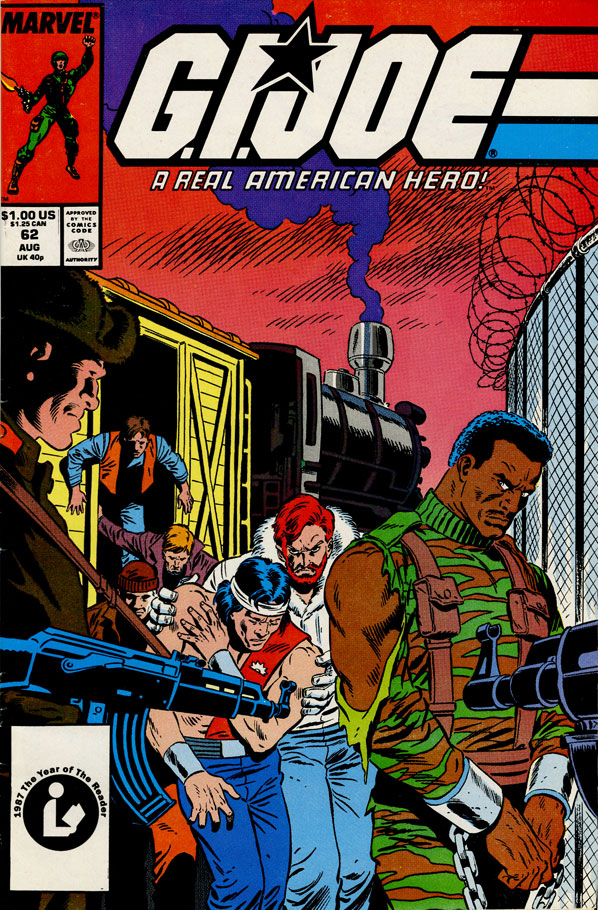
G.I. Joe issue #62 cover by Mike Zeck - as printed

There’s tension. You’re worried about the prisoners. One looks injured, one looks seriously ticked off. Maybe he’ll try to escape! Visual cues let you know they’re out of their element: barbed wire and AK-47s particularly. These guys are prisoners behind the Iron Curtain. That’s a scary thought for a soldier in 1988 or so, or a boy following his exploits. But the cover loses all its power if there’s copy:
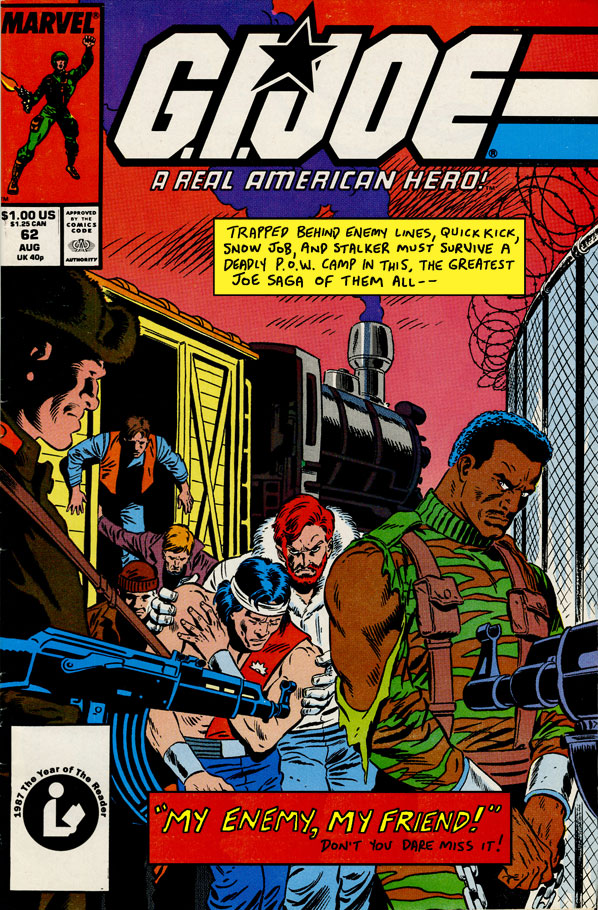
G.I. Joe issue #62 cover by Mike Zeck - type added

So when Kevin and I found issue #94 at Waldenbooks, with its leading cover text, even if we didn’t consciously realize it, the “part 1 of 3” and the mere presence of a blurb meant that something was different. Now it may have just been Editorial trying to goose sales — Read this issue or you’ll miss out! – but the cover treatment, whether it pulled in additional readers or not, was an accurate reflection of the heightened stakes in this run of issues. I mean, last month the Baroness just blew up the Dreadnoks’ van. In this new issue, she shoots Scarlett point blank in the head! I’m not a bloodlustful guy, but I do appreciate edgy kid entertainment, and stories that don’t talk down to me. This kind of violence could never have flown on TV, but we knew that in war, people get hurt. People die.

And some wars come to a premature end.  Which one was it, metaphorically?  Tune in next week to find out!

Part OneTwo Three FourFiveSixSevenEight – Nine

Leave a comment

Filed under Prehistory

G.I. Joe: Retaliation Trailer

The first trailer to G. I. Joe: Retaliation went live the other day, and a few people have asked what I think of it.  First, here it is:

It’s difficult to discuss this without making comparisons to G.I. Joe: The Rise of Cobra, a flawed and disappointing, yet enjoyable, movie.  A proper review of that earlier flick is a topic for another day (um, I have 15 pages of notes, so it will be a long day), but suffice it to say Retaliation looks to ignore much of what didn’t work, accentuate what does, and still move the story ahead (it is a sequel, after all) without alienating those who missed Rise of Cobra.

Things I like: 
-The White House subplot is capitalized on.  (Ha!)
-Lots of action
-Dwayne Johnson’s charisma, and the fact that he’s taking taking the film seriously, but not too seriously
-Bruce Willis
-The lesser actors from the first film are not present
-Machine guns rather than pulse guns

Things I like but as an over-protective fan, need to be won over on:
-Ninja cycle with guns
-Willis should have hair
-Cobra doesn’t seem to have leadership?
-But seriously, something seems familiar here…

Seriously, I can’t be the only person who immediately thought, “Wait, I’ve seen Snake-Eyes ride a dark motorcycle with guns on it right-to-left before,” can I?

G.I. Joe Retaliation comparison

1990 Ninja Force TV ad and "G.I. Joe: Retaliation" comparison

Much is yet to be revealed (and they’re still making the film, so much could change), but this early out, a tip of my hat to director Jon M. Chu, writers Rhett Reese and Paul Wernick, production designer Andrew Menzies, and the folks at Hasbro for what looks like a fun and more faithful G.I. Joe movie.

10 Comments

Filed under G.I. Joe live action films, G.I. Joe: Retaliation, G.I. Joe: The Rise of Cobra

G.I. Joe: The Movie Screenplay, excerpt 2

G.I. Joe Movie screenplay 1987 tease 2

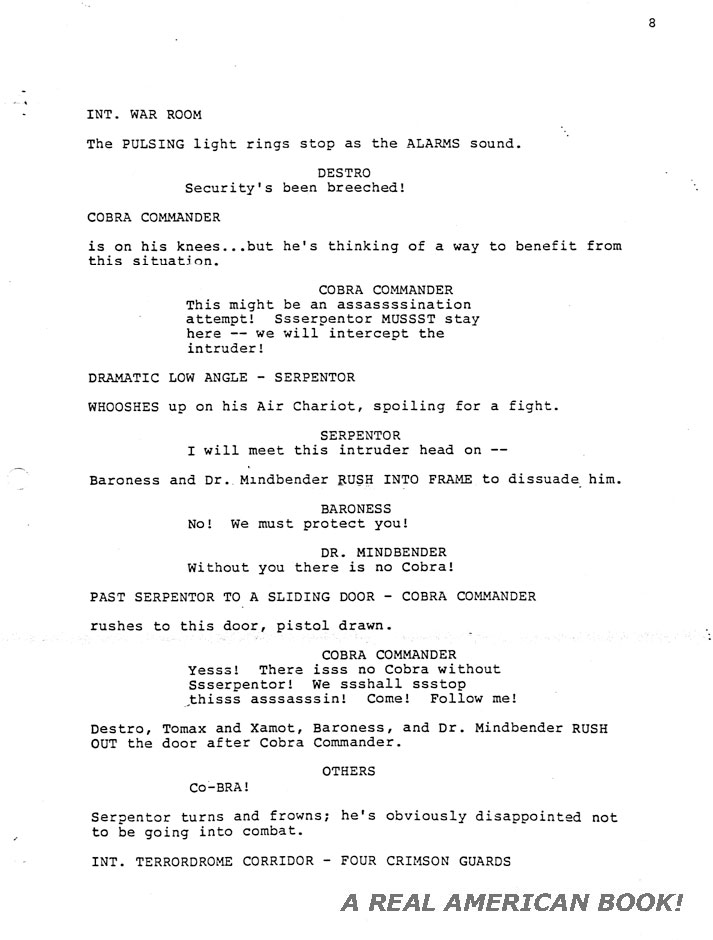
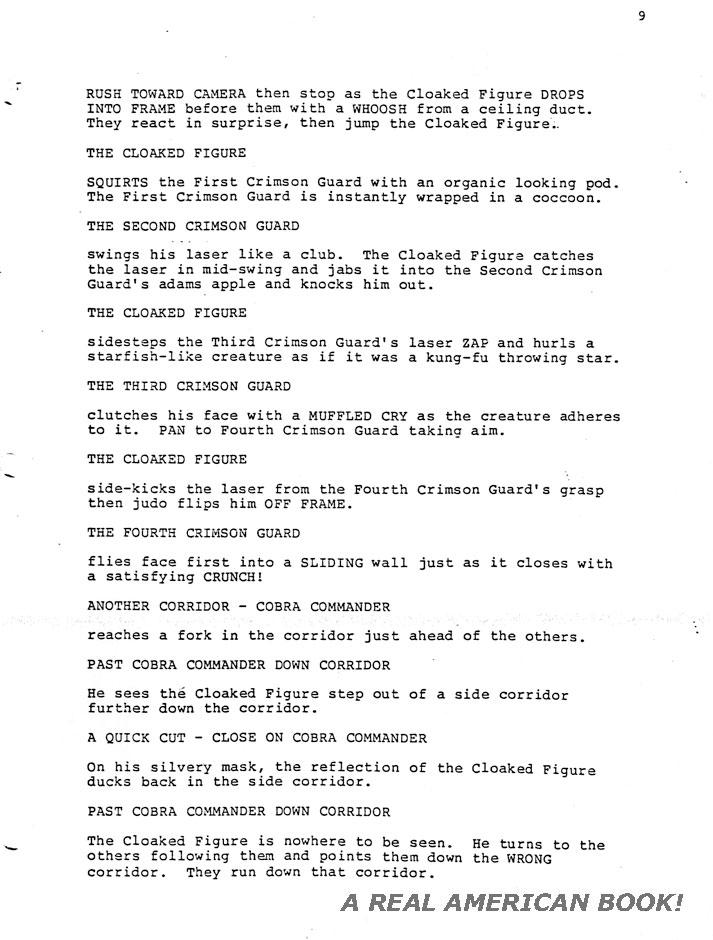
This week, pages 5-9 of the Ron Friedman/Buzz Dixon screenplay to 1987’s animated G.I. Joe: The Movie.  And a greeting to those of you Googling for the screenplay to G.I. Joe: Retaliation.  Take a load off.  Stay awhile.

Pages 0-4 | 5-9 | 10-14

G.I. Joe: The Movie 1987 screenplay pg 005 Friedman/Dixon G.I. Joe: The Movie 1987 screenplay pg 006 Friedman/Dixon G.I. Joe: The Movie 1987 screenplay pg 007 Friedman/Dixon G.I. Joe: The Movie 1987 screenplay pg 008 Friedman/Dixon G.I. Joe: The Movie 1987 screenplay pg 009 Friedman/Dixon

Pages 0-4 | 5-9 | 10-14

Leave a comment

Filed under Animation, G.I. Joe Behind the Scenes

“Revenge of Cobra” 1984 Generic Joe II model sheet

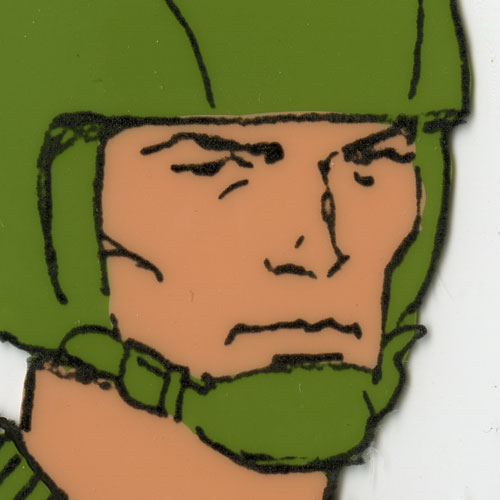
G.I. Joe model sheet tease Generic JoeI don’t recall when this generic trooper (version two) appeared within the 1984 G.I. Joe animated miniseries, “The Revenge of Cobra,” (feel free to chime in in the comments), but here’s a little art of him.  (Version one, not pictured in this post, is sans camo.)  First up is a black and white photocopy of the model sheet, with cel paint color codes written in pencil.

G.I. Joe model sheet tease Generic Joe

And here’s the color model sheet — cel vinyl (like acrylic paint) on the back of an animation cel.  Two or three of these were painted for every single character that appeared (standard for animation, not just the G.I. Joe production).  One or two stayed in the States, and one or two went overseas with all the scripts, storyboards, and background keys to the animation studio that would produce the bulk of the show, in this case Toei in Japan.

G.I. Joe color model sheet Generic Joe

This art is likely Russ Heath, since he’s the main designer credited on “Revenge,” but I should point out that eight other artists appear in the end credits of these five episodes.  They did costume changes, props, and lesser background characters so there’s a chance one of them took a Heath drawing of Generic Joe version one and added a few details.

I don’t know if the term “greenshirts” came about in early Joe fandom, or in 2000 when Devil’s Due Press published its G.I. Joe comic book and canonized the term, but I’ve never liked the word (even though it’s wonderfully accurate) because it represents the animation’s misunderstanding of the Joe concept from almost year one.  With generic soldiers running around in the background of every episode, G.I. Joe becomes a stand-in for the regular, larger armed forces, rather than Delta Force, (what it’s actually a stand-in for), akin to the A-Team or the Mission: Impossible folks.  It’s not hundreds of men and women, it’s five or ten or 20 on smaller missions.

But seriously, I don’t recall when this guy shows up.  Do you?

13 Comments

Filed under Animation, G.I. Joe Behind the Scenes

G.I. Joe: The Movie Screenplay

G.I. Joe: The Movie screenplay tease

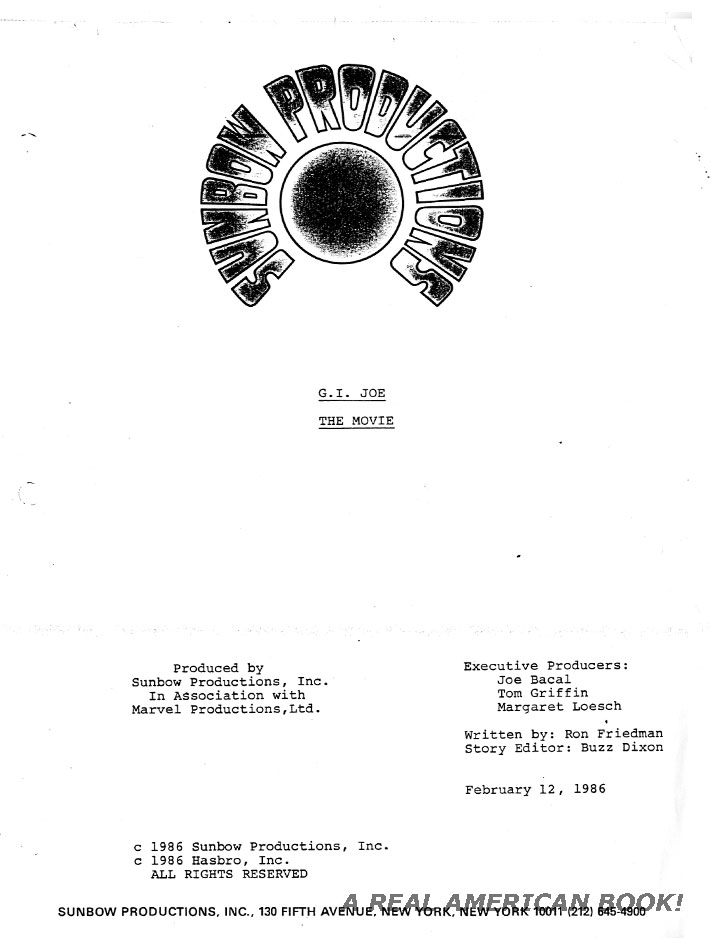
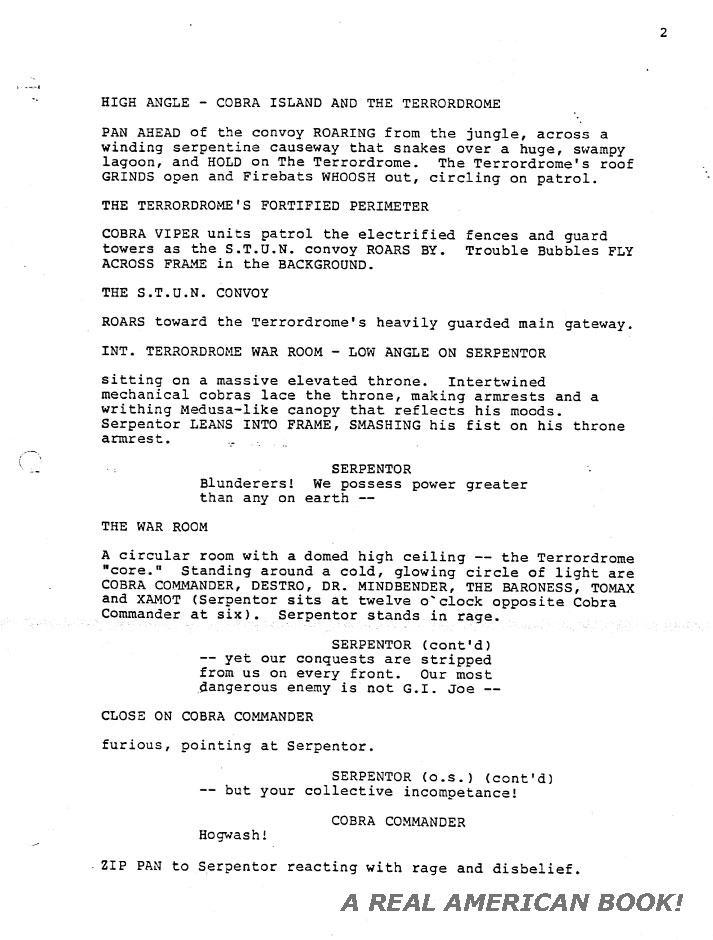
Credited writer Ron Friedman and credited Story Consultant Buzz Dixon have different takes on how much of this they wrote.  Based on their recollections from when I interviewed each, as well as their recall on various Rhino Home Video G.I. Joe DVDs from 2003-2004 my sense is that much more of the credit should go to Dixon.  I delve into this a bit in Chapter 8 of my book, but either way, here’s the first five pages of screenplay from Sunbow Productions’ 1987 G.I. Joe: The Movie.

G.I. Joe: The Movie screenplay title pageG.I. Joe: The Movie screenplay pg 1

G.I. Joe: The Movie screenplay pg 2

G.I. Joe: The Movie screenplay pg 3

G.I. Joe: The Movie screenplay pg 4

3 Comments

Filed under Animation, G.I. Joe Behind the Scenes

Posting Schedule Update

Sorry about not posting recently.  Things have been busy, but I’ll be back on track after Thanksgiving.G.I. Joe Norman Rockwell Thanksgiving by Tim Finn

Leave a comment

Filed under Uncategorized

Cobra Commander’s lost gun!

G.I. Joe photography by Wes Rollend

1982 Cobra Commander photo by Wes Rollend

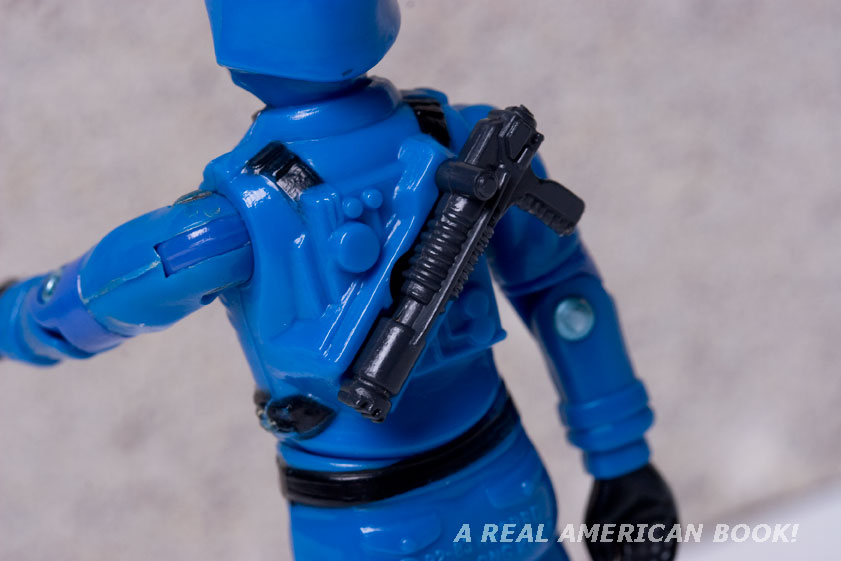
I’m pretty sure this hasn’t surfaced previously.  Commonplace is Cobra Commander’s weird blow dryer/flashlight/laser pistol-thing.

G.I. Joe photography by Wes Rollend

1982 Cobra Commander photo by Wes Rollend

It came with his 1982 straight-arm figure, and the 1983 swivel-arm retool, and the 1984 mail-in hooded version of the character.  (Embarrassing trivia:  My brother and I never knew the gun fit into CC’s back!  I figured this out in 2008, meaning I should probably call off this whole book thing.)

G.I. Joe photography by Wes Rollend

1982 Cobra Commander photo by Wes Rollend

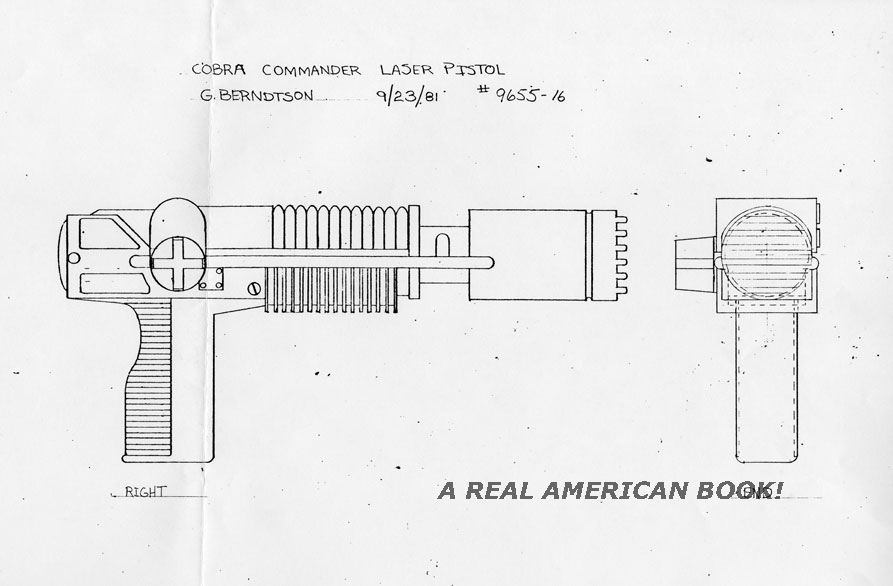
From 1981, here’s Greg Berndtson’s control art for the weapon in question.  This was drawn concurrently with Ron Rudat’s figure turnaround.

Cobra Commander 1982 laser pistol by Greg Berndtson 1

Cobra Commander 1982 laser pistol by Greg Berndtson view 2

And here’s Cobra Commander’s other weapon, the one that wasn’t ever produced and did not come packed with the Cobra Commander action figures!

Cobra Commander 1982 unproduced grenade gun by Greg Berndtson

Know of any other designed-but-scrapped weapons?


7 Comments

Filed under Book Behind the Scenes, Photography, Toys and Toy Art

G.I. Joe Book Photography – Duke and Spirit

G.I. Joe Duke and Spirit action figures MG0581

G.I. Joe toy photography by Andre Blais for Gladworks

Ace lensman Andre Blais came on board just a few weeks after I signed the contract for Gladworks to design my book, and part of the appeal was that he was (and is) in-house there.  So in one room there’s designer Liz Sousa at a Mac, and in another is Andre, with a cyc, pro lights and diffusion, tripods, and more.  (And a Mac.)  I’ll interview him soon for a future blog post.

The general idea for these photos came from the toy photography of Brian Malloy and Erik Hildebrandt in John Michlig‘s G.I. Joe: The Complete Story of America’s Favorite Man of Action.  (Regular readers will recognize that book as one of the two main inspirations for A Real American Book.)  There are only four “fantasy” shots in Michlig, where the reader point of view is in scale with the 12-inch Joes, but the toys themselves are set against the scale of the man-made world.  Rather than product shots, like a catalog displaying toys on a table top (even if the table top is a dressed set), I wanted story moments, like movie stills.

This was also practical.  I don’t want to reproduce too many visuals that are commonly available.  My book aims to continually show and tell unrevealed facts, anecdotes, and imagery.  But whole sections tell the history of people talking and making decisions, but people weren’t taking candid photos of co-workers at the office in 1982.  (Which may seem odd compared to today when every cell phone and music player is also a high resolution camera.)  If an interviewee recalls making the Snake-Eyes figure, an obvious pairing would be a photo of that figure, or a scan of a concept sketch.  But what if there’s no obvious pairing?  To break up stretches of history that have no clearly analogous visuals, the solution was to sprinkle in dramatic diorama-style toy photos.

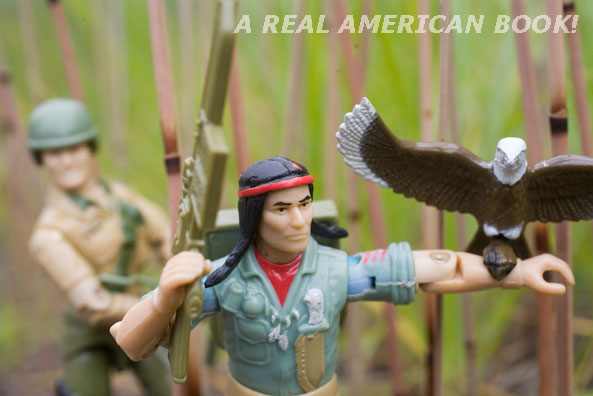
For this photoshoot, I had only a vague idea of where (or why) an image of Duke and Spirit would go.  Maybe Chapter 4, when the narrative gets to the second and third waves of toys?  Sadly, nothing from this shoot made the final cut.  There are two reasons for that:  First, I had forgotten to bring Spirit’s belt.  I was worried that hardcore fans would dismiss the photo for not being fully accessorized, so I asked Andre to crop above Spirit’s waist, which really limited the composition.  Second, the chapter where this photo would go ultimately didn’t need a photo of two action figures in a “fantasy” setting, even if it’s a great photo.

G.I. Joe Duke and Spirit action figures, photo by Andre Blais - MG0590

G.I. Joe toy photography by Andre Blais for Gladworks

G.I. Joe Duke and Spirit action figure photo by Andre Blais - MG0590

G.I. Joe toy photography by Andre Blais for Gladworks

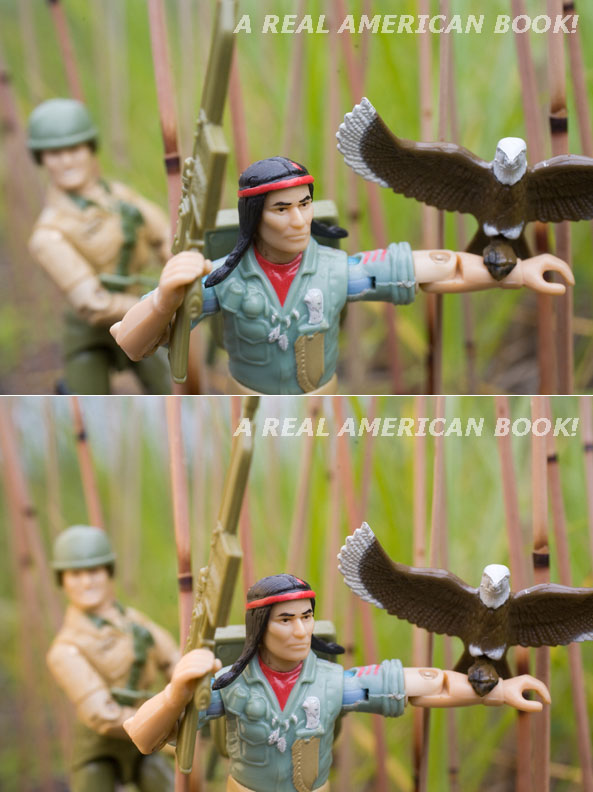
Note the difference in these two — how the golden light from the left adds dimension and warmth to Spirit’s hair, gun-holding arm, and torso.  It’s not in the first shot.  Here they are together for comparison:

G.I. Joe Duke and Spirit action figure photo by Andre Blais - MG0590

G.I. Joe toy photography by Andre Blais for Gladworks

A few weeks later we tried this shoot again, this time with the belt, but the magic was too difficult to recapture.

Leave a comment

Filed under Book Behind the Scenes, Photography

The Comic That Changed Everything – Part Eight

Part OneTwo Three FourFiveSixSeven – Eight – Nine
In our last episode, Tim bought G.I. Joe #93, a comic book that promised to tell much about NINJA COMMANDO Snake-Eyes, but surely would not reveal his never-before seen face!  But then Tim turned to page 18…

There it was, taking up almost the entire left side:  A full portrait of Snake-Eyes, unmasked!  Four huge scars crossed his cheeks and mouth, his right eye bugging out, a calm expression on the martial arts master’s face.  It was a shock.  I must have made some noise outloud, or burst out “WHOOOA!”  Kevin must have asked what was up.  I didn’t show him the page, but I sure wanted to.  “There’s something in here you’ll really like,” was all I could tease.  Surprises in fiction, whether they be dramatic reveals at the end, unexpected cameos, or twists and turns along the way, are the most exciting parts of reading stories and watching films or TV, and this was possibly the biggest surprise of them all.  (In a dead heat for first place are the deaths of several key characters at the beginning of the animated Transformers: The Movie, a shocking theatre-going experience that had taken place three years earlier and three miles north.)

Looking back at Mark Bright’s robust portrait of everyone’s favorite Joe I’m struck by how tame the gore is by any standards of action and violence twenty years on.  (This is a topic for another day, but it’s clear that what used to net an R-rating now is routinely PG-13, and concerning blood and violence we’re a much more permissive and desensitized society.)  When I really think about it, Snake-Eyes doesn’t look that bad.  This is the face of a soldier who took trace fire in Vietnam, and who took a face full of exploding fuel in a crashing helicopter on the way to the Iranian Hostage Crisis?  I mean, his skin doesn’t look like what little I know of burn victims.  But again, this is me being rational and methodical in an analysis that benefits from decades of hindsight and reflection.  This image, and indeed all of the violence in Marvel’s G.I. Joe, had to meet the standards of the The Comics Code Authority, the industry’s self-censorship board.  But as a soon-to-be sixth grader mired in the height of kid G.I. Joe fandom, this was a revelation without comparison.

The rest of the issue is thrilling.  The Joes arrest and then lose the Dreadnoks, Flint and Roadblock threaten civilians (not really), the Baroness learns that the same plastic surgeon who fixed her years earlier (a footnote to issue #22, waaay too early for my brother and I to register as a big deal) is the some one operating on Snake-Eyes, and that Snake-Eyes killed her brother!  And then, the Baroness blows up Zarana and the Dreadnoks’ van via remote control — while talking to Zarana on the telephone!  This ranks as one of the best cliffhangers ever, and is heightened by the cruelness with which the Baroness executes her task, frowning while she literally pushes a red “detonate” button.  (“Luckily I had a contingency plan.”  WHAM!)  It was all too much excitement, and if it weren’t for needing to shove the issue into my brother’s hands so he get up to speed, I would have read it again from page 1 that very instant.

It is this magic that I long for when I read comic books.  A thrilling hunger to know what will happen next, and a  nervous worry that anything will, and that my favorite characters might not make it out of the next story alive.

What Kevin and I couldn’t have known was that we started reading the G.I. Joe comic book right around the time that writer Larry Hama was pulling together several plot threads and character revelations, and that the next few months would be my favorite comic books of all time.

What are they?  Tune in next week to find out!

Part OneTwo Three FourFiveSixSeven – Eight – Nine

2 Comments

Filed under Prehistory

Behind the Scenes of G.I. Joe – Cobra concept art, 1990

Kurt Groen unproduced G.I. Joe Cobra marker sketch dated 1990

For every figure that made it into the line, dozens  were proposed as concepts and sketches.  Here’s a color marker comp (ink on a photocopy of pencil art) by Kurt Groen of an unproduced Cobra  soldier — likely some kind of Viper — from spring of  1990.  I’m not sure if this character made it into three dimensions, but I doubt it.  Click for a slightly larger image:

Unproduced G.I. Joe Cobra marker sketch by Kurt Groen dated 1990

Subtly refining the art and adding a touch of detail, Groen redrew this as a finished color presentation “painting,” but by the time he was involved with the brand the toy development process dictated the internal presentation paintings no longer be painted.  The final art, not pictured, looks just about the same as the rough, above.

Presumably this character was initially pitched for the 1992 product line.

12 Comments

Filed under G.I. Joe Behind the Scenes, Toys and Toy Art