
Jim Sorenson and Bill Forster did a great job putting together two books of G.I. Joe animation model sheets – must-own for Joe art fans. (A parent was browsing in the “Action” section of my comic book store, pulled from the shelf volume 1 of G.I. Joe Field Manual, and sort of thought it was a coloring book. I would have spoken up, but it was clear from their casual browsing that they weren’t that interested, and I didn’t want to come across as an aggressive sales person.) Animation model sheets started out in black and white, and that’s mostly how they were seen by many of the artists who worked on the shows.
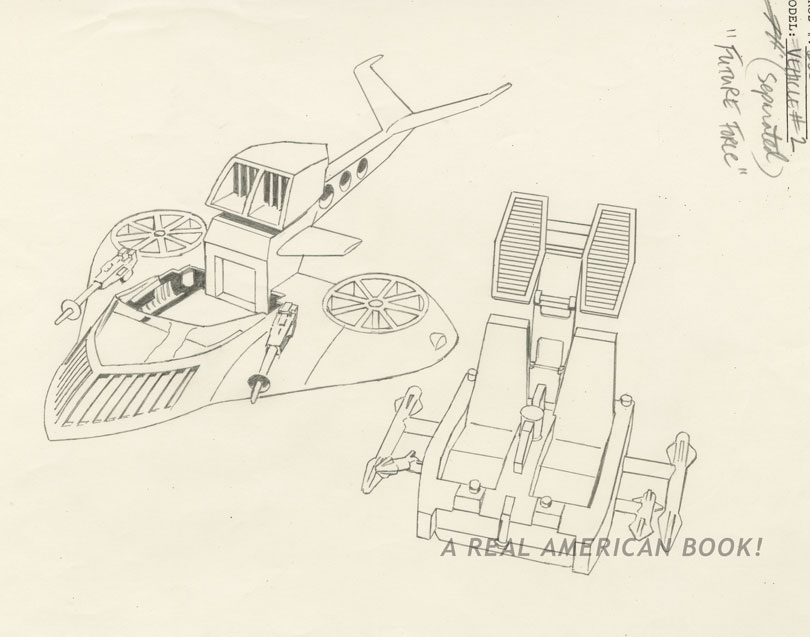
 Or in this case, commercials, since animated Battle Force 2000 only appeared in G.I. Joe advertising. And I should say that artists tended to see photocopies of them in very-actual black and white. Rarer is seeing the original art, here, pencil on paper, dark grey on off-white. Russ Heath, who’s gotten some attention here at A Real American Book, drew today’s post: Three views of the “Vindicator” hovercraft.
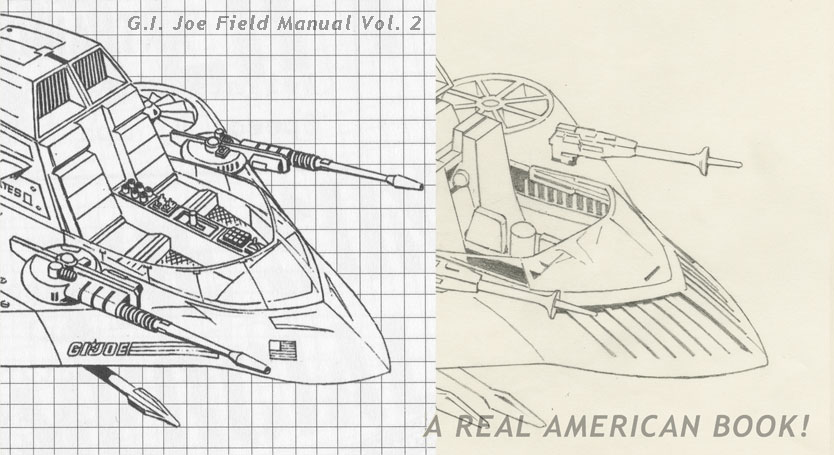
  This is before Hasbro settled on the name “Battle Force 2000,” when the line was still “Future Force.” (I’ve seen some Hasbro paperwork with “Future Force” on it.) What makes these interesting is that they are early versions with different and fewer details than their Battle Force 2000 counterparts. I’m not sure why, and it’s hard to tell from the ad since that only has four seconds of animation. To my eyes, these models are clearly drawn from photos of toys (or toy mock-ups) or drawn from objects Heath had in front of him. So maybe that’s it, maybe they’re referenced from mock-ups. Not sure how that would have helped the animators, as they’d still need the final model sheets.

Perhaps of note, or not, is that these three drawings weren’t done on the same day. The top one is dated 9-9-86, the middle one is four days earlier, and the lower one ten days after. That may not mean anything, as Heath had stacks of drawings to do for any Joe commercial or episode, and was working for multiple productions at any one time. The other “Future Force” vehicle drawings I have are dated between August 5 and September 19. That’s a big range for what was all going to appear together in one ad, but maybe it was a package deal — several ads and all their materials (script, boards, designs, sound) going overseas at the same time. This is all conjecture.
But going back to “early versions with different and fewer details than their Battle Force 2000 counterparts,” you might be hoping for a side-by-side. So here’s an excerpt from Sorenson and Forster’s book on the left (pg 125), with the comparable pencil drawing on the right.
 So today we have our usual kind of mystery — discrepancies in design — with some dates and guesses. Makes you wonder.










 A Real American Book!