Upcoming: “Retaliation” Review

GI Joe Retaliation Roadblock by Tim Finn

I saw “G.I. Joe: Retaliation” last Friday. I’ll post a proper review soon after I collect some thoughts, but for now, I enjoyed it, and as many have said, it’s a big step up from the 2009 film.

Leave a comment

Filed under G.I. Joe live action films, G.I. Joe: Retaliation, G.I. Joe: The Rise of Cobra

10 Things You Didn’t Know About G.I. Joe

Destro Duke GI Joe action

My article for TheFw is up.  Read it here!

Leave a comment

Filed under Animation, Comic Books, G.I. Joe Behind the Scenes, G.I. Joe: Retaliation, Toys and Toy Art

Unproduced – Dave Dorman Dreadnok

Dorman_UnproducedDreadnok_TEASE

As previously mentioned here, in the mid-’80s freelance artist Dave Dorman painted fully rendered presentation pieces of characters already sketched out by figure designer Ron Rudat.  These were internal-only to Hasbro, and not intended as package art or for public consumption.  Even at this stage, a Joe or Cobra could still get nixed.  From 1986, here is an idea for a Dreadnok that didn’t make it further.  Note the misspelled name. Continue reading

6 Comments

Filed under G.I. Joe Behind the Scenes, Toys and Toy Art

Andrei Koribanics Interview Link

Andrei Koribanics Hasbro signature

Sorry it’s been so long since the last update!  To tide you over for a few days (just a few days, I promise), Matt Dillon of Leaky Suit Brigade has just posted an interview with Andrei Koribanics, Hasbro G.I. Joe designer who drew some art I posted here a few months back.  Nice work, Matt!

Leave a comment

Filed under G.I. Joe Behind the Scenes, Toys and Toy Art

I Was a Teenage Sunbow Intern – Pt 10

Title card for Tim Finn's article about interning at Sunbow Productions, art by Ben Edlund

In our last exciting episode ([Part 1] [2] [3] [4] [5] [6] [7] [8] [9]), Tim described the metal filing cabinets at Sunbow with their thousands of photocopies of Brothers Flub and Salty’s Lighthouse production documents, and their dearth of same for important shows like G.I. Joe.

I combed through the G.I. Joe and Transformers folders and found just a few episode synopses, and lists of episode titles, air dates, and writers’ names.  No artwork.  But I did find two documents that made my brain buzz, the first of which I did not make a copy of – for which I still kick myself.  It was a memo from someone dated 1987 asking if the font size in the end credit crawl of G.I. Joe: The Movie could be increased.  Actually, the photocopy was of the response memo, which included the original question, and the responder said no, the font was as big as it could get.  (I guess making it larger would have meant speeding up the crawl to match the music, either making the scroll too fast or requiring a music edit?)  I was three years from realizing I needed to write a book about G.I. Joe, but in the back of my mind I knew this was the kind of ephemera that I wanted to keep, and that I wanted more of.  And for no good reason I did not keep a copy.  The second document, which I’d like to find space for in Chapter 6 of my book, is from an outside consultant to Sunbow listing the episodes of G.I. Joe that have less fighting and property damage, and are therefore better candidates for selling overseas.  Fascinating stuff!  (If it doesn’t make the book I will certainly post it here.)  G.I. Joe had a reputation for being a “violent” show (an epic topic for another day), and had trouble getting on the air internationally after the initial run.

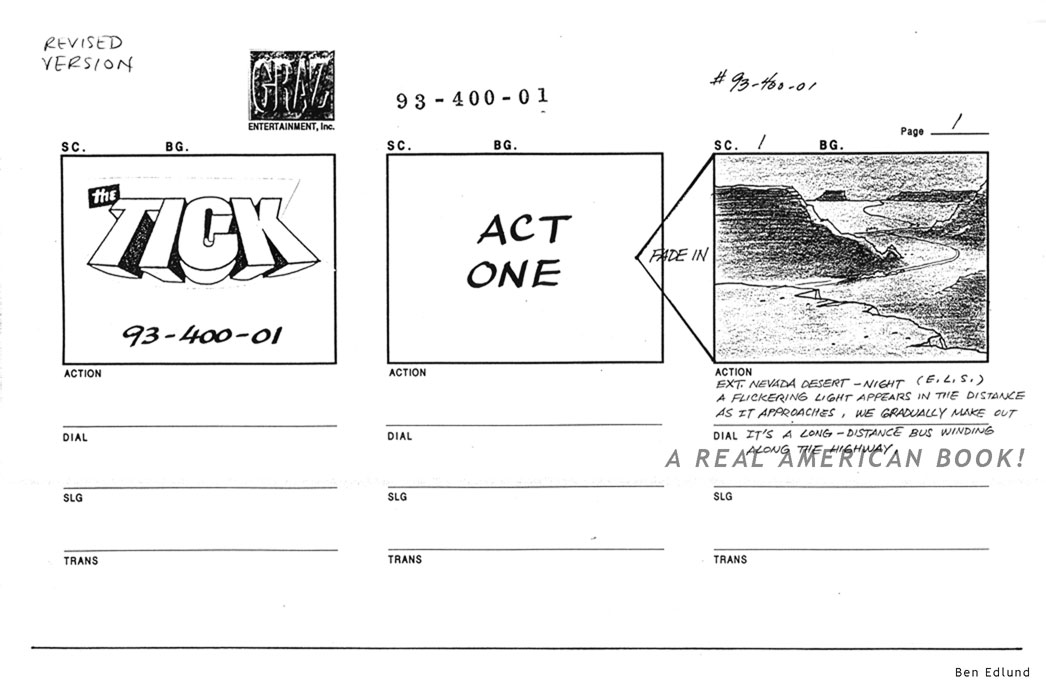
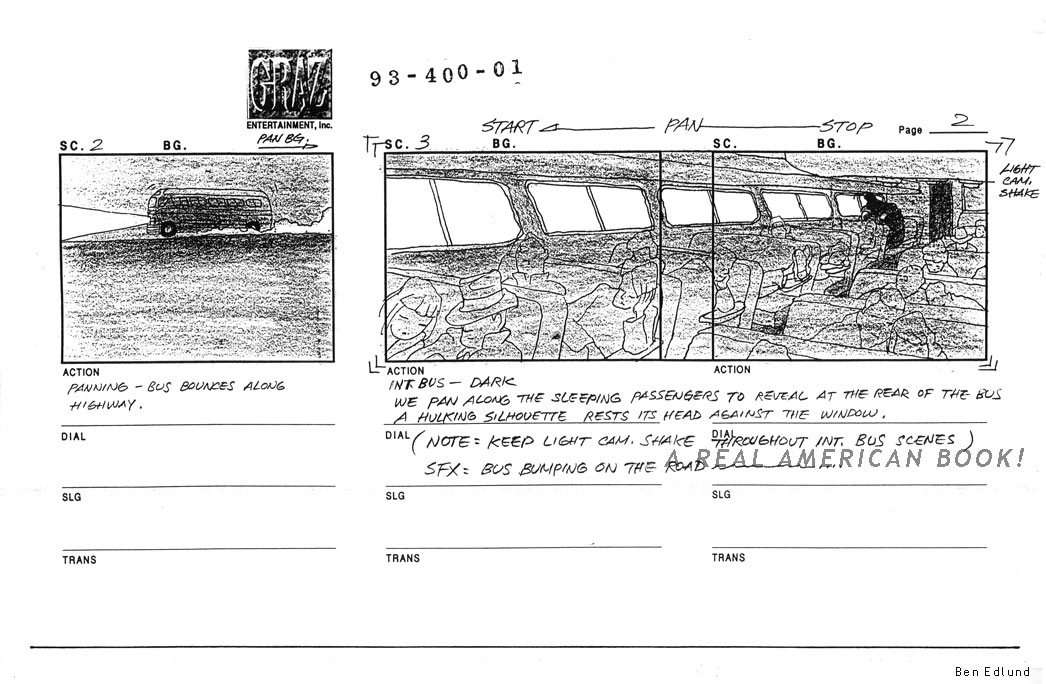
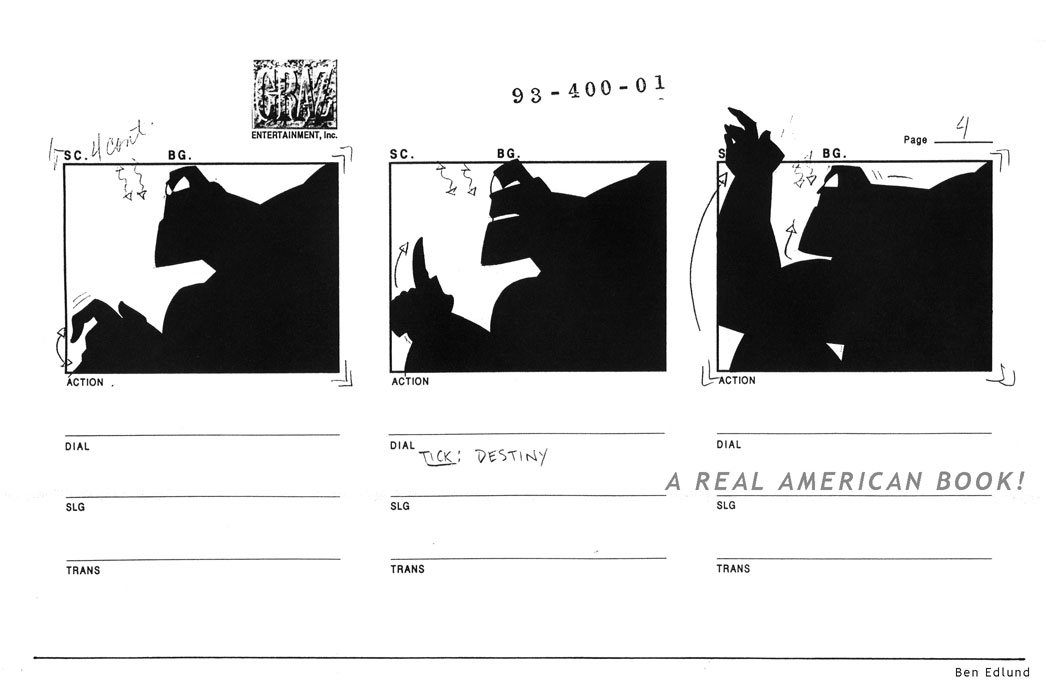
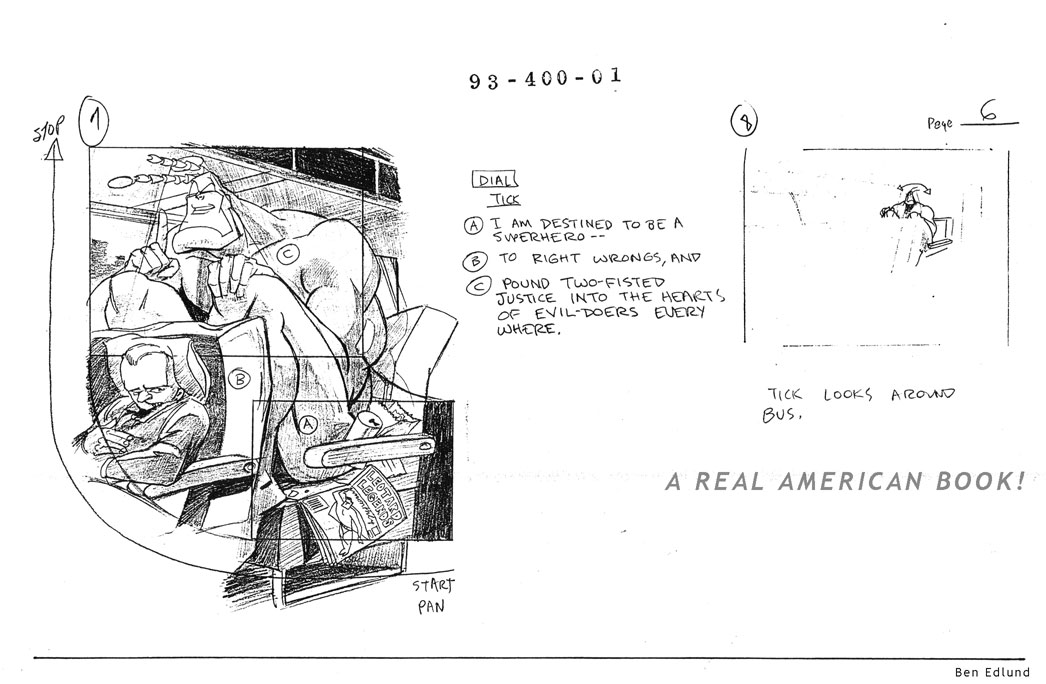
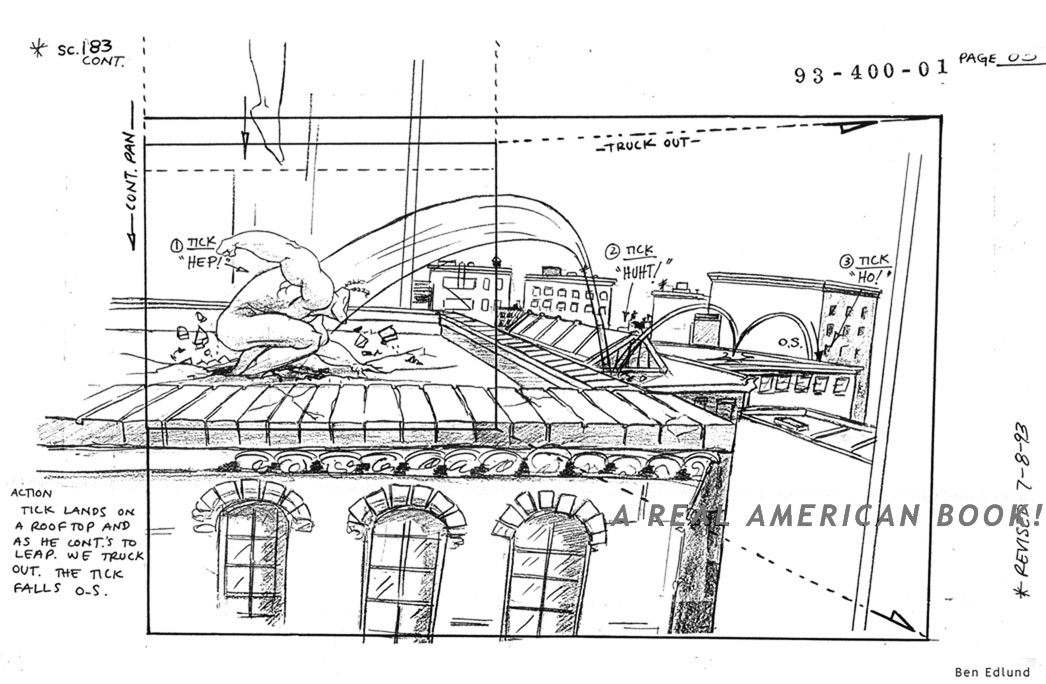
Although there was no art for the older shows, at least there was some for a more recent show of which I was an avid fan.  One of the higher ups mentioned, perhaps one day when she saw me glued to some Tick storyboard photocopies, that Ben Edlund had storyboarded the first episode entirely himself.  I recall that someone told me that Edlund storyboarded the first few by himself.  This was revelatory, as well as shocking.  My friend Andrew and I had long been fans of The Tick comic.  Old school Tick fans know the frustration of waiting for a new issue.  It had taken writer/artist Ben Edlund seven years to create 12 issues of the black and white series.  (And one issue he didn’t draw!) I don’t say this out of criticism.  The Tick was the funniest comic I had ever read, and after it I have no need for any other super-hero parody (including my own – yikes!)

It was amazing to think that after drawing a small quantity of panels for the comic series, Edlund had then gone on to quadruple that amount for animation storyboard panels!  And his boards here not rough!  They were on-model, and crisply delineated like his comics work.  Photocopying the entire first episode board might have been too obvious, or such an amount of paper could have crossed the bounds of what is reasonable to remove from an office job, so I contented myself with just the first few pages, and two later ones with sharp art.  Which are here for your perusal, and as far as I know never online until now.  (Tell your friends!)

The Tick ep1 storyboard pg title art by Ben EdlundThe Tick ep1 storyboard pg001 art by Ben Edlund The Tick ep1 storyboard pg002 art by Ben Edlund The Tick ep1 storyboard pg003 art by Ben Edlund The Tick ep1 storyboard pg004 art by Ben EdlundThe Tick ep1 storyboard pg005 art by Ben EdlundThe Tick ep1 storyboard pg006 art by Ben EdlundTheTick_ep1_SBpg_note1_BLOGThe Tick ep1 storyboard pg071 art by Ben EdlundTheTick_ep1_SBpg_note2_BLOGThe Tick ep1 storyboard pg085 art by Ben Edlund

But the oversized beige metal filing cabinets were just the tip of the iceberg.

What else did Tim find?  Tune in next time to find out!  

3 Comments

Filed under Prehistory

I Was a Teenage Sunbow Intern – Pt 9

Title card for Tim Finn's Sunbow internship blog article part 9

In our last episode,  ([Part 1] [2] [3] [4] [5] [6] [7] [8]), Tim spent his first day reading materials for Brothers Flub, and soon accomplished his only art-related task of the whole summer.

The real work for production interns was filing paper and dubbing tapes.  Let’s start with the former.

Every morning from the Los Angeles office we received a large FedEx box, the size that holds 10 reams of copy paper.  In it were photocopies of scripts, storyboards, character designs, background designs, and prop designs for Brother Flub.  This was before e-mail attachments of any reasonable size, and FTP sites, so this remarkably inefficient method was the most efficient way to get these materials across the country.  And they needed to be filed.  Ostensibly producers Randy and Tammy were reviewing them all, but either they had already seen earlier versions, or that’s one of those jobs that no one does even though on paper it’s part of the job.  Again, this was thousands of sheets of paper per day.

So I or one of the other interns would slide this very heavy box (sometimes there were two) over to the oversized beige metal filing drawers, pull open the Brothers Flub folders, and file away all this paper.  There were folders for each category, for each episode.  And much of the paper – storyboards and models particularly – was 8.5 x 14 inches, bigger than standard letter-sized paper.  It was brainless, but exactly the kind of task someone is obliquely referring to when he or she says to you that your internship or production assistant (read: gopher) job will be a learning experience even if you don’t do anything important.  Because you will observe things, overhear things, and become familiar with processes that make up the everyday at a company.  And you will see physical objects up close you would not have otherwise.

So it was for me.  Model sheets for costume changes of the main characters.  Model sheets for props or anything that moved in the episode, like the shape of the tear a finger made poking through a newspaper.  And teleplay scripts, with minimal stage direction, and names and dialogue centered on each page.

And of course there were folders for shows besides Brothers Flub.  There were many for Salty’s Lighthouse, the other show in-production (and on-air at that time, I think), and there were many for The Tick, one of the last shows Sunbow had worked on prior.  But the real teases were the folders for the older shows:  G.I. Joe, Transformers, Visionaries, My Little Pony.  (Also, shows I didn’t care about, like Conan the Adventurer.)

Sadly, those folders had very little of interest.  At one point, years earlier, they would have had everything.  Every script, every design.  Not color cels and backgrounds, of course – those (mostly) stayed in the Orient, but many contour images on white paper.  And a single half-hour of animation generates of lot of that over its six months of production.  By the time I got to Sunbow, the show folders mostly consisted of episode lists, writer lists, episode summaries, and the like.  I recall a box under the desk in the dubbing room had transcripts of dozens of G.I. Joe episodes – transcripts, not scripts.  In the UK, G.I. Joe aired as Action Force, so here I suppose British actors could redub the parts where the Joes yelled their “Yo, Joe!” battle cry with “Full Force!”  I’ve never seen Action Force, so if there are any international readers out there, please leave a comment if this rings true.

I did find two fascinating G.I. Joe documents in those files, however.

What were they?  Tune in next time to find out!  [Click here for Part 10]
2 Comments

Filed under Prehistory

Unproduced G.I. Joe Vehicle – Borer

G.I. Joe Unproduced Borer by Andrei Koribanics close-upAndrei Koribanics freelanced for Hasbro in the mid-1980s.  Besides today’s Borer art, I’ve also come across a figure concept by him (that may end up in Chapter 14 of my book) and the presentation painting of Sgt. Slaughter’s Renegades (in Chapter 6).  Leaky Suit Brigade has a tiny interview with Koribanics, and should have a longer one up at some point. Continue reading

12 Comments

Filed under G.I. Joe Behind the Scenes, Toys and Toy Art

“The Rotten Egg” storyboards batch 6

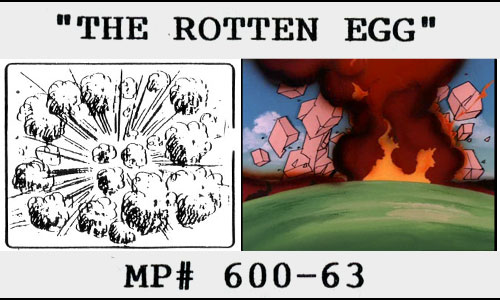
Sorry for the delay!  Back to blogging!  Thanks to all the visitors who clicked here while I wasn’t posting.G.I. Joe season 2 storyboard to animation still comparison "The Rotten Egg"

Pages [1-5] [6-7C] [7D-10] [11-15] [16-19] [20-24] [24A-28]

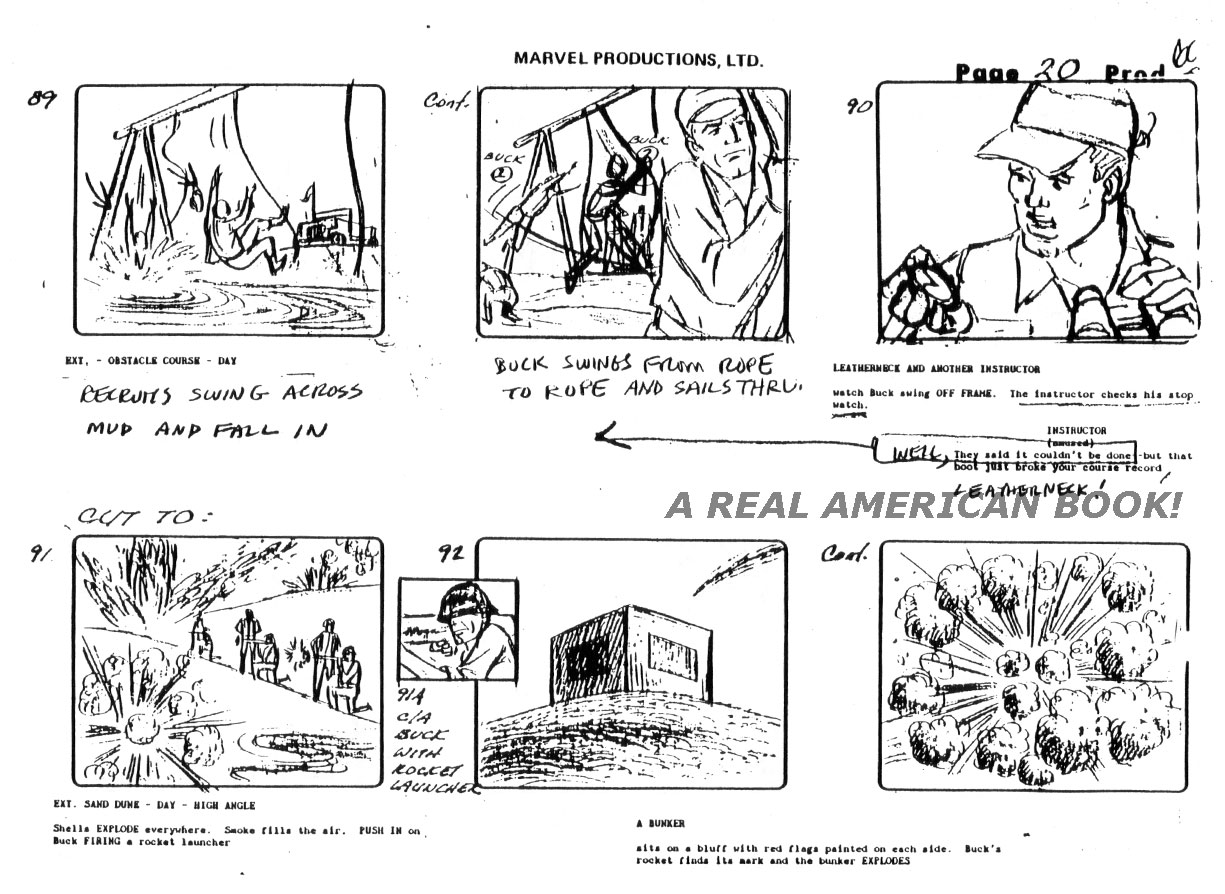
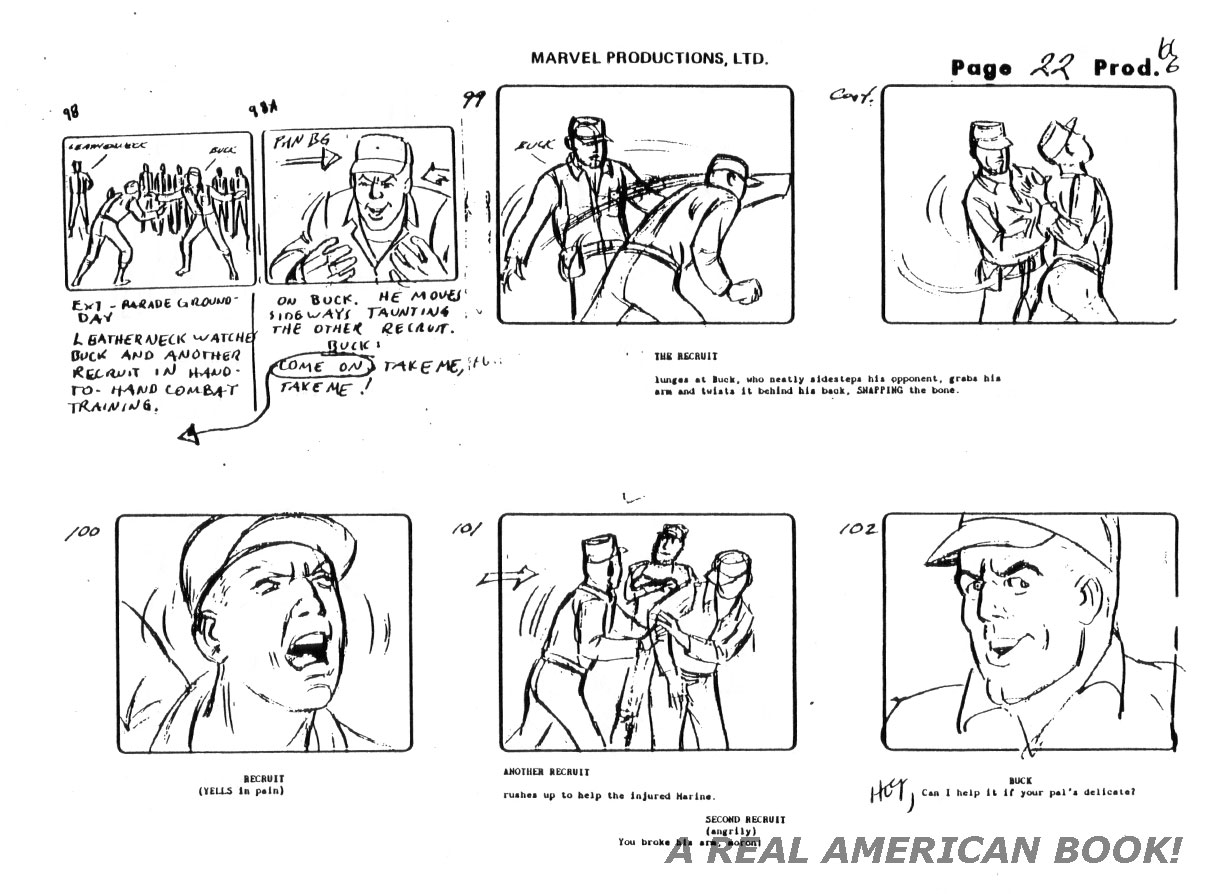
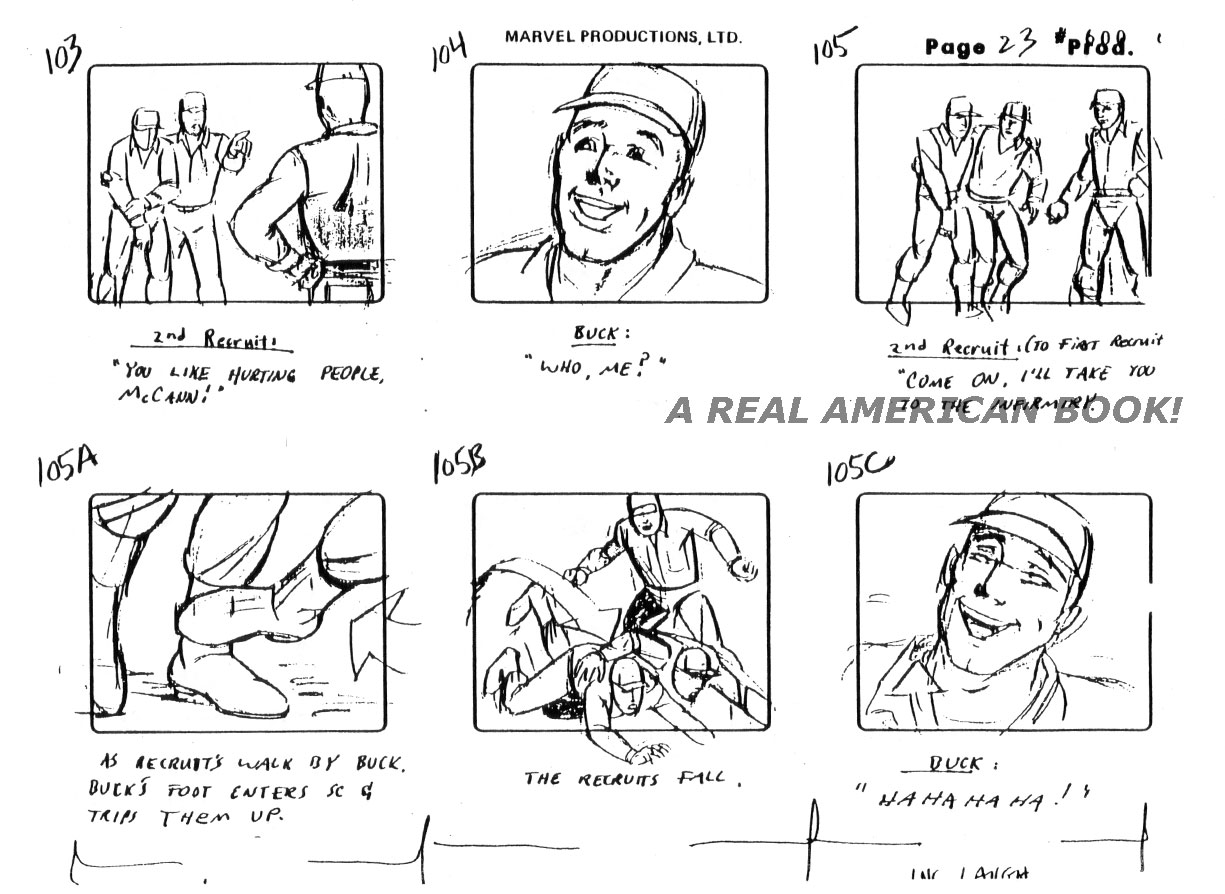
More storyboards from writers Steve Mitchell and Barbara Petty’s “The Rotten Egg,” this time pages 20, 21, 22, 23, and 24.  Sorry, I don’t know who boarded these, but when I do I’ll update this sentence.

G.I. Joe "The Rotten Egg" Season 2 storyboard page 020

G.I. Joe "The Rotten Egg" Season 2 storyboard page 021

G.I. Joe "The Rotten Egg" Season 2 storyboard page 022

G.I. Joe "The Rotten Egg" Season 2 storyboard page 023

G.I. Joe "The Rotten Egg" Season 2 storyboard page 024Things will get a little more interesting with batch 7 when the final animation deviates a little from the storyboard.

Pages [1-5] [6-7C] [7D-10] [11-15] [16-19] [20-24] [24A-28]

1 Comment

Filed under Animation, G.I. Joe Behind the Scenes

Cobra Night Raven designs by Steve Reiss

Cobra Night Raven by Steve Reiss tease image for Tim Finn's G.I. Joe blog

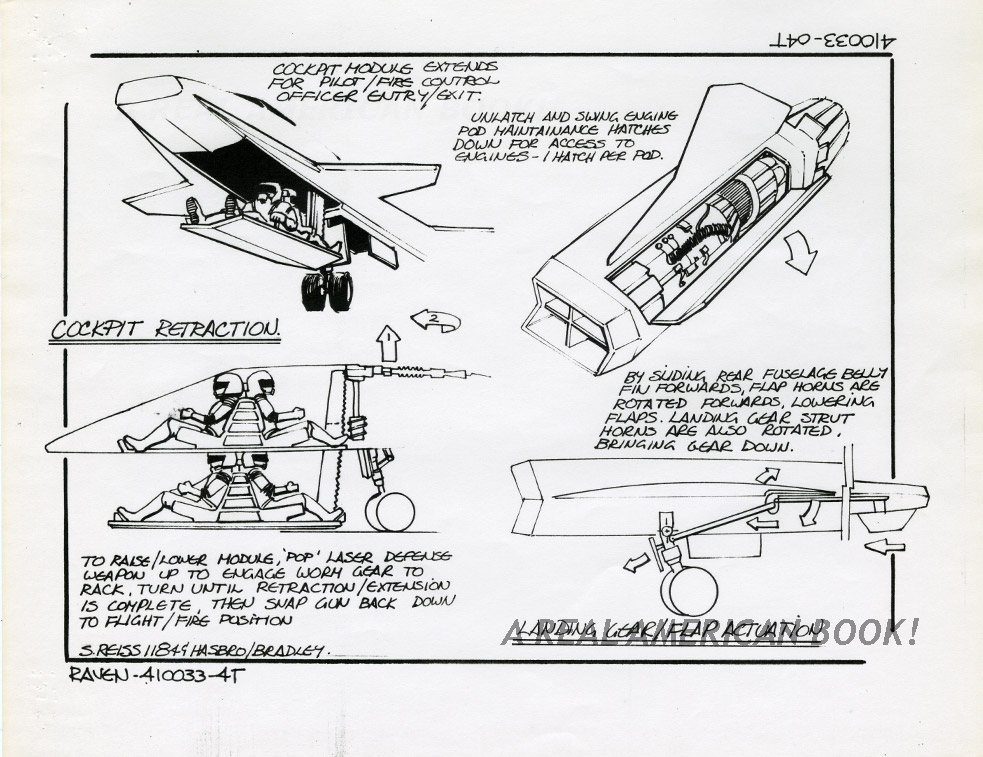
Steve Reiss attended CCS, the College for Creative Studies, before it had that name, back when it was called Society of Arts & Crafts in Detroit.  It had long been a school with a reputation for vehicle design.  After Reiss joined Hasbro in 1985 he was soon designing G.I. Joe vehicles, like the stunning 1986 Cobra Night Raven, based on Lockheed’s also-stunning SR-71 “Blackbird.”  For your reference, here’s the real thing:

SR-71 NASA photo by Judson Brohmer as comparison to Steve Reiss G.I. Joe Cobra Night Raven toy for Hasbro    And here are Steve Reiss’ six pages of designs, the basis for a rough, three-dimensional model.

Cobra Night Raven design pg 1 by Steve Reiss for G.I. Joe 1986 toy line

Cobra Night Raven design pg 2 by Steve Reiss for G.I. Joe 1986 toy line

Cobra Night Raven design pg 3 by Steve Reiss for G.I. Joe 1986 toy line

Cobra Night Raven design pg 4 by Steve Reiss for G.I. Joe 1986 toy line

For play value, Reiss added a one-person drone that latched onto the top of the larger jet:

Cobra Night Raven design pg 5 by Steve Reiss for G.I. Joe 1986 toy line

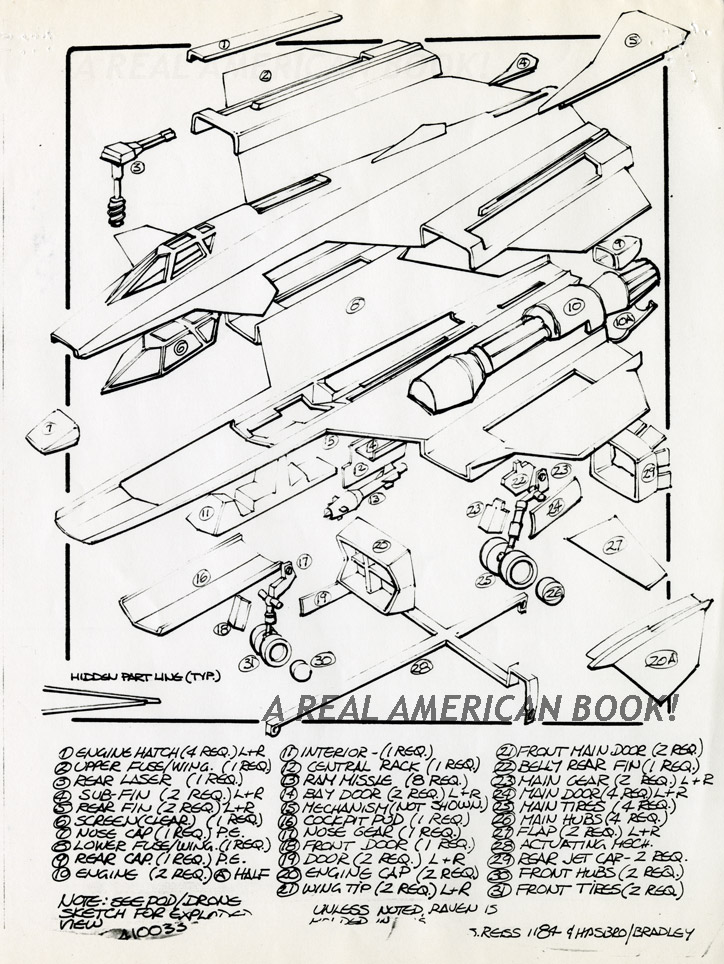
And here’s the parts breakdown.

Cobra Night Raven design pg 6 by Steve Reiss for G.I. Joe 1986 toy line

The final toy is black with opaque red accents, and the clear red cockpit windows are a lovely, extra detail.  The Night Raven is also quite long, and I recall always needing two hands to support it.  It’s one of the most attractive products in the entire Real American Hero product line — elegant, sleek, and aggressive.

11 Comments

Filed under G.I. Joe Behind the Scenes, Toys and Toy Art

“The Rotten Egg” storyboards batch 5

G.I. Joe season 2 storyboard to animation still comparison "The Rotten Egg"

Pages [1-5] [6-7C] [7D-10] [11-15] [16-19] [20-24] [24A-28]

More storyboards.  This time it’s pages 16, 16A, 17, 18, and 19.

G.I. Joe "The Rotten Egg" Season 2 storyboard page 016

G.I. Joe "The Rotten Egg" Season 2 storyboard page 017

G.I. Joe "The Rotten Egg" Season 2 storyboard page 017A

G.I. Joe "The Rotten Egg" Season 2 storyboard page 018

G.I. Joe "The Rotten Egg" Season 2 storyboard page 019

Pages [1-5] [6-7C] [7D-10] [11-15] [16-19] [20-24] [24A-28]

Leave a comment

Filed under Animation, G.I. Joe Behind the Scenes