Sorry for the lack of posts Friday.
Pages [1-5] [6-7C] [7D-10] [11-15] [16-19]
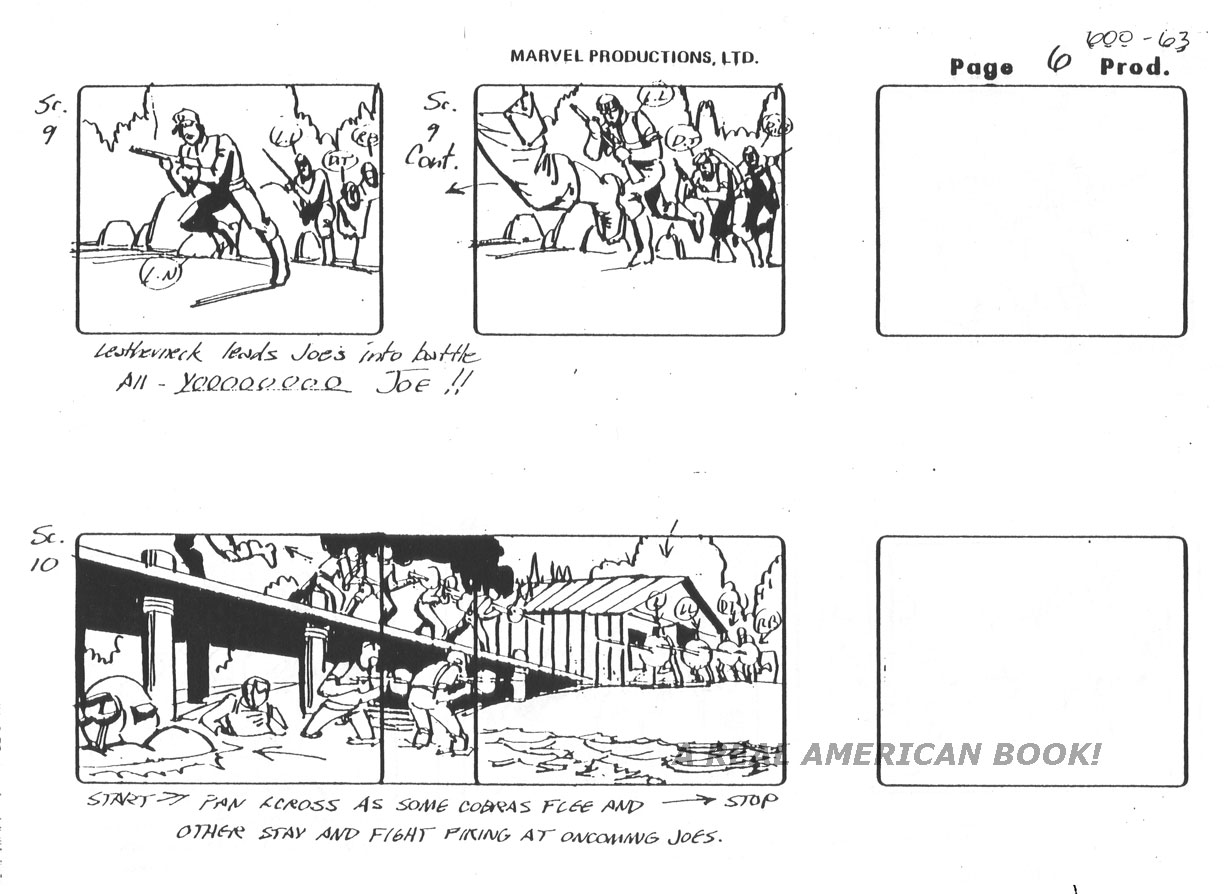
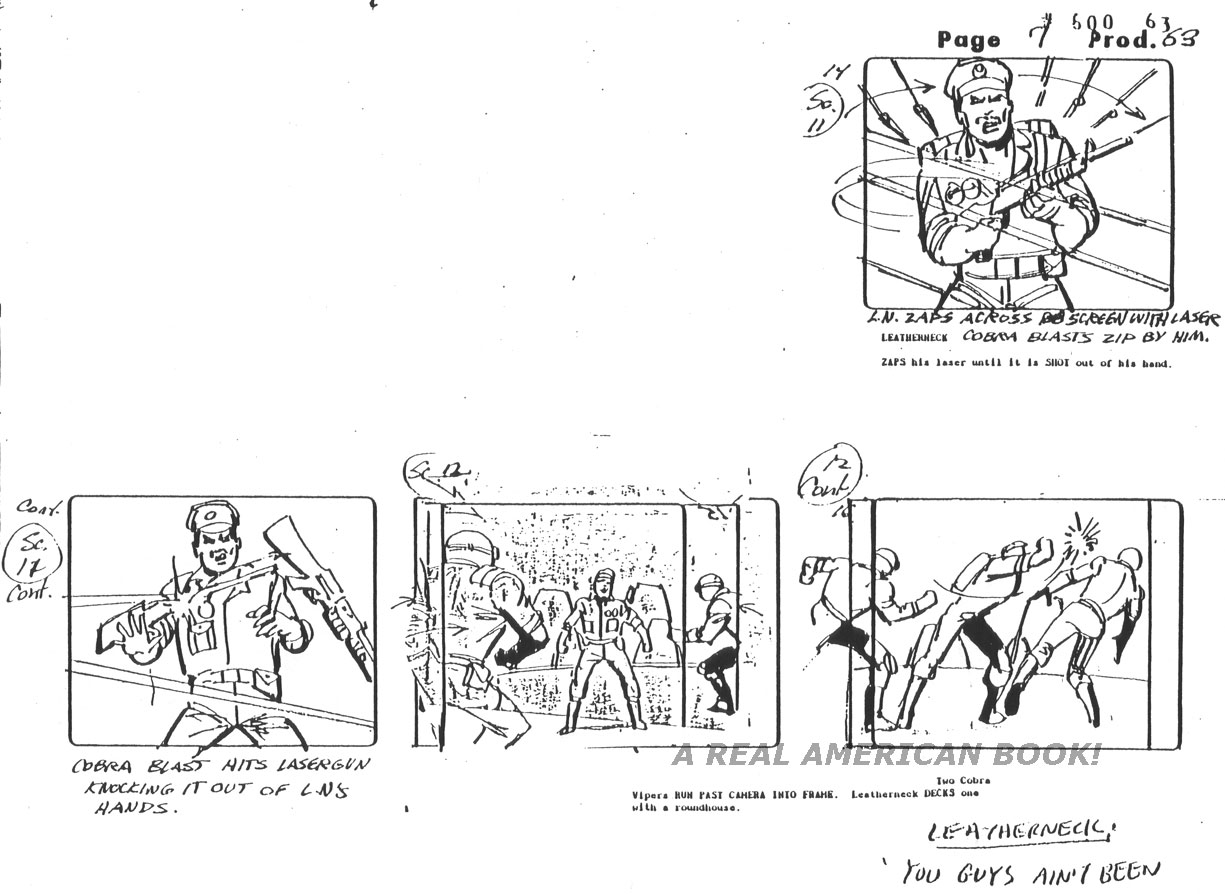
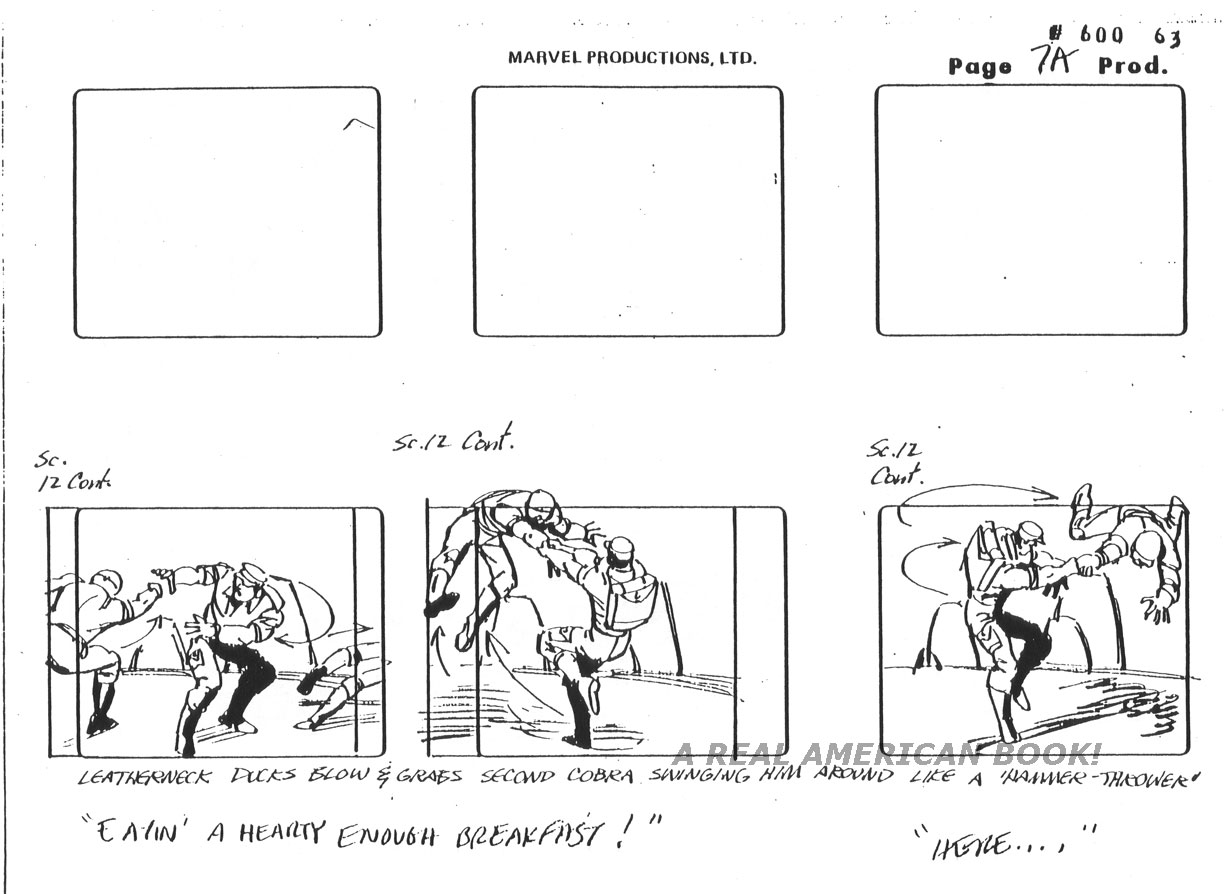
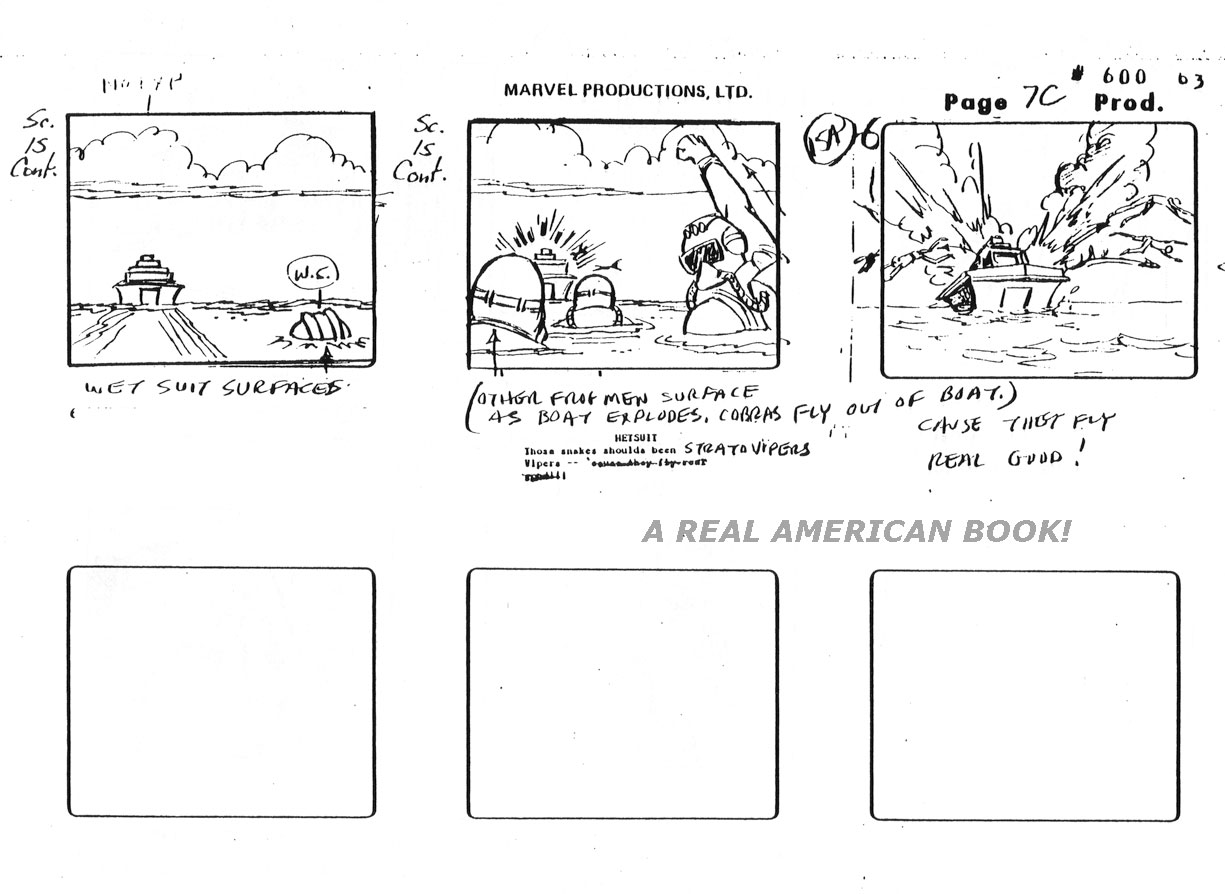
Continuing our look at the Season 2 episode “The Rotten Egg,” here are five more pages of storyboards, page 6, 7, 7A, 7B, and 7C.

Sorry for the lack of posts Friday.
Pages [1-5] [6-7C] [7D-10] [11-15] [16-19]
Continuing our look at the Season 2 episode “The Rotten Egg,” here are five more pages of storyboards, page 6, 7, 7A, 7B, and 7C.
Filed under Animation, G.I. Joe Behind the Scenes

Sorry for the late post. Monday’s supposed to be art day, with Tuesday a reserve should Monday get swamped. Anyway, happy Wednesday!
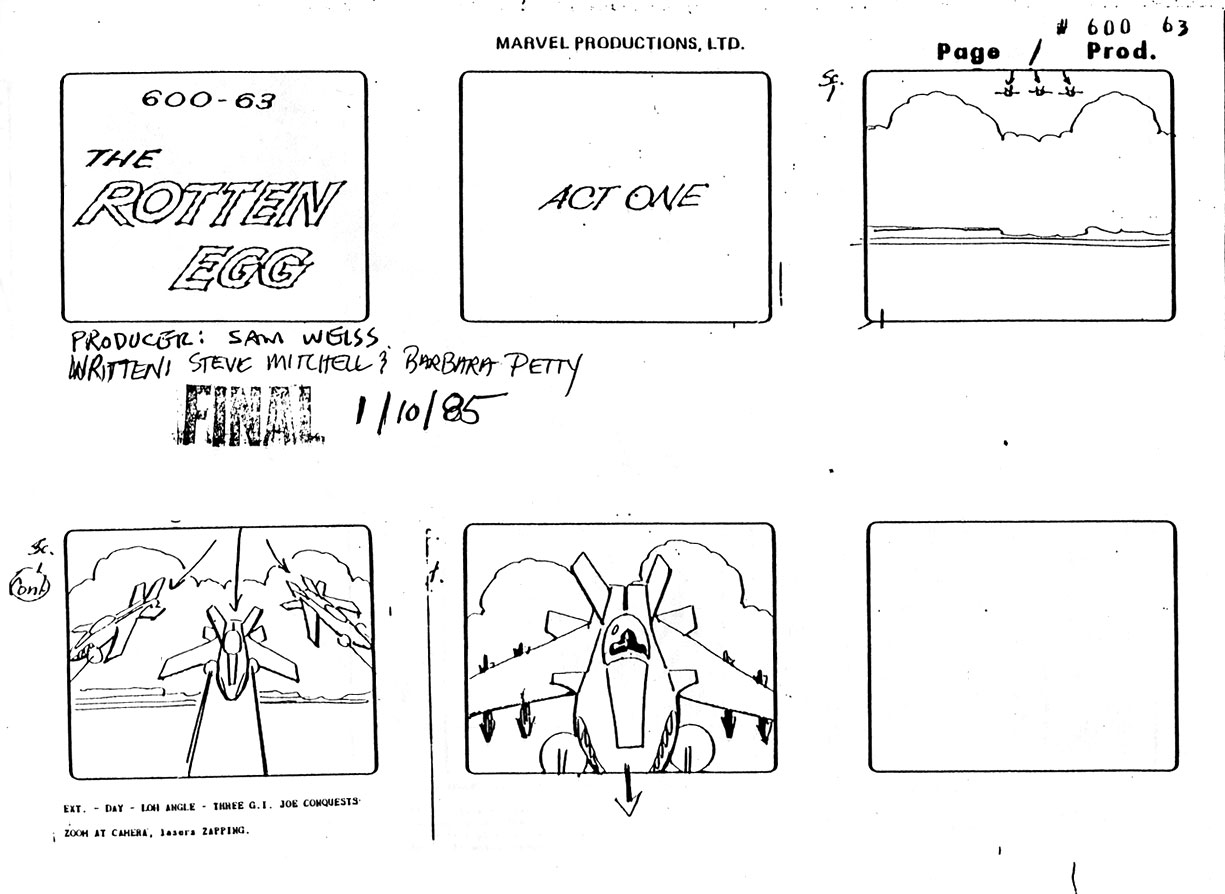
Today we look at the first few pages of storyboards from the Steve Mitchell and Barbara Petty-written season 2 G.I. Joe episode “The Rotten Egg.”
This episode has a great premise, that Leatherneck’s old rival is now running a military academy, and invites him to graduation ceremonies, but the two have a long-standing grudge that comes to a head. Also, Cobra’s peripherally involved. The emotional through-line — that grudge — is tight, and not that you’d know if from this art but voice actor Chuck McCann gives an Emmy-worthy performance as Leatherneck. Dick Gautier, elsewhere heard as Serpentor, is similarly stellar as antagonist Buck McCann — a play on the other actor’s name.
I should know who drew these Act I boards, but I don’t. If I find out, I’ll update this post later.


Filed under Animation, G.I. Joe Behind the Scenes

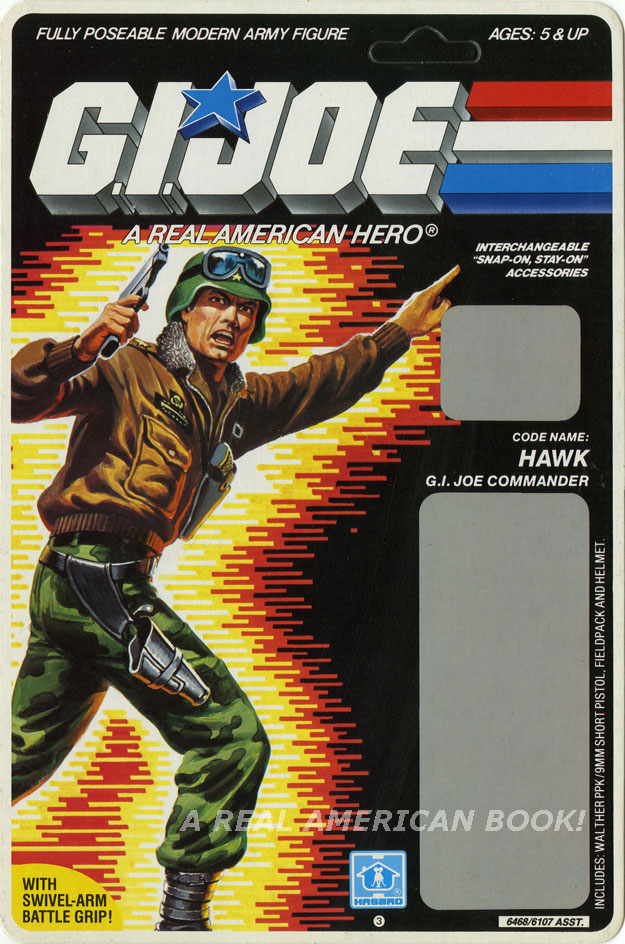
Something simple today: A blister card sample, front and back, for 1986 Hawk. No blister, no figure, no accessories.
I’m attributing the artwork to Hector Garrido.

Filed under G.I. Joe Behind the Scenes, Toys and Toy Art
Today’s art post is the complete sculpt input (i.e. “turnaround”) for the 1988 Hydro-Viper. Again for casual or non-fans, let’s start with a photo (by me, not my fancy book photographer) of the production figure for a baseline comparison.

Here’s George Woodbridge’s turnaround. Such a crisp and clean line, and a deft spotting of blacks.

Note that the figure is referred to as “Cobra Frogman,” so “Hydro-Viper” hadn’t yet cleared Legal.
Woodbridge’s association with G.I. Joe is limited. He drew most of the ’88 inputs, and did many of the Hasbro-internal figure presentation paintings that Dave Dorman and Bart Sears didn’t around 1988. Writer Mark Evanier wrote a short biography of Woodbridge in 2004 when the artist passed away. You can find it here, but if you want a shorter version, I’ll just throw out the terms “Mad Magazine” and “military and historical illustration.” In the near future I’ll show a few more pieces like this here, and in the not-near future I’ll have Woodbridge’s Crazylegs (a Joe paratrooper) color piece in my book.
Here are three sheets of the Hydro-Viper’s accessories, drawn by Bart Sears. In toys, Sears is known for designing Hasbro’s C.O.P.S. In comics, Sears drew Justice League Europe and has recently penciled some Conan and Indiana Jones for Dark Horse. Of note here is the ray, the most bizarre of all animals that any G.I. Joe figure came packaged with.


Filed under G.I. Joe Behind the Scenes, Toys and Toy Art

Endorsed by the National Child Safety Council, a non-profit founded in 1955, the now infamous G.I. Joe public service announcements (PSAs) were created to elevate the series’ profile as an agent for pro-social values and to ward off criticism from parents’ groups that the G.I. Joe cartoon was a) violent and b) a half-hour toy commercial. 35 PSAs were created in all, with topics ranging from not giving in to peer pressure, to nutrition, and to owning up to one’s own mistakes. The format was likely borrowed from Filmation’s 1983 series He-Man and the Masters of the Universe. In that show, at episode’s end a marquee character would directly address the audience and refer to an incident from the proceeding episode. The Joe ones were different, working both in “regular” continuity wherein the Joes spoke to kids in-scene, and not the television audience, but also a kind of parallel universe where the Joes were always near suburban danger and utterly lacking in top secret status.
For Footloose’s rapid-fire instructions, PSA #10 is one of my favorites — there’s no way I’d remember what to do in my own soccer crisis unless I had a transcript handy. Also, this is perhaps one of three incidents in all of G.I. Joe animation 1983 to 2000 where the animators showed blood. I appreciate the added dash of seriousness.
Here’s the storyboard for PSA #10. I should know who drew this, but don’t. I’ll check my sources and update this post when I can.
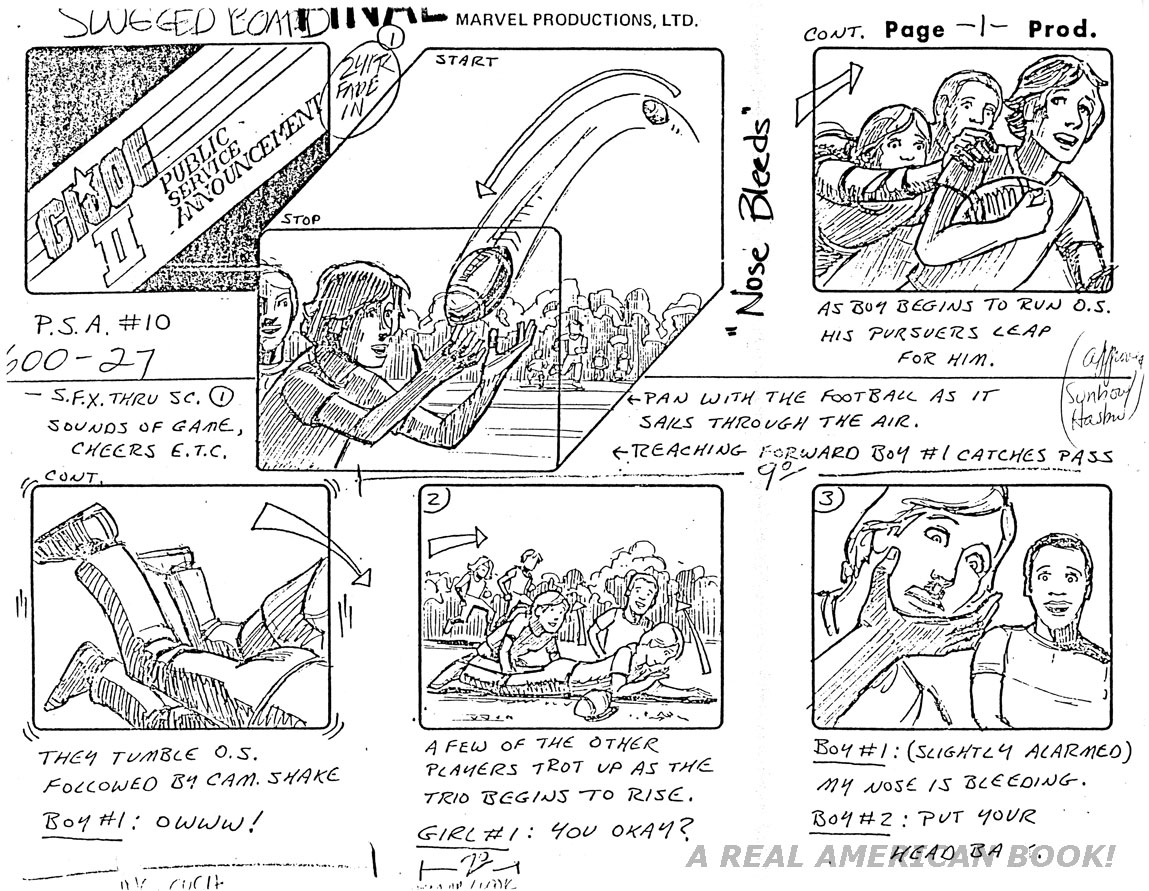

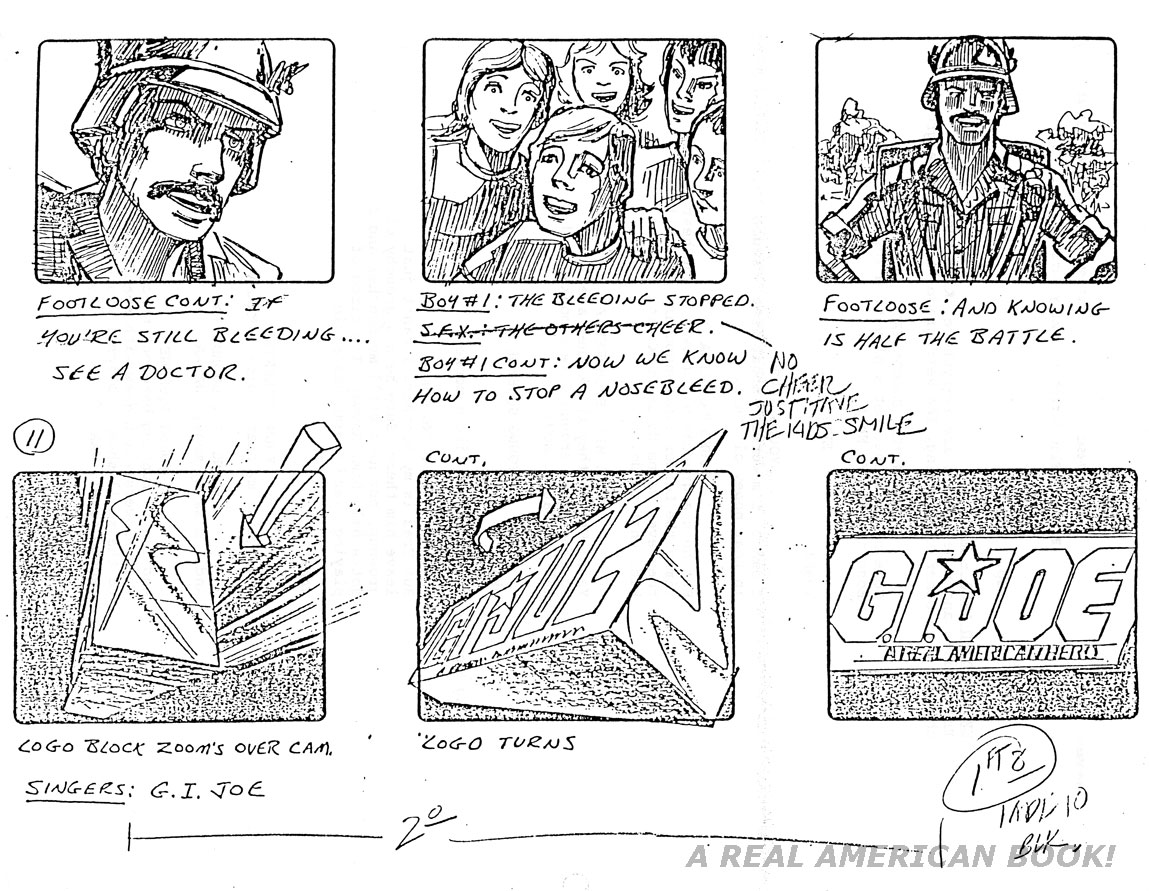
For those unfamiliar with storyboard formatting, here are a few items of note:
-The second panel — the stretched out one — represents a camera move.
-The numbers under the panels represent length of footage in feet and frames. Old school film editing (and animating) was measured not in seconds/frames, but in feet/frames, with a foot being the physical length of 16 frames of film, and a frame lasting 1/24th of a second. So where it says “SLUGGED BOARD” at the top left of page one, the board artist has timed out to the audio track each shot’s duration, or is providing a time table for the animators to show how long each shot should last.
As a special thank you, I’d like to acknowlege YouTube user PSAGIJoe, who has uploaded the original, non-satirized PSAs. You can find them here.
Filed under Animation, G.I. Joe Behind the Scenes
Today’s post reveals some development artwork for the 1990 Cobra Rock-Viper. First, a not-great photo by me of the production toy to serve as a baseline for all you casual fans.

Interesting to note this Cobra soldier, of which there were many (rather than a specific individual like Destro or Gristle) has a moustache. So I guess graduates from training school had a facial hair requirement?
First up is Dave Hasle’s sculpt input drawing for the Rock-Viper’s backpack:

A black and white photocopy (probably of a color photocopy and not a chrome) of Dave Dorman’s internal presentation painting:

Note above and below there’s no moustache. Here’s the pencil sketch of what will become the final package painting. I’m attributing this to Hector Garrido:

Here’s the almost complete layout of the cart front and back, in b+w photocopy form, with Garrido’s drawing now a finished painting:

I don’t have a color copy of the painting or a full blister card (any readers want to help?) so this cropped close-up from my dossier and the tiny back-of-package thumbnail of Garrido’s final painting will have to do for comparison.

If you didn’t read this above, check it out here. Dossier writer Larry Hama’s sense of humor on display.

Filed under G.I. Joe Behind the Scenes, Toys and Toy Art
Today’s art peak brings you several photocopies of Russ Heath’s model sheets for the 1985 season of the animated G.I. Joe. While the Snake-Eyes action figure was iconically all black, the TV series had previously shown him in dark blue. (All black doesn’t “read” well in animation.) For 1985, SE went dark grey, which to my eye reads better than the dark blue and works better as a stand-in for black since dark blue is already associated with Cobra. Russ Heath’s front view:

Clearly based, as many of his drawings were, on Hasbro’s internal presentation artwork:
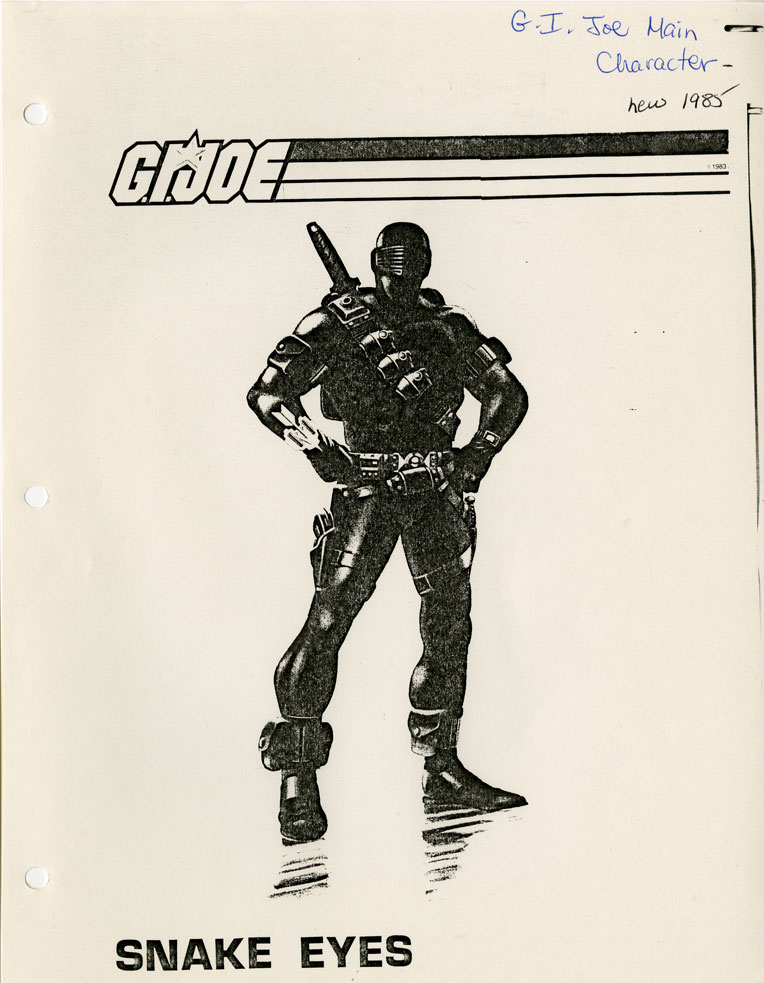
This one, a black and white photocopy, doesn’t have a signature, and I’ll admit I don’t know who painted it. To my eye it’s not Ron Rudat — the proportions and clothing folds don’t match with work that I know is Rudat. The anatomy is tight, which says George Woodbridge, but his Joe work was colored and black ink, not rendered paintings. Maybe one of you eagle eyed Joe collectors can correct me in the comments. There is a slightly better reproduction of this image, still a black and white photocopy of a color photocopy, though, in Vincent Santelmo’s Official 30th Anniversary Salute to G.I. Joe.
Two more views by Heath:

And SE’s undercover disguise, drawn by Bruce Timm, from the beginning of “Battle for the Train of Gold.” To give you a sense of the timeline, this was drawn in August 1984, and the episode aired 14 months later.

And what appears to be an unused alternate from same.

I’m not sure where in the storyline of “Train” there would have been an opportunity for SE to wear this, but there is a horse farm in act 3, so who knows?
Filed under Animation, G.I. Joe Behind the Scenes
It’s Monday or Tuesday, which means another preview of rare, lost, and never-seen art from the making of G.I. Joe 1980-2000 to whet your appetites for my book. Today’s image is a 1994 Kurt Groen pencil and marker drawing of a proposed X-Soldier.

Very little is publicly known about X-Soldiers. It’s telling that they are neither mentioned nor pictured at the encyclopedic yojoe.com. I don’t say that as a swipe against the site as I love it and have referred to it weekly for the past six years of writing my book. Just that the line, unlike many other unproduced Joes, hasn’t been widely seen or discussed. Google searches yield almost nothing.

But print offers a succinct explanation: According to G. Wayne Miller’s Toy Wars, “[Kirk] Bozigian’s biggest setback had been X-Soldiers. Shown prototypes, boys in focus groups had been disinterested. The concept needed work, and the line was unlikely to reach market before the summer of 1996, if then.” (pg 185)
A line of traditional super-heroes that would battle for and with G.I. Joe, and each figure would have had an action feature. Seven X-Soldier characters are known to exist as color marker illustrations.
Filed under G.I. Joe Behind the Scenes, Toys and Toy Art
My book can’t contain all the sketches, drawings, paintings, designs, photos, and layouts that went into making even a single G.I. Joe toy product. But what it aims to do is present a juicy slice of that material, much of it never seen publicly, and to put it in context. Today’s image has been seen publicly, posted at HissTank two years back, but as a slightly fuzzy, cropped photo rather than a crisp scan. So today I present to you Dave Dorman’s stunning 1986 presentation painting for the 1987 Cobra Ice Viper figure.


Dorman is best known for his Star Wars book and comic book cover art, but was freelancing for Hasbro in the mid-1980s. In addition to these internal presentation paintings — a different category than the painted art seen on the final G.I. Joe toy packaging — Dorman also did covers for the Lorimar-published G.I. Joe Magazine that ran from ’87 to ’88. A recent coffee table book published by Desperado through IDW, Rolling Thunder: The Art of Dave Dorman, features a few pages of G.I. Joe art.
Filed under G.I. Joe Behind the Scenes, Toys and Toy Art


 A Real American Book!