Russ Heath – Primord Chief

Russ Heath original art detail G.I. Joe "Satellite Down" Primord Lord

In this Ted Pedersen-written episode of G.I. Joe from 1985, “Satellite Down,” the Joes track a lost satellite to somewhere in an “unexplored region” of Africa.  There they meet a tribe of primitives called Primords, who worship the satellite as a god.  And Storm Shadow and Spirit fight!

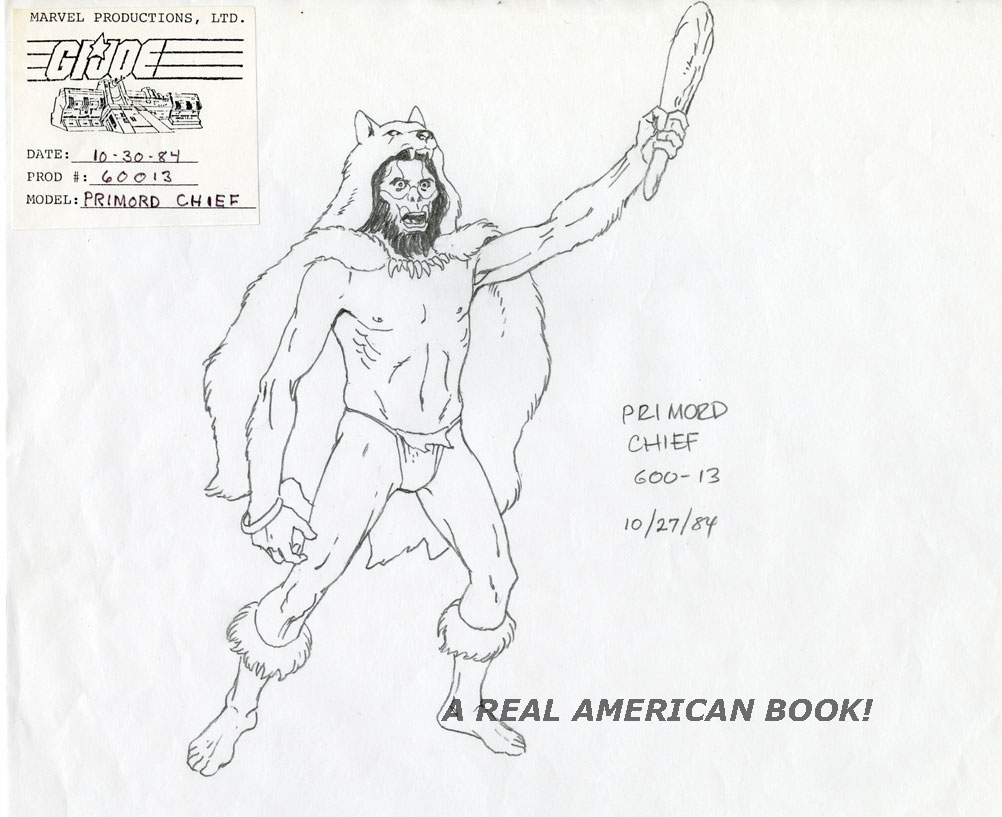
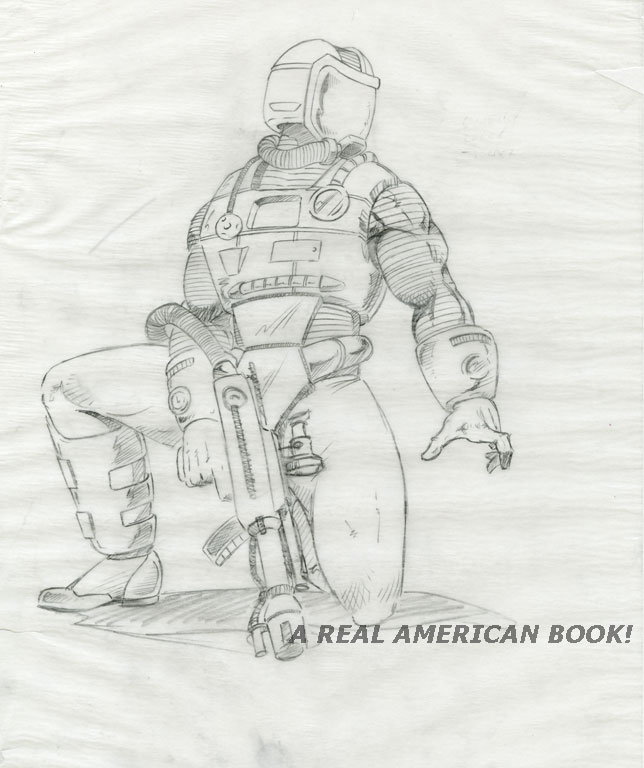
Here’s Russ Heath’s original artwork (pencil on animation bond — I cropped out the punch holes) for one version, unused in the episode, for the Primord Chief.

Russ Heath original art G.I. Joe "Satellite Down" Primord Lord

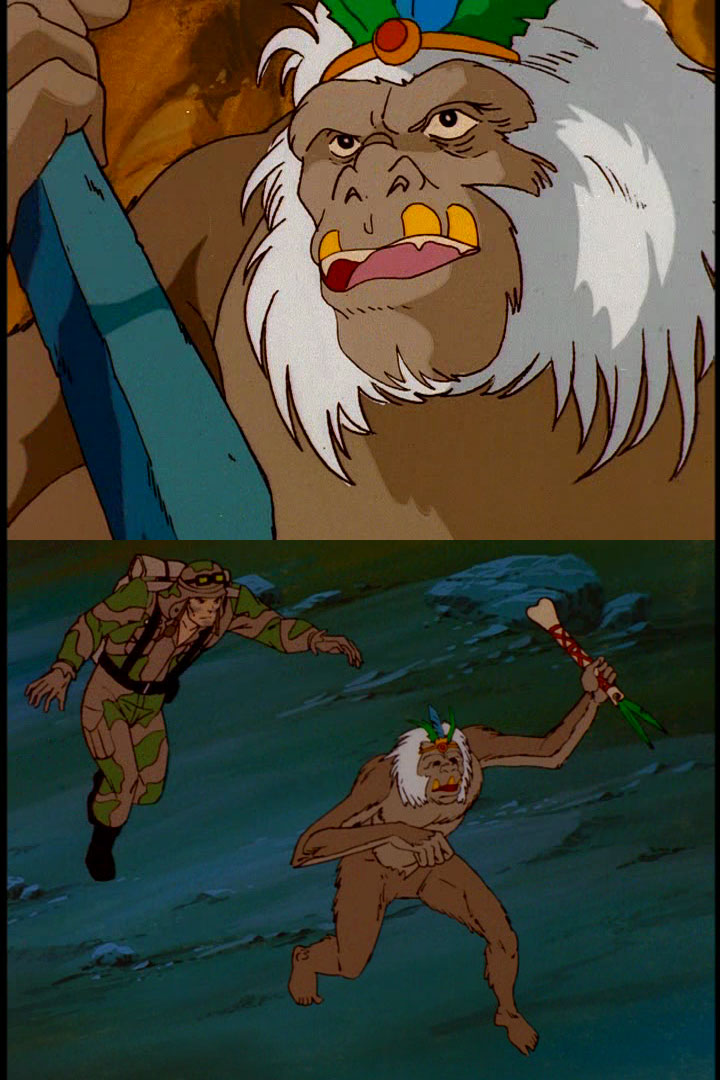
The final design differs greatly from this drawing.  In the episode, the chief is covered in body hair, has no loincloth, hood, or cape, and less face paint.
G.I. Joe "Satellite Down" screencap Primord Lord

Leave a comment

Filed under Animation, G.I. Joe Behind the Scenes

The Comic That Changed Everything – Part 13

Punisher War Journal issue 19 detail by Jim Lee and Klaus Janson

Part 1[2] [3] [4][5][6][7][8][9][10][11][12] – [13]

In our last episode, Tim went on a tangent from describing buying G.I. Joe comics and this week the tangent expands!

The title of this series of articles refers to G.I. Joe issue #90, and how scanning just a few pages kicked off a sequence of events that turned me from a G.I. Joe fan who liked reading into a comic book collector/reader for life.  And how one issue of G.I. Joe became the next one, and then the older ones, and all the newest ones, and then The ‘Nam.

But something had to bridge my brother and I into the Marvel Universe proper, since Joe and The ‘Nam were both in their own universes.  Kevin and I didn’t know anything about super-heroes, which is what most of Marvel and DC Comics publish.  To put this in context, it’s important to remember than in the 1980s, super-heroes had no cultural footprint.  My 2nd grade sticker album had a Colossus sticker (from a junk store or a birthday party favor), but I had no idea who he was.  The Superman films crashed and burned with the embarrassing Quest For PeaceThe Incredible Hulk was relegated to a few made-for-TV movies that were more dramatic than super-heroic.  The 1966 Batman TV series showed up in reruns some summers, but it had little effect on us.  Spider-Man and his Amazing Friends was over, and we hadn’t ever watched it anyway.  I didn’t pay attention to the Amazing Spider-Man newspaper strip, but if I did I would have noticed how little happens.  This is still a decade and a half before Marvel’s live-action films, starting with Blade and X-Men, shook up Hollywood.  It’s still years before Fox’s Spider-Man cartoon, Fox’s Batman: The Animated Series, and any live-action Batman sequels.

So rather than super-heroes plural, we only had a sense of Batman.  Certainly the Batmania of 1989 was enough for our pop culture appetite, but in terms of comic books, there was no entry point.  Whatever was needed to get us into DC Comics hadn’t happened yet.  But in the pages of G.I. Joe and The ‘Nam were checklists and ads for other Marvel books.  And the Marvel logo on the top left corner was familiar, so if we were to try out something super-heroic, it would likely be Marvel.  So as 6th grade was winding down, a full year after we started G.I. Joe, Kevin led the way into the Marvel Universe, tugged by the giant gun and overwhelming coolness of this:

Punisher War Journal issue 19 cover by Jim Lee and Klaus Janson

And what a perfect entre.  The Punisher isn’t a super-hero, but he interacts with them.  As a Vietnam vet, Frank Castle was the bridge to the other two comics we read – one about Vietnam and the other with occasional flashbacks to it.  And again, we were boys who liked guns.  The Punisher may get slammed or ignored for being a one-note vigilante book, but that’s an unfair judgment.  Even the stories lacking pathos are exciting action tales, and a handful of stories from the 1980s – notably Grant and Zeck’s “Circle of Blood” and the odd Mike Baron yarn – are smart and compelling.  And to my surprise, Garth Ennis’ 2004-2008 run on the character comprises some of the most satisfying comics I’ve ever read.  (But they’re bloody and grim, and not for everyone.)

A month after Punisher War Journal #19, we picked up (the regular) Punisher with issue #35, which happened to be the start of a 6-part, biweekly-shipping story arc.  Two months later, we took the super-hero plunge with Uncanny X-Men #268.  (Which doesn’t modestly flaunt super-powers since the three spotlight characters in this one issue don’t fly or shoot eye beams.)  Another two months later it was Daredevil, with issue 286.  Again, another grounded hero.  While Matt Murdock does have enhanced senses, he doesn’t fly and he doesn’t shoot eye beams, and his costume is as restrained as super-hero tights go.  And even if he had been over the top, we were primed by now.  Somewhere in there was Wolverine #24 as well, a character a friend in school had talked up. (And written a paper about.)

I don’t want to overdo it on this street-level, depowered bit.  Super-heroes with fantastic powers could well have grabbed us earlier, and we would likely have accepted it.  Sci-fi and fantasy were a-okay in ours books.  I loved Transformers and Tron, Kevin was getting into Dungeons and Dragons, and we both liked the animated G.I. Joe: The Movie, even with its 40,000 year-old Himalayan snake man who wants to conquer Earth.  Make that re-conquer Earth.  But the path is worth noting, that we didn’t jump into super-heroes immediately.  It probably says more about culture than us.  Had we been born five years later we’d probably have been watching Ninja Turtles and Power Rangers instead of reading the black and white Turtles book and ignoring Power Rangers.

During that first year, while purchasing only 6 monthly comic book series our collection went from one comic book to more than fifty.  You’ve already read about that first mail order shipment, but what was different about the next one?  Tune in next week to find out!

Part 1[2] [3] [4][5][6][7][8][9][10][11][12] – [13]

Leave a comment

Filed under Prehistory, Reading comics

Charbroil presentation painting

Bart Sears G.I. Joe Charbroil presentation painting detail photocopy

To comics fans, Bart Sears means Justice League Europe, C.O.P.S., his “Brute and Babe” column for Wizard Magazine, Turok, X-O Manowar, Spider-Woman, and more recently a Legends of the Dark Knight double-sized issue and some Indiana Jones work.  Sears was also at Hasbro in the late ’80s.  There he briefly worked on G.I. Joe, and designed the company’s C.O.P.S. line.  Here’s his presentation painting, seen internally and not part of any package design, for Charbroil.  Unfortunately it’s a color photocopy, so it’s much contrastier than the original artwork.

Bart Sears G.I. Joe Charbroil presentation painting photocopy

Leave a comment

Filed under G.I. Joe Behind the Scenes, Toys and Toy Art

The Comic That Changed Everything – Part Twelve

The 'Nam issue 36 cover detail by Wayne Vansant

Part 1[2] [3] [4][5][6][7][8][9][10][11] – Twelve

In our last episode, Tim and his brother Kevin are interested in Vietnam, and have started reading comic books!

Marvel published a monthly series called The ‘Nam.  I didn’t really know what that was, but I could put two and two together:  The title design was a military stencil font, those three letters looked like the end of the word “Vietnam,” and there were Army guys in green on the covers.  While comic books starring super-heroes were grabbing some attention from Waldenbooks’ two spinner racks at our local mall, we hadn’t made that jump yet.  G.I. Joe was “realistic” in a way Uncanny X-Men (whatever that was!) was not, so if we were going to start reading a second comic book (third, counting our truncated following of Joe’s spin-off book G.I. Joe Special Missions), it needed to be similarly grounded.  I had been flipping through this ‘Nam comic for two months now.  Issue #36 had had a particularly compelling cover:

The 'Nam issue 36 cover by Wayne Vansant

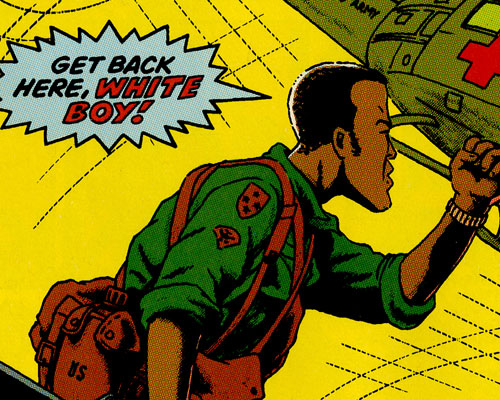
I hadn’t experienced any racism in my life, but I knew what it was.  A friend of the family had been singled out a few times, and in grade school we talked about the Reverend Dr. Martin Luther King, Jr. every January.  There we even had a short play about mean parents not letting their kids befriend kids of other races that we performed each year.  And the nation’s capital was the next city over, so the 1963 March on Washington was referenced on local TV news and in the pages of the Washington Post probably a tad more than in the, say, Los Angeles or Anchorage media.  And as much as racism was a real topic that we talked about in history class, it wasn’t anything anyone talked about in any day-to-day fashion.  There was a heaviness to it, as if it was taboo.  So to see it a) on the cover of a comic book, and b) on the cover of a war comic, was surprising to me, a white suburban 6th grader.  The ‘Nam #36 was on-sale the same month Kevin and I got back from summer camp and bought G.I. Joe #92, our second real issue of that series, so we hadn’t passed the tipping point — we were still only buying a G.I. Joe comic book, not just any comic.  But by the time issue The ‘Nam #38 came out two months later, we had 20 or so comic books, and this cover was most compelling.  (If a little lurid for what was an otherwise tastefully done book.)

The 'Nam issue 38 cover by Mark Texeira

This moment, buying The ‘Nam (in what I believe was the last week of) the first month of 6th grade was the tipping point.  This is where Kevin and I went from enjoying more G.I. Joe stories than we could get from just the TV cartoon to becoming regular and devoted comic book readers; When we started buying a second, regular, monthly comic book series.  (So by a certain definition, it’s The ‘Nam #38 that was “The Comic That Changed Everything,” rather than G.I. Joe #90.)

This title, because of its higher quality paper stock, color separations, and limited distribution, was pricier than G.I. Joe.  It was $1.75 rather than a mere dollar.  But the dam was starting to burst.  Kevin and I just liked comics.  We liked stories, we liked art, we liked reading.  With this purchase it would no longer be confined to G.I. Joe stories, G.I. Joe art, G.I. Joe reading.  So I bought this issue of The ‘Nam, and tried to read it on the way home (but I get lightly car sick if I read, so I gave up after a page or two).  At home I discovered it’s a great comic.

Before I could buy the next one, however, I bought my first graphic novel.  Long before DC had any kind of backlist, back when Marvel had only published about fifteen trade paperback collections of famous runs of comic books and didn’t really know what they were doing (as evidenced by the ISBN number ending up on the spine of Marvel’s 1989 The Power of Iron Man and other cutely poor editorial and design choices), Marvel did have three modestly-priced graphic novels reprinting the first twelve issues of The ‘Nam.

The 'Nam TPB covers by Michael Golden

Next to the two spinner racks of individual comic books, Walden had a larger spinner rack of graphic novels (whatever those were!).  That included the second and third ‘Nam books, and for whatever reason, I found the cover of the third one the more compelling.  After hovering around for a few weeks, I bought it.  Excellent art, tight scripting, compelling characters, and the shocking death of a major character.  Regular readers had known him for nine months.  I’d only known him for twenty pages and yet it was an affecting surprise.  And soon I bought the other graphic novel, and then issue 39, and 40, and somewhere the first volume, and then we were regular readers, meaning we now collected a second comic book monthly besides G.I. Joe.

But to be honest,  besides all this grand talk of pathos, characters, and dramatic tension, my brother and I were still just boys who liked guns.  G.I. Joe and The ‘Nam had those in spades.  So it was only natural that the next comic book title we tried out was replete with fire arms as well.

And what Marvel series in 1989 was all about guns?  Tune in next week to find out!

Part 1[2] [3] [4][5][6][7][8][9][10][11] – Twelve

Leave a comment

Filed under Prehistory, Reading comics

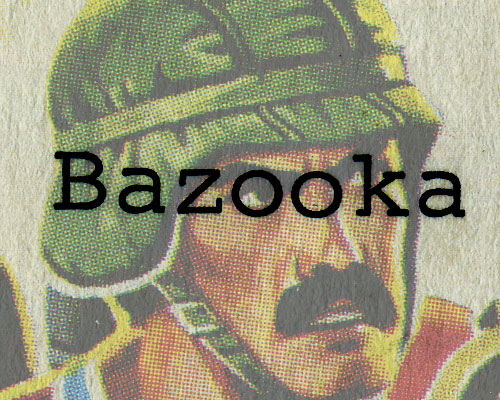
Bazooka original dossier by Larry Hama

G.I. Joe Bazooka 1985 dossier Larry Hama teaseYou’ve probably seen this:

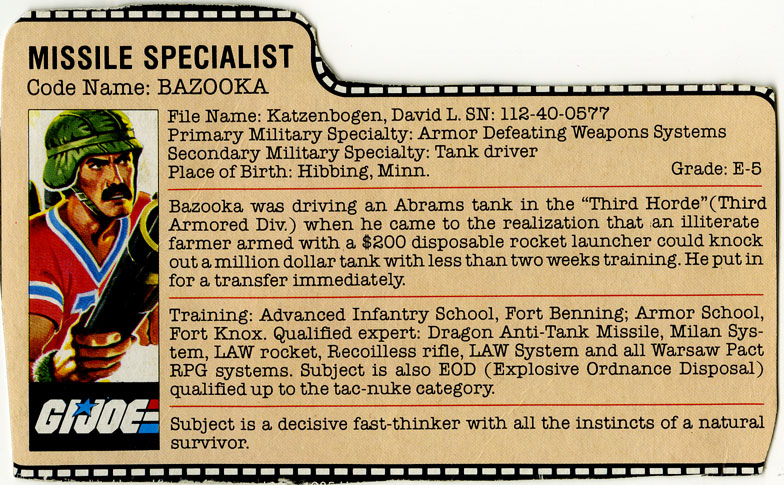
G.I. Joe Bazooka 1985 cardback dossier by Larry Hama It’s Bazooka’s 1985 toy cardback dossier, or “command file,” to use the official term.  Many fans know Larry Hama wrote these, so in addition to the monthly adventures from Marvel Comics, Hama was also influencing the Hasbro toys.  But before computers and the internet and .doc files and e-mail attachments, Hama’s originals would have been typewritten and faxed from New York to Pawtucket.  So you may not have seen this:

G.I. Joe Bazooka 1985 cardback original dossier by Larry Hama

You can even see the correction fluid.  (Certain typewriters had a second ribbon in white for fixing typos, many did not.)  This dossier is particularly interesting for Hama’s comment on outdated gear, and has his customary codename suggestions for Hasbro Legal to check.

4 Comments

Filed under Behind the Scenes, G.I. Joe Behind the Scenes, Toys and Toy Art

The Comic That Changed Everything – Part Eleven

G.I. Joe issue 94 panel Snake-Eyes Vietnam flashback by Bright and Emberlin

Part 1[2] [3] [4][5][6][7][8][9][10] – Eleven

In our last episode, Tim and his brother Kevin bought G.I. Joe issue #94!

Part one of the NINJA COMMANDO’s spotlight reveals more about Snake-Eyes’ origin, and how he first crossed paths with the Baroness, and why she holds a grudge.  (Played out in general that she’s on the Cobra side and he’s a Joe, and specifically that she goes after him in Switzerland while he’s anesthetized.)  The flashback is Saigon, 1968.  And Vietnam was of interest for me.  Why?

My father subscribed to several military magazines, and those sat on our coffee table next to hardcover books on jets, and near novels and histories like God is My Co-Pilot, Thirty Seconds Over Tokyo, and Time Life’s WWII set.  And while Dad was more interested in The Second World War than Vietnam, the latter was still fresh on the minds of many Americans.  Saigon fell just two months after my brother was born.  The Vietnam Veteran’s Memorial, “The Wall,” was dedicated the same year Real American Hero debuted.  And President Reagan’s rebuilding of the Armed Forces was still palpable.  Mom worked for Senator Dodd.  Dad worked for NASA.  Neither of those related to Vietnam, the place or the war, but as an “inside the Beltway” family the TV news was on every night for two hours, so though we didn’t have anyone in the family serving in the military, we were aware of it.

The Vietnam War, or I guess The Vietnam Conflict, since America still doesn’t technically consider it a war (if my 12th grade history serves me), was recent.  Americans were coming to terms with it.  College classes were now being taught on it.  Stone’s Platoon and Kubrick’s Full Metal Jacket were earning box office dollars and winning accolades.  At the same time, CBS was running a great TV series called Tour of Duty.  This show only lasted for three years, and had the unfortunate timeslot of Saturdays at 10pm.  (Not quite the kiss of death that it would be now, but still not great.)  (This meant I would watch “The Golden Girls” with my mom at 8, Tour of Duty at 10 with my brother and father, and PBS’s broadcast of the BBC Robin Hood at 11.  [Yes, I watched The Golden Girls because it was a well-written, well-acted, funny show.]

Tour of Duty was an hour long drama about the regular soldiers of Company B serving in Vietnam.  Season 1 was filmed in Hawaii, so it looked great, and benefited from writing that portrayed the ups and downs, and the shades of grey the average Army grunt experienced in country.  That this show came along when G.I. Joe was in full bloom, combined with my brother and father’s interest in war history and military armament, was a coincidence.  But it only enhanced our appreciation of the military themes in G.I. Joe.

The show lasted three years, and was about as gritty as the accepted standards of the time.  It was violent, but not overly so, and the violence was tastefully done.  This was before TV ratings, back when a “Parental Discretion is Advised” disclaimer was rare, and a big deal.  (The show didn’t have it.  ABC’s 1989 broadcast of Robocop did, for comparison.  And that was quite edited from the theatrical cut.)  More importantly, Tour of Duty dealt with racism, ethnic divisions, moral ambiguity and the fog of war, and the hopelessness of the day-in, day-out slog.  It, like G.I. Joe, was told from the grunt’s point of view.  There were no cutaways to the White House, the Pentagon, or the Paris Peace Talks.

So with all this swirling around in the cultural ether — TV shows and movies and government — it was quite exciting when Marvel’s G.I. Joe veered into Vietnam via flashback.

Moreso, those three months of checking the spinner racks at the Montgomery Mall Waldenbooks, where we went from G.I. Joe issues 90 to 92, and then to 94, offered something even more focused:  An entire comic book series about Vietnam.

What was it called?  Tune in next week to find out!

Part 1[2] [3] [4][5][6][7][8][9][10] – Eleven

Leave a comment

Filed under Prehistory

Toxo-Viper v2 presentation sketch and comp

Detail of Kurt Groen 1991 Toxo-Viper v2 color comp

In 1986 Hasbro revised the generic Cobra Soldier, the anonymous man in a dark blue cloth uniform, as the Cobra Viper.  The basic Viper is far from basic.  He has knee-high books, a beefy backpack, body armor, a bigger machine gun, and a silvery face mask that resembles Cobra Commander’s.  In every way the Viper is more aggressive and cooler than the 1982 Cobra Soldier.  A brilliant idea that followed a year later was to use the name “Viper” as a base, and connect it to a variety of prefixes that denote specific types of Cobra troopers — Strato-Vipers are pilots, Frag-Vipers are grenade-lobbing specialists, Astro-Vipers are, um, astronauts.  And on.

1988 saw a strange debut:  Toxo-Viper.  (Click that link for a photo in a new window.)  The garish color scheme and alien-looking helmet were seemingly not a good fit for G.I. Joe, but the concept, a soldier suited for hostile environments (fuel spills, chemical weapons) was sound.  And the Toxo-Viper had a counterpart on G.I. Joe, the 1985 figure Airtight.  In 1991, with environmental awareness on the rise, Hasbro introduced an entire sub-line of toxic waste spreaders and fighters, the extra garish Eco-Warriors.  Toxo-Viper got a redesign:

Kurt Groen 1991 Toxo-Viper v2 pencil artKurt Groen 1991 Toxo-Viper v2 color sketch

The above pencil art and marker art are by figure designer Kurt Groen.  Here’s a detail, color added in marker to a photocopy of the pencil art:

Kurt Groen 1991 Toxo-Viper v2 color sketch detail

The next step would have been a larger, slightly more polished marker drawing.

I’ve always found the Toxo-Viper version 2 to be oddly restrained compared to version 1.  Waist-down it’s underdetailed and undersculpted, and the helmet is much less interesting, (although at least it doesn’t look like an alien).  I suppose time and money were diverted to version 2’s water-shooting canon and color-change feature.  I’ve never owned this figure, so I don’t have one to photograph, but here’s a picture at yojoe.

Leave a comment

Filed under G.I. Joe Behind the Scenes, Toys and Toy Art

The Comic That Changed Everything – Part Ten

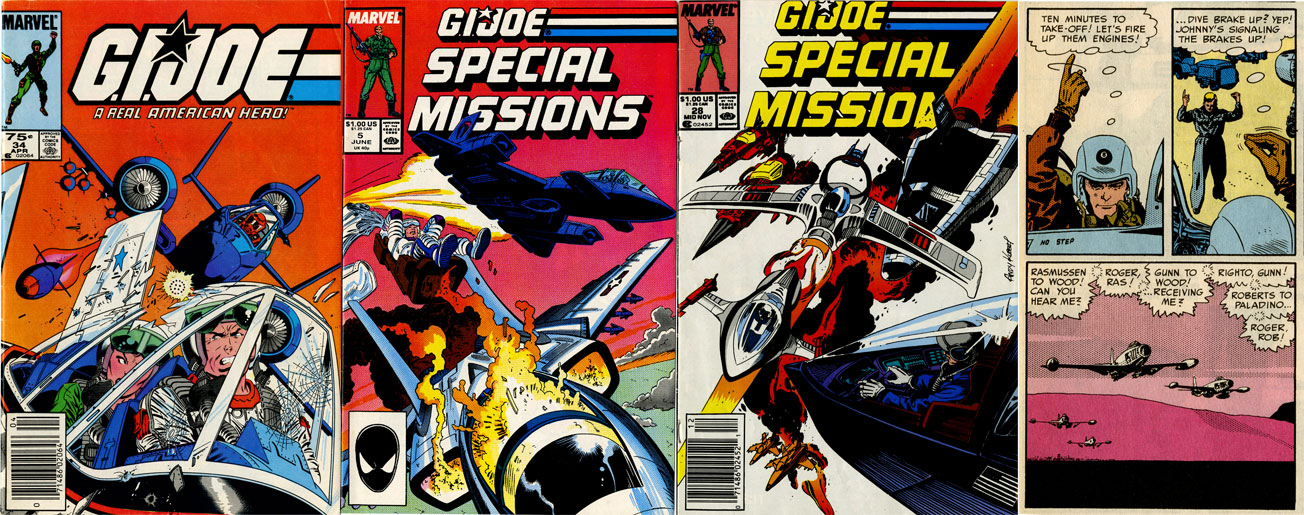
Detail of Andy Kubert's cover to "G.I. Joe Special Missions" issue 28

Part 1[2] [3] [4][5][6][7][8][9] – Ten

In our last episode, Tim and his brother Kevin bought G.I. Joe issue #94! 

Before I get too far into the Snake-Eyes Trilogy, I want to take a step back one month and sideways.  Marvel’s G.I. Joe had a spin-off, G.I. Joe Special Missions.  And Kevin and I showed up just in time to catch the final issue.

By 1986, writing G.I. Joe offered a certain challenge for scribe Larry Hama.  Every year, Hasbro delivered to him 20 new characters, but the monthly series already had plenty.  (Not to mention the vehicles, which may have lacked dialogue, but still netted starring roles, like all the attention paid to the Skystriker and Rattler jets in issue #34, “Shake Down!”)  Marvel had already solved the problem of having too many X-Men characters by starting a second X-Men title in 1982, the monthly New Mutants.  I don’t know whose idea it was – someone in Marvel Editorial, Marvel Sales, someone at Hasbro, kids writing in letters, Hama himself, or some combination, but G.I. Joe and Marvel’s coffers could use a similar expansion.

The double-sized G.I. Joe issue #50 featured a back-up tale of five Joes stopping a jetliner hostage situation, and two months later, G.I. Joe Special Missions debuted as its own bi-monthly series.  (It went monthly in ’88.)  Special Missions spotlighted Joes that didn’t appear in the regular series, and was all self-contained, single-issue stories.  Cobra appeared, but the serial drama of G.I. Joe was side-stepped in favor of discrete 22-page narratives of overseas missions, backstabbing, and another hostage situation or two.

And this is a striking book.  Artist Herb Trimpe drew almost every issue, and for its tightly written narratives, fast pacing, and crafty twists, it’s actually my desert island comic.  While I’ve gone on at length about the merits of G.I. Joe, if I could only take one run of comic books with me on a permanent tropical exile, it would be the 28 issues of G.I. Joe Special Missions.  While I love what Hama can do with a cliffhanger, and weaving threads together and apart over time, he’s at his best with finite sagas.  (Going back to G.I. Joe #34, for example:  It’s a self-contained story starring only 4 people and two jets, yet it doesn’t feel confined by 22-pages.  It’s about fighting to live, honor, and the larger canvas of conflict reduced to a tiny scale, all told as a light adventure tale.  Imagine 27 more comics like that and you have G.I. Joe Special Missions.)

In August of 1990, my father, mother, brother and I were headed to New York from Maryland to visit my paternal grandmother.  (According to my calendar, this was right around when we went to the beach and found issue #93, although the two memories don’t “feel” chronologically close.)  Near the Bethesda subway stop, our local Jerry’s Subs and Pizza, and one of the city’s three major intersections sat a Crown Books and a Dart Drug.  I don’t know if the bookstore carried comics — I’d guess no – but it turns out that the drugstore did.  Near the cashiers was a low, light grey rack of magazines, puzzle books, and possibly other comics.

Please remember at this point, Kevin and I only collect G.I. Joe.  We haven’t yet moved on to other comic book series.  (That’s one month away, and the topic for next week’s blog post.)  While we’re not quite leery of other series, G.I. Joe makes sense, and our money is committed to action figures, LEGO, and the occasional radio controlled dune buggy.  But if there’s a comic book that reads “G.I. JOE SOMETHING SOMETHING” on it, that’s not a big stretch.

There on that low, light grey rack was G.I. Joe Special Missions issue #28.  Big, yellow block letters.  White background.  And tantalizingly, several vehicles we hadn’t yet seen in that one comic book we did read:  The Cobra Stiletto, the Cobra Condor Z25, the G.I. Joe Defiant (or was it the Crusader?), and what kind of looked like the G.I. Joe Phantom X-19.  And notably, no people.  Again, the kind of cover you’d never see on Superman, Batman, or X-Men.  This was just tanks and jeeps and planes.  Or in this case, just planes.  And like G.I. Joe issue #90 three months earlier, it was just a dollar.  I bought it, or perhaps convinced my dad to buy it for me since I’d be reading it on a car ride and parents are suckers.  And while Kevin had initially advised against buying #90, he was onboard this time.

G.I. Joe/Frontline Combat art by Zeck, Trimpe, and Toth

Special Missions #28 is a great read.  (If you want to learn how to write airplane comics, read it, the aforementioned G.I. Joe #34, Special Missions #5, and “Thunderjet!” from EC’s 1952 Frontline Combat #8 by Harvey Kurtzman and Alex Toth.) Hama deftly balances the nuances of piloted flight with the action of aerial combat, all while using authentic jargon, finding opportunities to explain that jargon to readers, and throwing in some goofy fun or less-than-realistic moments. In the case of Special Missions #28, that would be the Joes landing their Space Shuttle on the flight deck of their aircraft carrier.  Without an arrestor cable.  Which is somewhere between ridiculous and impossible.  But it still makes for a fun yarn, and “Condor” (the title of this story) is the only time in all of Hama’s comics where the on-page characters speak directly to the readers.  In this case it’s Hawk, kneeling in front of all the Joes, soccer team photo-style, on the deck of the Flagg, telling us to keep reading the regular monthly G.I. Joe.  I didn’t like this breaking of the fourth wall, and I didn’t like discovering a whole ‘nother G.I. Joe series that was over the day I found it, but I’ve come to terms with Hawk’s goofy dialogue and I have a faint wish to track down the original art for that final page splash, buy it, frame it, and hang it on my wall.

Credit goes to Hama’s artistic collaborator, the talented and reliable Herb Trimpe, who had drawn the first year of G.I. Joe.  Trimpe flew planes, and owned his own, so Hama tried to give him planes to draw in this spin-off.  I’m convinced this particular comic book would never have happened unless Herb Trimpe was paired with Larry Hama to draw G.I. Joe Special Missions:
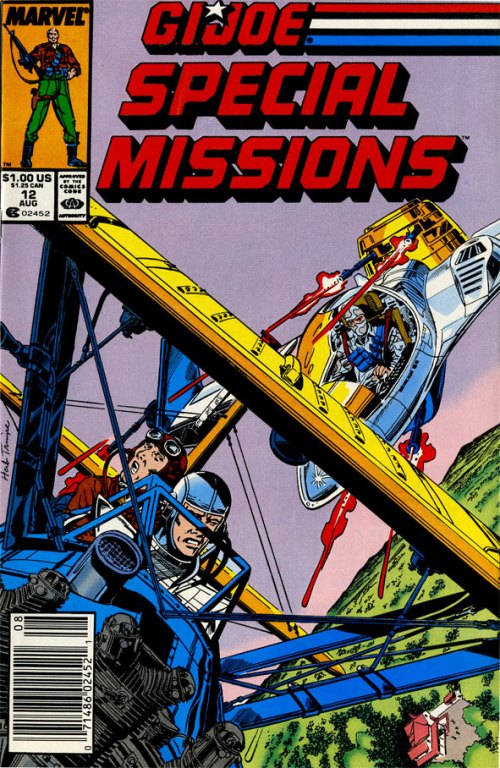
G.I. Joe Special Missions issue 12 cover by Herb Trimpe

Back to the victorious Dart Drug purchase, I don’t remember reading that issue in the car ride north, but I do remember throwing it in the back of our Chevy Malibu station wagon a few weeks later when we drove the hour to visit my other grandparents in Baltimore.  This was before Kevin and I discovered protective bags and boards, in that first year when our entire G.I. Joe collection sat stacked in a cardboard box at knee height on a bookshelf in my bedroom.

Anyway, Special Missions doesn’t get a lot of attention, but narratively it’s as vital as the regular series.  And because each issue is a complete story unto itself, it’s actually more satisfying than G.I. Joe, even without Snake-Eyes and Storm Shadow showing up all the time.

I have a distinct recollection of seeing a TV commercial for Special Missions #28, but I have never seen any evidence of it on the Internet.  Bethesda, Maryland’s Dart Drug and Crown Books were demolished a few years later.  A feud in the Crown family tore the business apart, competition from Borders and Barnes & Noble was fierce, and that entire plot of land was to become a eighteen-story, double-towered headquarters for Chevy Chase Bank.

But this wasn’t the end of buying comics in Bethesda.  What was our new outlet?  Tune in next week to find out!

Part 1[2] [3] [4][5][6][7][8][9] – Ten

2 Comments

Filed under Prehistory

Behind the Scenes – Law blister card

G.I. Joe 1987 Law blister card close-up

Something simple today:  A blister card front sample for 1987 Law.  No blister, no figure, no accessories.

I’m attributing the artwork to Hector Garrido.

G.I. Joe 1987 Law blister card

Many fans know Law was sculpted to resemble Kirk Bozigian, number 2 marketer for G.I. Joe when it relaunched in 1982.  In fact, several figures from the whole ’82-’94 span resemble Hasbro employees, but it was much less often that the package paintings did.  I can’t find my Law figure, so that’s why there’s no accompanying photo today, but the toy does match the person, and in this case, the painting appears to as well.

2 Comments

Filed under G.I. Joe Behind the Scenes, Toys and Toy Art

Interview – Flag Points Part One

In October I fired up my microphone and Skyped with Don and Dave of the G.I. Joe podcast Flag Points.  It’s pretty nerdy, but should appeal beyond a narrow band of hardcore toy Joe fans.  We talk about collecting, my book, and Hasbro, and we also make Star Wars and Transformers references.  And after I overmodulate for the first few minutes I back off from the microphone.  Perfect for those long drives or killing time on the treadmill.  We talked for so long they broke it in half.  You can stream or download to take with you.
http://flagpoints.podbean.com/2011/10/28/flag-points-10-part-1/

Leave a comment

Filed under Behind the Scenes