The Other Half of the Battle: “The Cobra Strikes”

In this new semi-regular series here at arealamericanbook, I take a look at key episodes of G.I. Joe (1983), G.I. Joe (1989), and GI Joe Extreme (1995) for your infotainment enjoyment.  Yes, there was a television show called “GI Joe Extreme”.

“The Cobra Strikes”
original airdate 9/12/83
Written by Ron Friedman

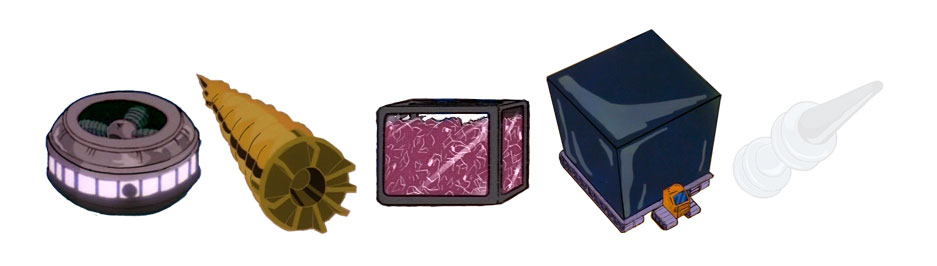
The plot in one sentence: Cobra blackmails the world with its matter teleportation device in the very first episode of G.I. Joe ever!

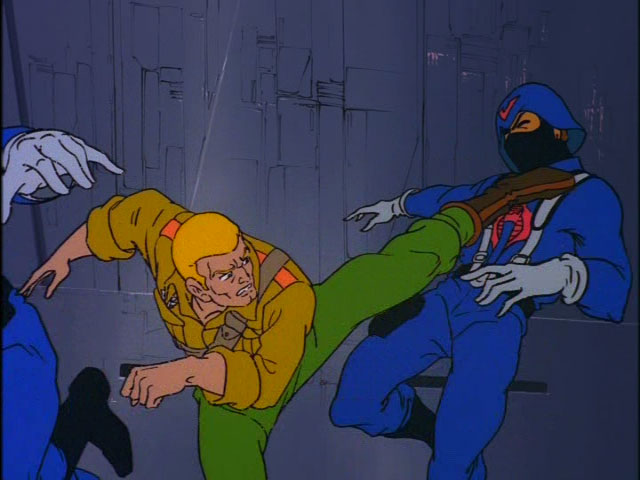
Best thing about this episode: This frame:

G.I. Joe "The Cobra Strikes" screencap Duke kicking

It starts as a face kick, but ends up being a neck kick.

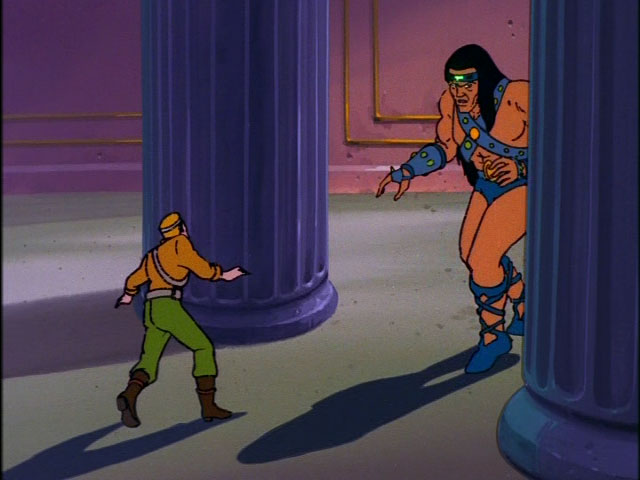
Weirdest thing about this episode: Duke’s about 6 feet tall, right?  So what’s up with Ramar?

G.I. Joe "The Cobra Strikes" Duke and Ramar

Personal Trivia:  I don’t think I caught this in its initial broadcast.

Best line:  “The shipment was difficult to assemble, and I lost more time climbing to this ridiculously melodramatic location!” (Destro to Cobra Commander)

Worst line: “I’m going to kick the mustard out of that crazy hotdog!” (Duke)

Number of times a Joe kicks a Cobra in the face/neck in this episode:  One.

Number of times a Joe kicks a Cobra in the face/neck in the entire series:  Two.

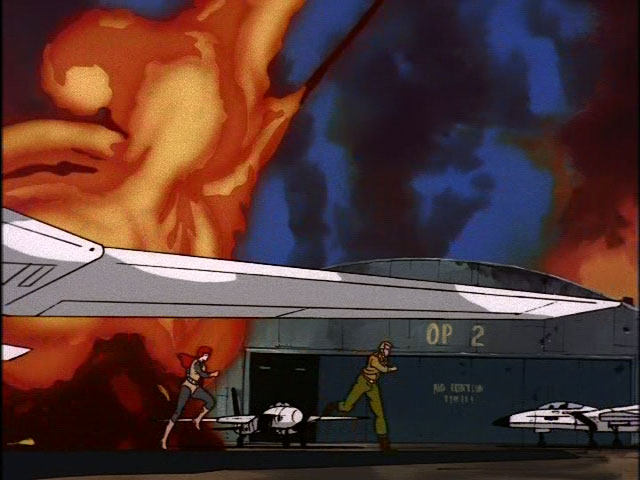
Historical significance?  After Masters of the Universe started a new trend, G.I. Joe was the next big kids cartoon to debut in first-run syndication.  You can bet children dulled by the tame and static Hanna-Barbera and Ruby-Spears cartoons of the 1970s had never seen so much mayhem.  To wit:

G.I. Joe "The Cobra Strikes" screencap Duke Scarlett Skystrikers

Most Skystrikers don't make it off the runway, destroyed in a Cobra raid.

Does it hold up?  The animation is the best of the entire series, with more fluidity and effects than any other episode until the higher budget G.I. Joe: The Movie came along in 1987.  The villains are delicious, there’s a nod to proper military hierarchy (something that many episodes eschew), and there’s more face punching, face kicking, and explosions than almost any other episode.  But there’s also a little too much goofiness, from Cobra’s mind-controlled slaves to the general concept of the matter teleportation device.

A Real American Book gives it 4 out of 5 MacGuffins

I give it 4 out of 5 MacGuffins.

Leave a comment

Filed under The Other Half of the Battle (Episode Reviews)

The Comic That Changed Everything – Part One

Part One – Two Three FourFive – SixSevenEightNine

Because my mom didn’t want to cook dinner every night of the week, Wednesdays we ate out.  This tradition lasted for about 6 years.  We loved our local mall.  (Ironic since the growth of the suburban mall in the 1970s reflected the flight of retail stores from the American Downtown, a trend that closed my grandfather’s Baltimore department store years earlier.)  After a renovation that added an entirely new wing complete with 3-screen movie theatre, video arcade, and food court, Montgomery Mall had us hooked.  So after Mom came home from work she and brother Kevin and I would drive up the Beltway (the loop of interstate around Washington, D.C., and now the bane of many an automotive commuter) eager for a reliable night out in the consistent 72 degrees of our hermetic shopping experience.

After fast food dinner, we’d browse the book store and then split up – my mom to the department stores, and Kevin and I to – the arcade was actually called this, with a red and green neon sign – The Name of the Game.  A half-hour later we’d drive home in time to finish homework and watch whatever ABC sitcoms were dulling our senses that particular season.

In the June between 5th and 6th grade, while strolling into Waldenbooks, past magazines and bestsellers, I looked up at the two spinner racks of comics and saw a revelation.  His name was Road Pig.

The G.I. Joe cartoon had been in reruns for two years, a death spiral we could not fathom it pulling out of.  New toys continually refreshed the line, but they didn’t speak or move.  The explosions were imaginary, made in the onomatopoetic lexicon of little boys splayed out on a shag carpet.

From that top rack I pulled a comic book – odd thing it was – and noted several important elements:  A bold “G.I. JOE” logo.  The aforementioned Road Pig, a villain we had met in our role play, but never on television.  He was brandishing his cinderblock-on-a-stick, a weapon so bizarre that if new episodes were on the air we inherently knew it would not appear, much like Snake-Eyes’ sword, television restrictions being what they were.  On this cover image Road Pig was hauling two… who were they?  I didn’t actually know since they were out of costume, but I could tell they were older Joes, circa year one.  And a foreboding sign on the wall, pointing past them to something called the “Brain Wave Scanner.”  Whatever all of this was, it begged several questions and I was curious for the answers.

Opening this flimsy periodical offered more surprises and teases.  Over the first four pages, more characters who were too new to have appeared on the G.I. Joe cartoon!  And an entire panel where one group of them – the Iron Grenadiers with their ceremonial swords (like U.S. Marines in their dress blues) actually brandish them!  Threateningly!  At other villains!  It was too much for me to take.  The Iron Grenadier action figures did come packed with swords, but they were permanently sheathed.  So if Snake-Eyes was never going to use his sword on television (he did have it in hand once, but didn’t get to impale a robot or anything), and the Iron Grenadier toys made it physically impossible to properly use these other swords, that an “episode” of the G.I. Joe comic book had more relaxed rules concerning action and “violence” content made my eyes bulge.

And then a Cobra villain shoots another Cobra villain!  All before page 5!  (It was just a tranquilizer gun, but a kind of gattling tranq on steroids.)

But this was the icky G.I. Joe comic book!  Hadn’t I already tried this out with Yearbook #3 and #4?  Weren’t those printed on a dull newsprint, with a limited palette that could not rival the saturated intensity of animation cel vinyl photographed on 35mm film and telecined for broadcast?  Yes.  They were.  But there were a few more colors here than those earlier comics, (or perhaps a more adept color artist), and the pull of all these characters and actions that were not available on television overrode my aesthetic concerns.

I flipped back to the cover.  One dollar.  That was a lot, but it also wasn’t.  Kevin and I had a weekly allowance, and did not spend it on candy or gum.  Or prose books.  Those were all parental purchases.  We tended to measure money with our own private system:  The least expensive toys we bought were about three dollars.  At Toys”R”Us, that meant a single G.I. Joe action figure, or an Autobot minicar (like Bumblebee).  Everything scaled up from there in multiples of three and five.  A $12 or $15 Joe vehicle was possible after a few weeks or months of saving.  The $30 Metroplex was a bit out of my reach and became a birthday request.  The $100 U.S.S. Flagg aircraft carrier was an utter impossibility.  (Even the rich kid down the street didn’t have that, and he had a Millenium Falcon!)

So when I showed G.I. Joe issue #90 to my brother, his immediate response deflated, but did not surprise me:  “Cool.  Don’t buy it.”

Did I? Find out next week!

Part One – Two Three FourFive – SixSevenEightNine

Leave a comment

Filed under Behind the Scenes

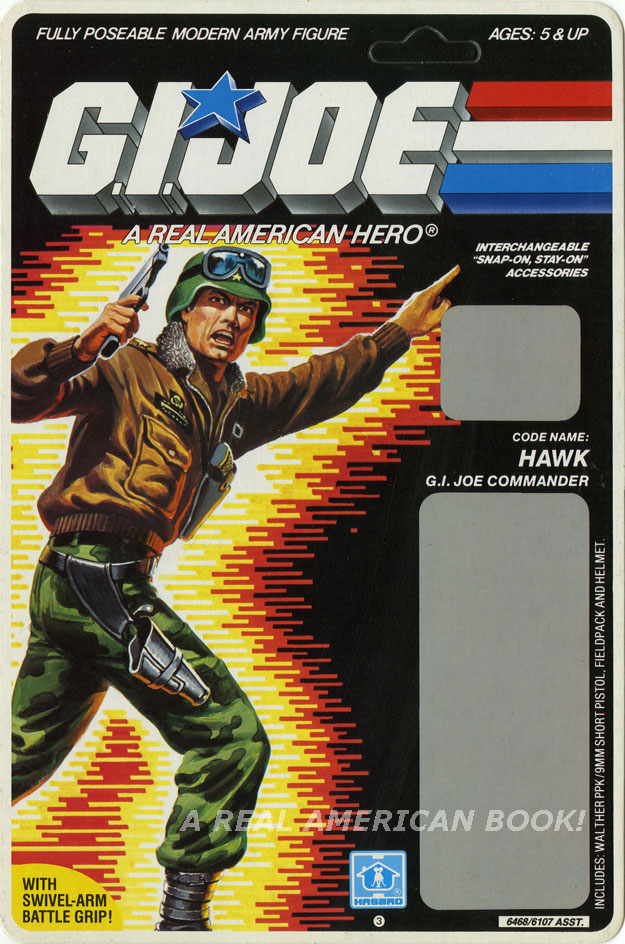
Behind the scenes of G.I. Joe – Hawk

1986 G.I. Joe Hawk Card front CU crop

Something simple today:  A blister card sample, front and back, for 1986 Hawk.  No blister, no figure, no accessories.

I’m attributing the artwork to Hector Garrido.

G.I. Joe 1986 Hawk blister card front

G.I. Joe 1986 Hawk blister card back

2 Comments

Filed under G.I. Joe Behind the Scenes, Toys and Toy Art

My First Comic Book Ever Was “G.I. Joe Yearbook” #3 – Part Three

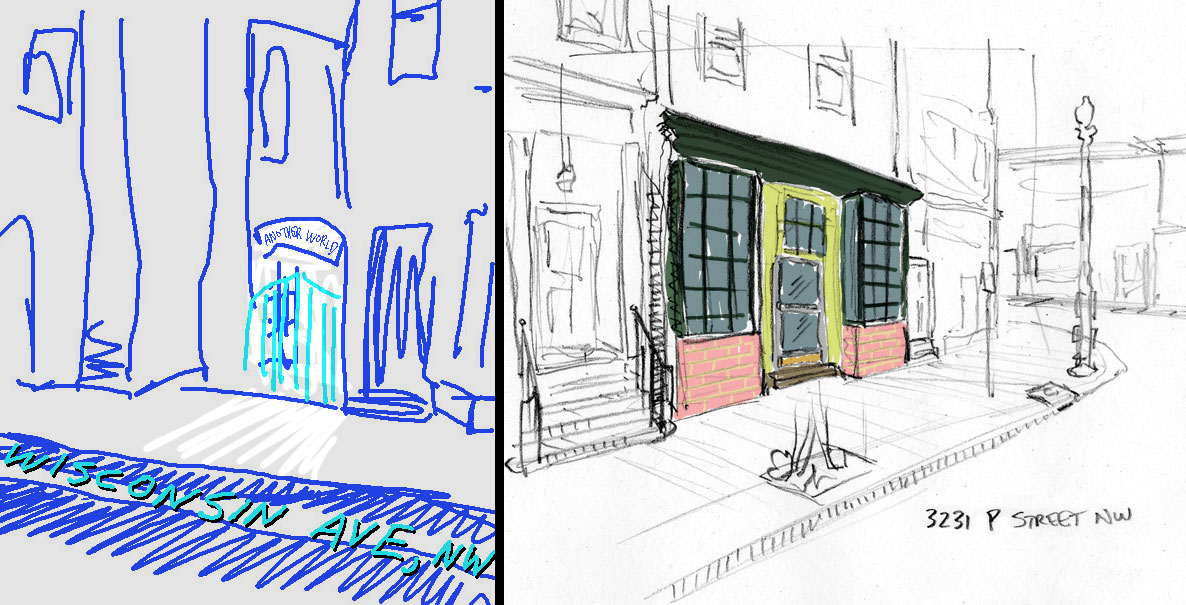
Note for last week’s readers:  The part two chicken scratch doodle of Another World has been partially updated.

In our last episode, Tim bought his first comic book ever, G.I. Joe Yearbook #3…

G.I.Joe Yearbook #4 cover art by Mike Zeck

G.I.Joe Yearbook #4 cover art by Mike Zeck, 1988.

Then, what I believe is one year later, but could have been only half that, we returned to Another World.  I bought G.I. Joe Yearbook #4, looked at but passed on another Mad, and Kevin bought two back issues: G.I. Joe #61 and #62.  (Or maybe he’d bought them on that first visit?  Memory’s funny that way.)  At home he promptly put them on a high shelf in his room where I couldn’t reach them.  He never offered them to me, and I never snuck a peak when he was elsewhere.  I didn’t even touch them until later when we were regular comics readers and those two issues were incorporated into our burgeoning G.I. Joe collection.  This should demonstrate the strange disinterest I had in comic books at that initial point.  (It is also indicative of our overly strong sense of personal ownership.  My toys were mine, Kevin’s were his.  We didn’t share, and we didn’t much trade.  This is not meant to sound mean, it’s just how our personalities worked.  We played with our G.I. Joe toys side-by-side, my characters and vehicles interacting with his, but him only holding and role-playing with his, and me with mine.  Weird, I know.  It’s worth an entire blog post, how we played with our toys.)  By then we had found D&D wares at the Waldenbooks at our mall (an important location that I’ll come back to in a later blog post), and rarely returned to Another World.  In fact, I don’t think Kevin ever went back.  I did go every year or three — it was friend and future editor Nick Nadel‘s local shop once he entered the picture, but until I had a driver’s license there was no point in shopping at this third-closest store.  It did move and renovate, and finally closed when parent company/comics mail order giant American Entertainment went belly up a decade later.)

But back to those two issues–

G.I. Joe #61 and #62 covers by Mike Zeck

G.I. Joe #61 and #62 covers by Mike Zeck, 1987.

Before Kevin whisked them away I do recall seeing these two covers, which by themselves form a kind of contained story, and being worried for the protagonists.  This is a point I’ll come back to at a later date on the blog — the power of the cover image — but for now you can likely acknowledge that even if you’re not a G.I. Joe fan or a comics reader, these guys are in trouble.  The barbed wire, the handcuffs, the menacing weapons.  Trouble!

As with the first comic I’d bought, Yearbook #4 did not turn me into a lifelong reader.  I just recall thinking there weren’t enough Joes in the lead Oktober Guard story, being confused by the recap pages that mixed narration with word balloons, and wishing the Joes in the back-up yarn wore their regular costumes and not their civvies.  Years later Tony Salmons would give me some original art from that story.

G.I.Joe Yearbook #4 pg 4 panel 4, art by Tony Salmons

G.I.Joe Yearbook #4 original art by Tony Salmons

So here’s where the biography stands:  Kevin and I have been buying G.I. Joe toys and watching the G.I. Joe cartoon for four years — half a lifetime.  For me it vies with Transformers as my favorite thing ever, for Kevin it’s no contest.  We read books and newspaper comics, and now own four actual G.I. Joe comic books.  But we’re still not readers!  What’s missing?

Tune in next week!

1 Comment

Filed under Back issues, Prehistory

Behind the scenes of G.I. Joe – Hydro-Viper

Today’s art post is the complete sculpt input (i.e. “turnaround”) for the 1988 Hydro-Viper.  Again for casual or non-fans, let’s start with a photo (by me, not my fancy book photographer) of the production figure for a baseline comparison.

G.I. Joe 1988 Hydro-Viper figure

Here’s George Woodbridge’s turnaround.  Such a crisp and clean line, and a deft spotting of blacks.

G.I. Joe 1988 Hydro-Viper figure turnaround

Note that the figure is referred to as “Cobra Frogman,” so “Hydro-Viper” hadn’t yet cleared Legal.

Woodbridge’s association with G.I. Joe is limited. He drew most of the ’88 inputs, and did many of the Hasbro-internal figure presentation paintings that Dave Dorman and Bart Sears didn’t around 1988.  Writer Mark Evanier wrote a short biography of Woodbridge in 2004 when the artist passed away.  You can find it here, but if you want a shorter version, I’ll just throw out the terms “Mad Magazine” and “military and historical illustration.”  In the near future I’ll show a few more pieces like this here, and in the not-near future I’ll have Woodbridge’s Crazylegs (a Joe paratrooper) color piece in my book.

Here are three sheets of the Hydro-Viper’s accessories, drawn by Bart Sears.  In toys, Sears is known for designing Hasbro’s C.O.P.S.  In comics, Sears drew Justice League Europe and has recently penciled some Conan and Indiana Jones for Dark Horse.  Of note here is the ray, the most bizarre of all animals that any G.I. Joe figure came packaged with.

G.I. Joe 1988 Hydro-Viper backpack turnaround

G.I. Joe 1988 Hydro-Viper weapons turnaround

G.I. Joe 1988 Hydro-Viper manta ray turnaround

11 Comments

Filed under G.I. Joe Behind the Scenes, Toys and Toy Art

My First Comic Book Ever Was “G.I. Joe Yearbook” #3 – Part Two

In our last episode, Tim’s parents took him and his brother to their first comic book store…

29 July 2011 - Still updating this art. At left, Another World's back entrance, not open to foot traffic, on Wisconsin Ave. On right, the front entrance on P Street. Wisconsin is visible in the background.

But this is where my memory gets fuzzy.  I believe we went to Another World one more time, six months or a full year later.  As best as I can piece it together, on the first visit, in addition to the Dungeons & Dragons set, I bought two periodicals:  I saw an issue of Mad Magazine and had to have it.  Mad was still a kind of forbidden fruit, and we had just gotten into it a few months earlier, but our subscription hadn’t kicked in.  For now it was the serendipity of seeing one on a newsstand, having the money, and getting the parental permission.  My other buy was G.I. Joe Yearbook #3.  (I should here define the series “G.I. Joe Yearbook” as an annual run of double-sized specials that complemented the regular, monthly G.I. Joe series.)  Interesting, Kevin also bought a copy.  Why did it grab us?  Probably because the cover showed favorite characters in distress, a scenario I was intrigued to see to its resolution.

G.I. Joe Yearbook 3 cover by Mike Zeck

Art by Mike Zeck.

I don’t want to undersell that point.  The cover made me worried about the characters.  Snake-Eyes is in trouble!  Scarlett defends him!  Storm Shadow — a villain — is also helping?  (This is a stark contrast to many comic book covers nowadays that feature glamor poses with little drama or story content.)

So Kevin bought Yearbook #3 as well – we were occasionally selfish and territorial about our possessions, and didn’t consistently share everything. 

Yearbook #3 was just a curiosity.  It did not turn me into a lifelong comics reader.  That would happen two years later.  But it was still an entertaining book, with a wordless story told only in pictures and pantomime that did in fact follow up on the cover image. My aversion to newsprint was abating.  (I can’t reconcile how newspaper comics were fine but comic books printed with the same palette on the same stock were not.  It might be that I was used to higher quality color and printing from glossy magazines like Hotdog and Dynamite, that I was already picky and fetishizing the bound periodical as a keepsake.)  (I mean “festishizing” in the general, non-sexual sense of the word.)  But as much neat content as it had, like a fun “Kitchen Viper” joke, and an article on the TV show, Yearbook #3 was still this weird… thing I didn’t entirely love.  It’s like an album you don’t appreciate until months or years later, but in this analogy, it wasn’t a single album, it was the entire pastime of listening to music.  I liked prose books, I liked magazines, I liked Garfield collections, I liked cartoons, but comics still hadn’t clicked.

I recall pulling Yearbook #3 off my shelf and reading it a few times afterwards, one time lying on my brother’s bedroom floor.  But it sparked no storylines for our G.I. Joe toy games, and no discussion of buying additional comic books.

What was the comic that changed Tim’s life forever?  Tune in next week to find out!

Leave a comment

Filed under Back issues, Prehistory

Behind the scenes of G.I. Joe – PSA #10 Storyboard

G.I. Joe PSA

Endorsed by the National Child Safety Council, a non-profit founded in 1955, the now infamous G.I. Joe public service announcements (PSAs) were created to elevate the series’ profile as an agent for pro-social values and to ward off criticism from parents’ groups that the G.I. Joe cartoon was a) violent and b) a half-hour toy commercial.  35 PSAs were created in all, with topics ranging from not giving in to peer pressure, to nutrition, and to owning up to one’s own mistakes.  The format was likely borrowed from Filmation’s 1983 series He-Man and the Masters of the Universe.  In that show, at episode’s end a marquee character would directly address the audience and refer to an incident from the proceeding episode.  The Joe ones were different, working both in “regular” continuity wherein the Joes spoke to kids in-scene, and not the television audience, but also a kind of parallel universe where the Joes were always near suburban danger and utterly lacking in top secret status.

For Footloose’s rapid-fire instructions, PSA #10 is one of my favorites — there’s no way I’d remember what to do in my own soccer crisis unless I had a transcript handy.  Also, this is perhaps one of three incidents in all of G.I. Joe animation 1983 to 2000 where the animators showed blood.  I appreciate the added dash of seriousness.

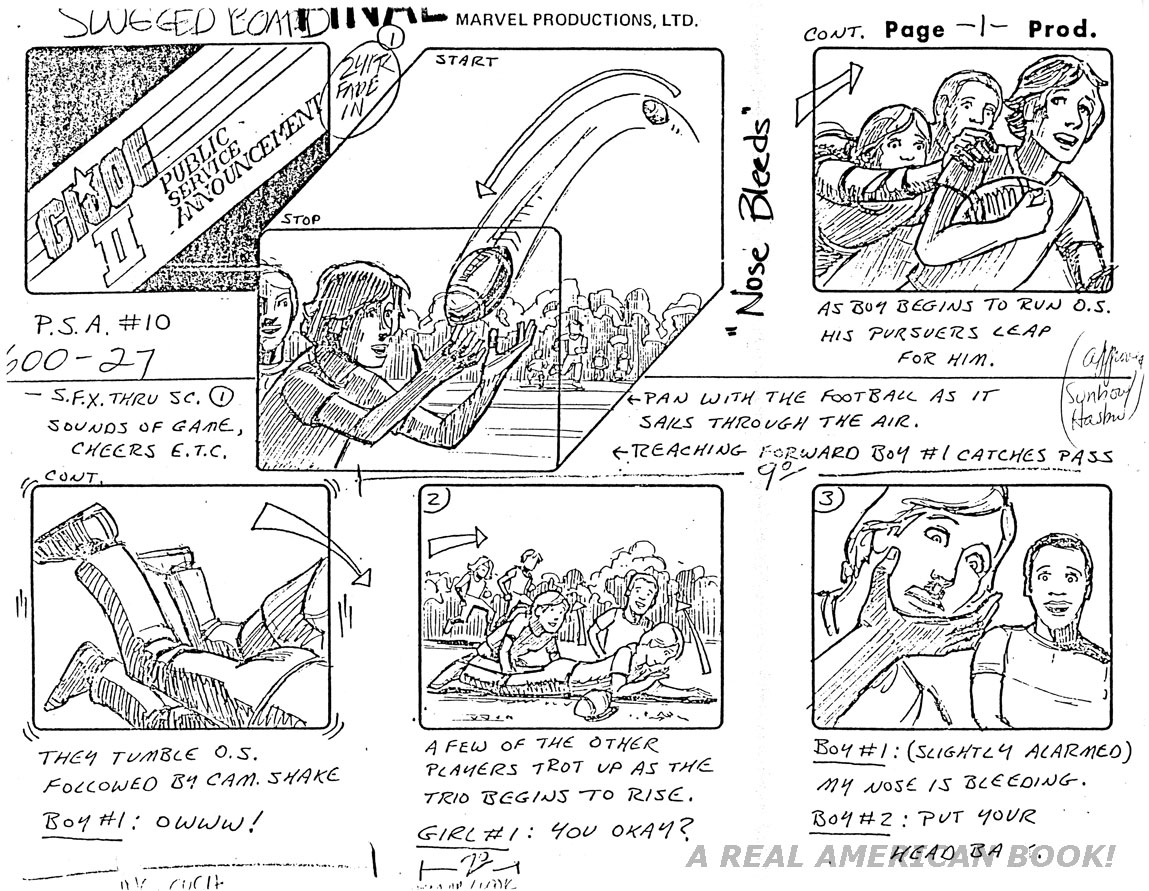
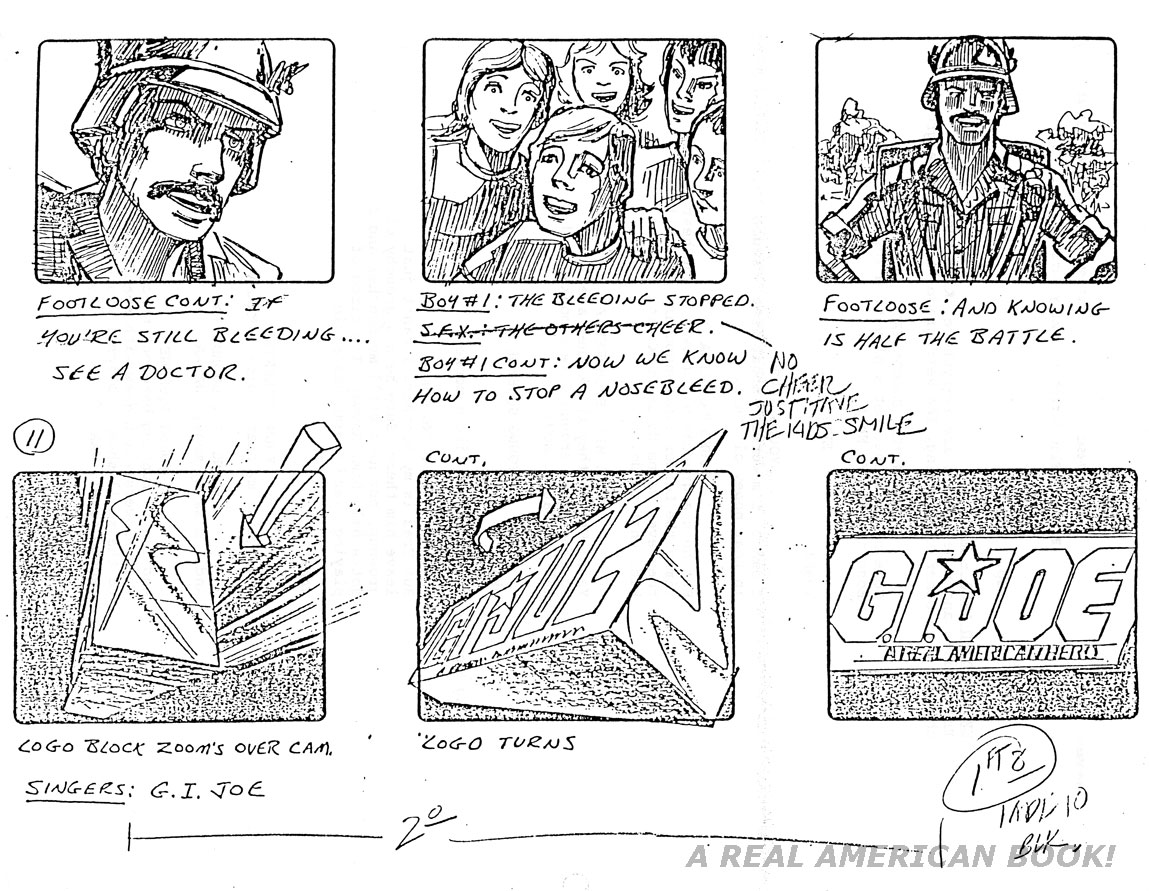
Here’s the storyboard for PSA #10.  I should know who drew this, but don’t.  I’ll check my sources and update this post when I can.

G.I. Joe PSA #10 storyboard pg 1

G.I. Joe PSA #10 storyboard pg 2 of 3

G.I. Joe PSA #10 storyboard pg 3 of 3

For those unfamiliar with storyboard formatting, here are a few items of note:

-The second panel — the stretched out one — represents a camera move.

-The numbers under the panels represent length of footage in feet and frames.  Old school film editing (and animating) was measured not in seconds/frames, but in feet/frames, with a foot being the physical length of 16 frames of film, and a frame lasting 1/24th of a second.  So where it says “SLUGGED BOARD” at the top left of page one, the board artist has timed out to the audio track each shot’s duration, or is providing a time table for the animators to show how long each shot should last.

As a special thank you, I’d like to acknowlege YouTube user PSAGIJoe, who has uploaded the original, non-satirized PSAs.  You can find them here.

1 Comment

Filed under Animation, G.I. Joe Behind the Scenes

My First Comic Book Ever Was “G.I. Joe Yearbook” #3 – Part One

I should have become a comic book reader two years before I did.

Another World, Georgetown, Washington, DC, c. 1988

Another World's closed-off back alley entrance. I think it's outdoor seating for a cafe now.

I was reading newspaper comics in the Washington Post for years before I picked up my first Marvel or DC.  And in those two years, the only parts of Mad Magazine that mattered were the comics – the movie and TV parodies, Spy Vs. Spy, The Lighter Side, and A Mad Look At.  I even scanned through a few comic books one day probably in 1987 – and a G.I. Joe issue to boot! – but put it down with disinterest:  Whereas the TV cartoon was saturated full color, the comic was limited four-color printing, and it looked dull on beige newsprint.  This was at the house of a friend from school, and I believe my brother read several of his G.I. Joe comic books.  But not me.

Friend Taylor and my brother reading comics.

Soon after, my brother Kevin immersed himself in Dungeons and Dragons, and brought me with him.  While we could potentially play with friends using their materials, and even though this board game without a board mostly took place in our minds, we knew we had to buy a few essentials – dice, a rulebook, perhaps a module.  I think what happened was that our mom looked up “gaming” in the yellow pages, and found a store in Washington, D.C.  It was half-hour drive in the “wrong” direction since we always drove north and west to shop at our local mall, and parking in Georgetown (that particular section of D.C.) was difficult, but Mom and Dad were up for it .  And so we visited Another World, a comic book shop with a large back issue selection (whatever that was – it smelled old), new comics, and some gaming.

Another World, Georgetown, Washington, DC, c. 1988

Imperfect recollection of Another World's first store layout

We procured the red boxed Advanced Dungeons and Dragons starter set.  Georgetown wasn’t going to be a weekly trek like our mall (or downtown Bethesda, two miles from our house) were.  And it wasn’t going to be monthly.  Perhaps Mom and Dad liked to stay out of D.C. on weekends since they were there Monday to Friday for work.  Or perhaps they were willing, but Kevin and I didn’t realize we merely needed to ask.  Whatever the case, my sense was that this was a special trip, not the start of something.  Adding to my disorientation was that Another World had two entrances and a quirky layout.  The store straddled two sides of an acute street corner without having the corner itself, was small and cramped, had two different “rooms,” and was on two different levels, one a few steps higher than the other.  And again, it was filled with comic books, which I didn’t understand or like, even if I had been seeing Griffin Bacal’s wonderful animated television commercials for Marvel’s monthly G.I. Joe series for years.

But we went back months later and Kevin actually bought some G.I. Joe comic books.

What happened at Another World?  Find out next week…

2 Comments

Filed under Back issues, Prehistory

Behind the scenes of G.I. Joe – Rock-Viper

Today’s post reveals some development artwork for the 1990 Cobra Rock-Viper.  First, a not-great photo by me of the production toy to serve as a baseline for all you casual fans.

Interesting to note this Cobra soldier, of which there were many (rather than a specific individual like Destro or Gristle) has a moustache.  So I guess graduates from training school had a facial hair requirement?

First up is Dave Hasle’s sculpt input drawing for the Rock-Viper’s backpack:

A black and white photocopy (probably of a color photocopy and not a chrome) of Dave Dorman’s internal presentation painting:

Note above and below there’s no moustache.  Here’s the pencil sketch of what will become the final package painting.  I’m attributing this to Hector Garrido:

Here’s the almost complete layout of the cart front and back, in b+w photocopy form, with Garrido’s drawing now a finished painting:

I don’t have a color copy of the painting or a full blister card (any readers want to help?) so this cropped close-up from my dossier and the tiny back-of-package thumbnail of Garrido’s final painting will have to do for comparison.

If you didn’t read this above, check it out here.  Dossier writer Larry Hama’s sense of humor on display.

2 Comments

Filed under G.I. Joe Behind the Scenes, Toys and Toy Art

Interview #1: Larry Hama, June 2001 – Part Three

Regular readers: Sorry for posting a day late!

In our last episode, Tim sat down to interview Larry Hama, either the best person to start with or the worst…

“Best” because Hama never answered a question with “I don’t remember.”  He recalled stuff from the beginning of G.I. Joe as well as the end.  He talked for two hours.  And he dropped several helpful names, good people to track down next.  He was candid, funny, and not severe.

So why was this the worst interview to start with?

One, because I was starstruck.  Could I even ask the questions without stuttering?

Two, would Hama call my bluff?  I wasn’t a writer, and what research project was I researching anyway?  But this was a writer.  Sitting in front of me, humoring me, was a major reason why I was a comics reader, a Wednesday regular wherever my local store was – Bethesda, Providence, Cambridge.  Here was this famous guy whose name was credited first in almost 200 comic books I kept in my closet at home.  The writer of my “desert island” comics.  I worried my questions were too fannish, that I was bothering Hama and wasting his time.

Three, some of his answers were short, not because he was cutting me off, but because that’s just the way he answers some questions.  To the point.  I didn’t know Hama or his conversational cadence, so in the short term I thought my inquiry was lacking if I wasn’t teasing out bigger answers.  I didn’t feel like I had gotten much of the information I had gone looking for.

Two hours in, Hama suggested we break, and offered up some snacks from his pantry.  As I had stupidly skipped lunch, but hadn’t wanted to impose by asking for food, my relief was palpable.  Those cheese slices, crackers, and salami were a relief, and in the times I’ve visited Larry since ’01 I always smile when I see his kitchen.  Years later I would realize in fact it was a great interview, and that much of the work philosophy and analytical introspection was better than nuts and bolts like “favorite character.”

Nth Man issue #16 cover by Ron Wagner and Bob McLeod, 1990.

We talked for a little while longer, bouncing around non-Joe topics like Nth Man, an underappreciated Marvel gem, and the K-Otics, the blues band Hama played in for years.  When we were done, Hama walked me out.  Heading toward the elevator I sort of mumbled that I was writing a book, which codified it for me.  If I hadn’t been writing a book before, I certainly was now, even if I didn’t know what that meant.  Off the cuff Hama mentioned one Susan Faludi, a writer for Esquire Magazine.  I didn’t know who this was.  Larry explained that she had previously interviewed him by phone for 45 minutes, and that she had interviewed “everyone” regarding G.I. Joe.  Everyone.  It ricocheted around in my head like a lightning bolt.  My heart sank.  Already my project had competition!  Someone had tracked down all the people I didn’t even yet know I needed to track down!  I would later learn that Faludi had won a Pulitzer Prize, and that any article or book of hers on society, the male, and/or G.I. Joe would in no way compete with mine.  But that word “everyone,” as frightening as it was because I was now behind in the race, was vital.  As the elevator doors closed I promised myself that I would interview “everyone” and more, that I would find obscure contributors to G.I. Joe comic books, toys, and animation.  That I would track down people until I had an unreasonably large number of interviews.

So I did.

2 Comments

Filed under Book Behind the Scenes, Writing Process