Behind the scenes of G.I. Joe – Heath Snake-Eyes

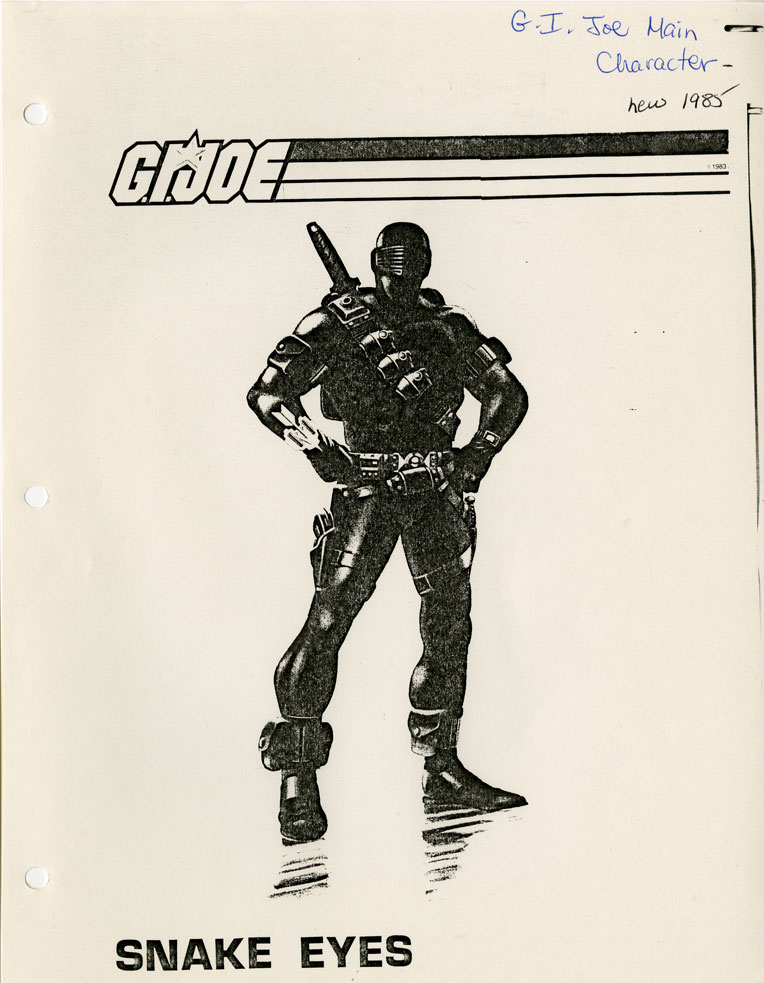
Today’s art peak brings you several photocopies of Russ Heath’s model sheets for the 1985 season of the animated G.I. Joe.  While the Snake-Eyes action figure was iconically all black, the TV series had previously shown him in dark blue.  (All black doesn’t “read” well in animation.)  For 1985, SE went dark grey, which to my eye reads better than the dark blue and works better as a stand-in for black since dark blue is already associated with Cobra.  Russ Heath’s front view:

Clearly based, as many of his drawings were, on Hasbro’s internal presentation artwork:

This one, a black and white photocopy, doesn’t have a signature, and I’ll admit I don’t know who painted it.  To my eye it’s not Ron Rudat — the proportions and clothing folds don’t match with work that I know is Rudat.  The anatomy is tight, which says George Woodbridge, but his Joe work was colored and black ink, not rendered paintings.  Maybe one of you eagle eyed Joe collectors can correct me in the comments.  There is a slightly better reproduction of this image, still a black and white photocopy of a color photocopy, though, in Vincent Santelmo’s Official 30th Anniversary Salute to G.I. Joe.

Two more views by Heath:

And SE’s undercover disguise, drawn by Bruce Timm, from the beginning of “Battle for the Train of Gold.”  To give you a sense of the timeline, this was drawn in August 1984, and the episode aired 14  months later.

And what appears to be an unused alternate from same.

I’m not sure where in the storyline of “Train” there would have been an opportunity for SE to wear this, but there is a horse farm in act 3, so who knows?

3 Comments

Filed under Animation, G.I. Joe Behind the Scenes

Interview #1: Larry Hama, June 2001 – Part Two

In our last episode, Tim secured an interview with Larry Hama and took a train to New York…

Canon GL-1 and a GE microcassette recorder

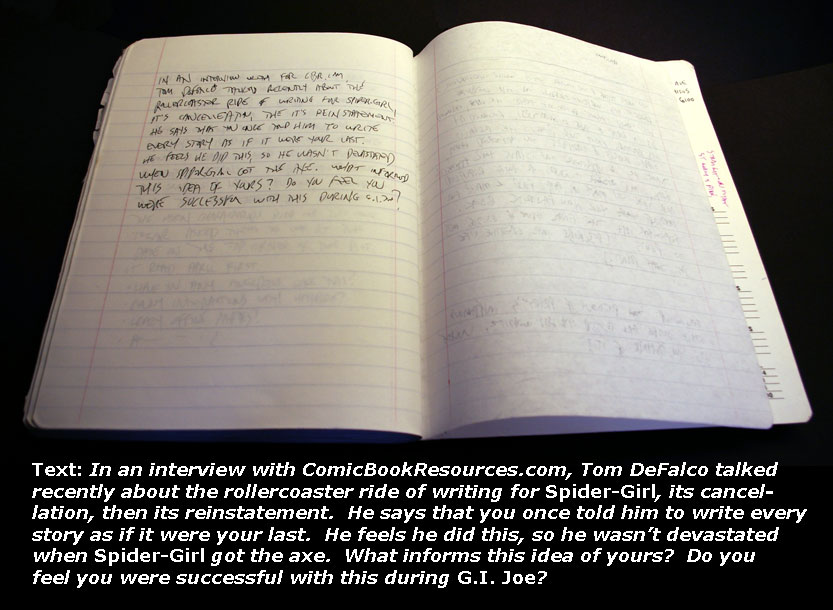
In my backpack were a marble journal for taking notes, a video camera for recording audio (I’d keep the lens cap on), and a back-up microcassette recorder.  Even though we hadn’t agreed on an exact time, I worried that I had no time for lunch, so I called from a payphone at Penn Station and immediately hopped a subway.  When I got to Hama’s place, I was struck by how open it was, a two floor studio apartment with lots of light and a high ceiling.  My experiences with New York living spaces were all dark and narrow — whatever college dorms and apartments friend (and future book editor) Nick Nadel had been squeezed into.  Years later Larry would tell me about how his building used to have a view all the way to New Jersey, but by the time I got there in 2001, the whole street was built up with shops and tall apartment buildings.

I was also struck by the decorations.  On the left wall was a Gary Hallgren post-modern painting of Dick Tracy.  Across from it was another Halgren of Blondie, Dagwood, and Krazy Kat.  Next to the kitchen was a 1976 ink drawing of Bilbo Baggins and 12 dwarves by a young Michael Golden.  Up the steps to a narrow passageway filled with books and packaged G.I. Joe toys (and Golden’s original cover artwork to The ‘Nam #12) was a tiny room – Hama’s office.  Art, photos, memos, and an old paycheck covered the right wall.  Straight ahead was a computer, to the left were windows and an A/C unit.  A second PC, papers and books, and a flight simulator joystick covered the spare table, smaller than a chess board.  The whole space must have been six feet by fifteen feet, a sliver of a room you’d give to your drunk friend who’s crashing after the party ends.  A glorified closet, and yet so out of the way and with such an interesting view of the street it made perfect sense as a writer’s room.  And this is where scripts and cover layouts for my favorite comic books had been typed and drawn.

I drew this after another visit years later. The space hadn’t changed.

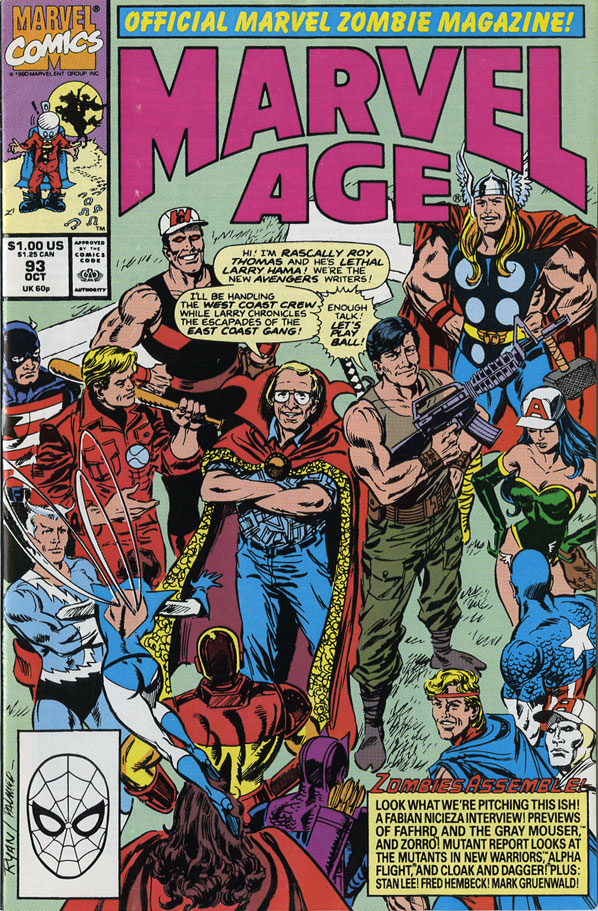
Leaning against the left wall and below the windows was Hama’s guitar.  (Years later on a subsequent visit there was a guitar and a metal 1:1 scale working model of a machine gun, which made me think of the Warren Ellis quote “Larry Hama, perhaps unsurprisingly, knows a lot of people with guns, and so has marvelous stories to tell about stone lunatics with too much artillery who also happen to be comic artists.”)  (And it’s telling that the one time Larry appeared on the cover to a Marvel comic book, he’s holding a machine gun.)

Art by Paul Ryan and Tom Palmer, 1990.

There was just enough space for the two of us to sit down, me in the spare seat.  I turned on my gear, and started asking questions.  Mel, Larry’s pug, joined us halfway through.  I will never stop smiling at the seeming incongruity of it:  The famous Larry Hama, who had written a light “war” comic for 12 years, and who guided Wolverine’s solo adventures through a swath of Yakuza and evil mutants for another seven, who bridged the ninja craze at Marvel Comics after Frank Miller left Daredevil for DC, thoughtfully and quietly reminiscing with a pug in his lap.  What did I expect?  A chat at a shooting range?  With no plan besides “get the interview,” I didn’t know what to expect, but it turns out that the man I met was the real Larry Hama: a reserved and modest guy, a thoughtful and learned reader and writer.

In some ways, this was the best interview to start with, and the worst.

Why?  Find out next week…

Leave a comment

Filed under Book Behind the Scenes, Writing Process

Behind the scenes of G.I. Joe – Groen X-Soldier

It’s Monday or Tuesday, which means another preview of rare, lost, and never-seen art from the making of G.I. Joe 1980-2000 to whet your appetites for my book.  Today’s image is a 1994 Kurt Groen pencil and marker drawing of a proposed X-Soldier.

Very little is publicly known about X-Soldiers.  It’s telling that they are neither mentioned nor pictured at the encyclopedic yojoe.com.  I don’t say that as a swipe against the site as I love it and have referred to it weekly for the past six years of writing my book.  Just that the line, unlike many other unproduced Joes, hasn’t been widely seen or discussed.  Google searches yield almost nothing.

But print offers a succinct explanation: According to G. Wayne Miller’s Toy Wars, “[Kirk] Bozigian’s biggest setback had been X-Soldiers.  Shown prototypes, boys in focus groups had been disinterested.  The concept needed work, and the line was unlikely to reach market before the summer of 1996, if then.” (pg 185)

A line of traditional super-heroes that would battle for and with G.I. Joe, and each figure would have had an action feature.  Seven X-Soldier characters are known to exist as color marker illustrations.

5 Comments

Filed under G.I. Joe Behind the Scenes, Toys and Toy Art

Interview #1: Larry Hama, June 2001 – Part One

The idea of me writing a book had not coalesced, despite the revelation that John Michlig and Paul Dini would likely never write my ideal G.I. Joe history.  It was still a vague notion.  But one day while wasting time on the internet at work, I stumbled across Larry Hama’s e-mail address.  I frequented toy and comic book news sites, and someone was announcing Hama’s birthday, or the completion of an interview.  Hama wasn’t doing much in comics in the spring of 2001.  His brief term as writer of the flagship Batman book the previous year was over, his seven-year Wolverine run had ended in ’97, and G.I. Joe’s 1994 finale was a distant memory.  Finding this address was dumb luck, and felt like I was breaking some unspoken rule.  This was a famous person, and I was not.  Whatever kind of opportunity this was, I had to take it, and I had to ask for an interview, even if I didn’t know what for.  I recall mentioning a “research project,” as if I was still somewhere in the limbo between my G.I. Joe Mixed Media issue and this as yet non-existent book.  Surely the fan or webmaster who had included this address had done so by accident!  I couldn’t just copy and paste it into a new e-mail message and bother the man, could I?

For years Larry Hama had been just this to me, a name — a credit — in hundreds of comics I owned.

I could and did.  Hama responded, which was a surprise.  I had only corresponded with two famous people at the time, and the instantaneity of e-mail was still shocking.   Moreso how it broke down barriers between fans and pros.  A celebrity would not call back by telephone, and paper mail was iffy, but e-mail was somehow different.  Hama provided a phone number and asked if I would need his fax, or if this would be an e-mail interview.  I suggested in-person.  New York wasn’t far and I knew that any interview would come out better if conducted face to face.  To my surprise, Hama said yes.  It was generous and trusting of him.  What if I turned out to be an axe murderer?  Or the worst kind of fanboy, digging for dirt and begging for autographs?
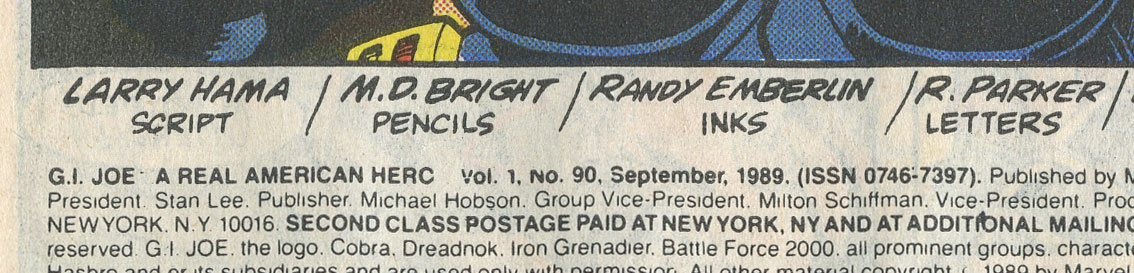
For years, all I knew about Hama came from this bio that had run in all Marvel Comics cover dated October 1987.

Hama had a few trips in the near future, and we settled on a tentative date in June.  I sent him links to various toy photos and catalog scans at yojoe.com, thinking that he might need a memory jog.  (He didn’t.)  And then I asked my friend and future editor Nick Nadel if he could help me come up with questions.

I didn’t want to ask noodley fan questions.  The problem was that I wasn’t a writer and didn’t know what made for good questions and what made for bad.  All I knew was that the interviews I read in Wizard Magazine were fluffy, while those in The Comics Journal were smart and long, and I needed to somehow keep Hama talking.  If he ended up terse or forgetful, the trip would be wasted, and whatever this “research project” was would now lack a necessary lynchpin.  Nick looked over my list and suggested fewer specifics like “Favorite issue?” and more process ones, like “Who do you write for?”  The day came and I hopped an Amtrak bound for Manhattan.

More next time…

1 Comment

Filed under Book Behind the Scenes, Writing Process

Behind the scenes of G.I. Joe – Dorman Ice Viper

My book can’t contain all the sketches, drawings, paintings, designs, photos, and layouts that went into making even a single G.I. Joe toy product.  But what it aims to do is present a juicy slice of that material, much of it never seen publicly, and to put it in context.  Today’s image has been seen publicly, posted at HissTank two years back, but as a slightly fuzzy, cropped photo rather than a crisp scan.  So today I present to you Dave Dorman’s stunning 1986 presentation painting for the 1987 Cobra Ice Viper figure.

Dorman is best known for his Star Wars book and comic book cover art, but was freelancing for Hasbro in the mid-1980s.  In addition to these internal presentation paintings — a different category than the painted art seen on the final G.I. Joe toy packaging — Dorman also did covers for the Lorimar-published G.I. Joe Magazine that ran from ’87 to ’88.  A recent coffee table book published by Desperado through IDW, Rolling Thunder: The Art of Dave Dorman, features a few pages of G.I. Joe art.

2 Comments

Filed under G.I. Joe Behind the Scenes, Toys and Toy Art

That First Time I Wrote a G.I. Joe Book – Part Three

In our last episode, Tim wrote an entire issue of the RISD student newspaper!

All that’s left of the original print run

When the print run was delivered the following Monday – The kickoff day of G.I. Joe Week! – I was giddy.  3000 copies were waiting at the mailroom, and I spent my lunch hour placing them in student mailboxes.  (RISD had 2000 students, so naturally I figured I would take the remainder.)  Regular editor Andy Dill helped, which I wasn’t expecting, but greatly appreciated.

I got great feedback from friends and acquaintances.  Some specifically loved the issue.  Others were just impressed by the commitment to take on the project.  And others still had different reactions.  Giant trash cans and round metal recycling bins lined the mailroom, overflowing each night with the day’s junk mail from 1800 undergraduates and 200 grads – catalogs, opened envelopes, memos from school.  After I disseminated Mixed Media, I hovered to see a few random reactions from people opening their mailboxes.  What was this green thing inside, anyway?  I also rescued about 30 copies from the trash.  I had plans to mail the issue to family and friends far and wide, and a vague notion to take a few hundred up the road to Hasbro, in Pawtucket.  (That never came to be.)

I was standing next to a trash can while two young women sorted through their mail.  They were in a hurry since lunch time was short.  “Bill, bill, junk, junk,” complained one, “What the fuck is this?!” she demanded of no one, looking at my masterpiece.  She threw it in the trash can and walked off in a huff.  Her friend finished her own sorting, tossed a few papers and her Mixed Media, and then noticed me standing right there, looking back at her and the trashcan.  In my arms were 40 copies.  She paused, looked in the direction of her friend, looked back at me, looked in the trash can, slowly pulled out her copy, and darted after her friend.

The issue turned out better than I expected, and I floated through the rest of my boring Wintersession short term class.  Designer Sean Deyoe had smartly separated the main article and the episode guide through margins and differing font sizes.  He had cropped and zoomed in wherever he wanted, and with me sitting quietly next to him, had slaved away on that killer back cover.  Two small production errors appear in the final edition – on the front cover and back cover, no less! — but I’m still so giddy with the end product that they don’t bother me.  Either because he was ready to move on or because my issue had broken him, Deyoe quit one issue later.  Andy Dill hung on as editor for a bit until some movement at the Office of Student Life installed two friends, Cory Mitchell and Mark Hoffmann, as new editors before the year was out.  They stayed on through our senior year and nicely revitalized the newspaper.  I would go on to write another article and submit a comic or two, but they were school related.  My ‘80s pop culture intrusions on Mixed Media were over.

Leave a comment

Filed under Prehistory

That First Time I Wrote a G.I. Joe Book – Part Two

In our last episode, Tim decided to write an entire issue of the RISD student newspaper.

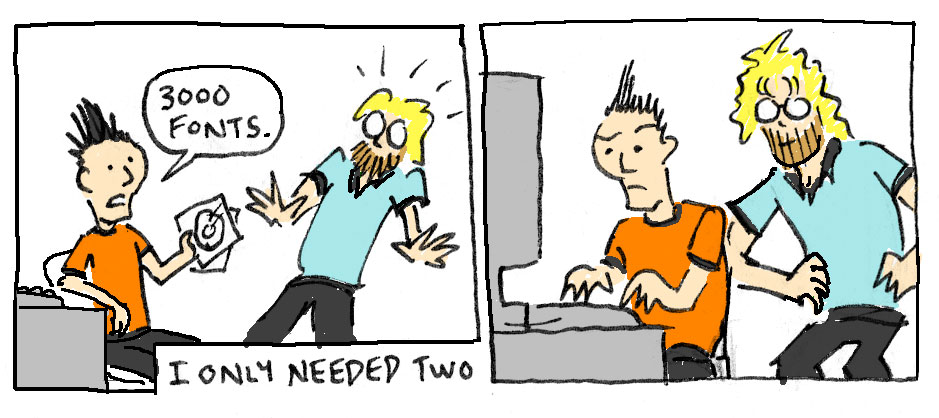
Mixed Media had its own office next to the Tap Room, which served alcohol before my time (hence the name), and is famous for being the site of an early, if not the first, Talking Heads performance.  When I was at RISD, this was a seldom-used space for music and drama, and tucked away next to it was a claustrophobic closet with a scanner, a Mac, and two desks.  The Mixed Media office.  Weekly meetings took place there, but no one attended besides editor Andy Dill, designer Sean Deyoe, and calendar organizer James Holland.  I had joked to Andy that he could take off for the issue, that me writing the whole thing was tantamount to guest editing it, and he was fine with that.  I sat down with Deyoe and explained that I wanted to have a lot of images.  Deyoe was a talented graphic designer, and had used MM as a place to experiment and play.  Because no one cared about it, the stakes weren’t high, but since it was a “real” publication, printed by a press on newsprint, it was a worthwhile project.

Deyoe was impressed (and later, probably bothered) at how many images I had ready.  This meant extra work for him.  Again, MM was dying of attrition.  The issue prior to mine had 16 pages (one of them blank) and 7 images, and the issue before that ran a paltry 8 pages (one of them blank) and featured three images.  Three!

Mine was a return to form:  32 pages with 64 images.

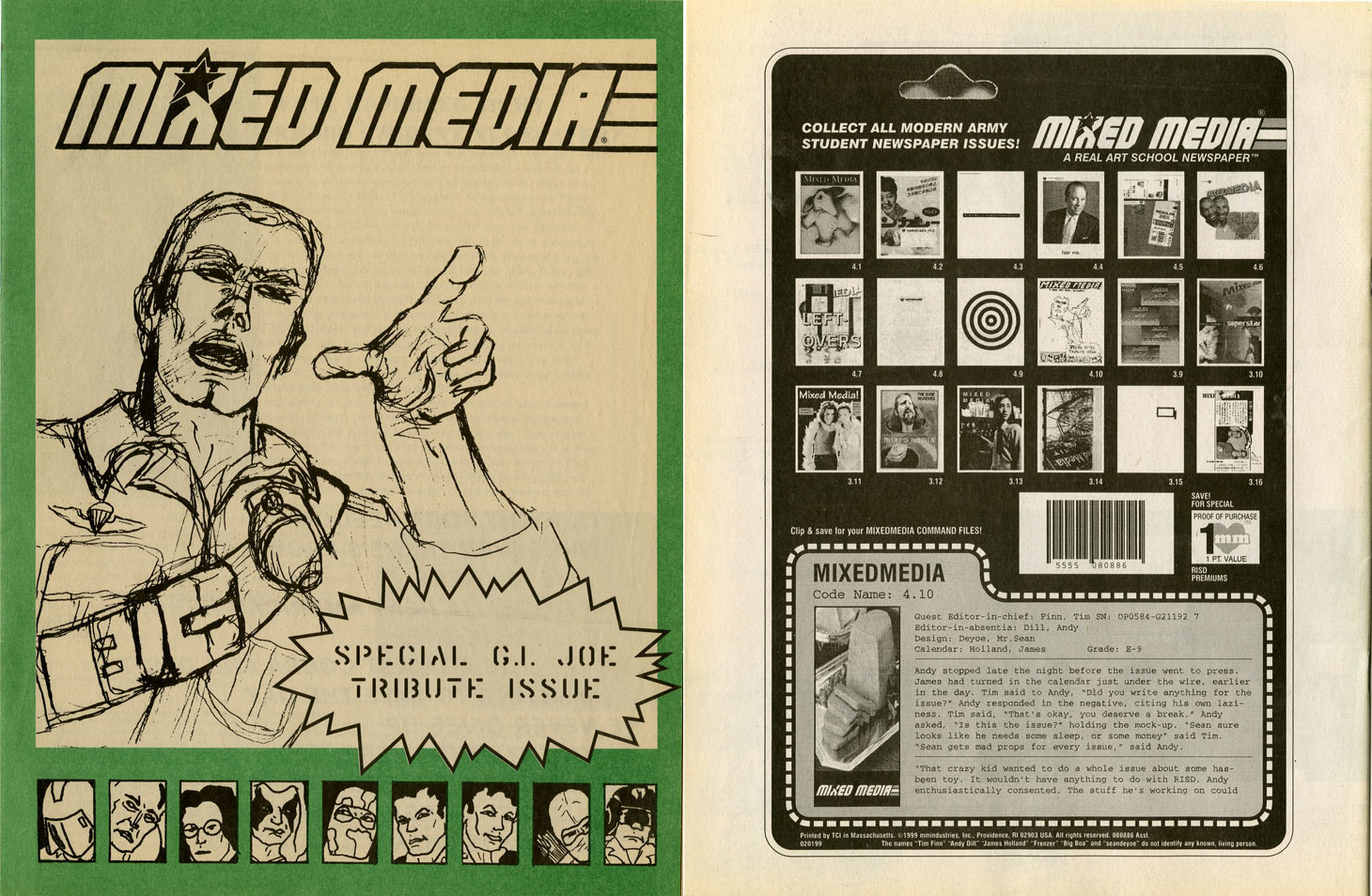
The contrast was clear.  I knew that even if people didn’t care for my content, they would notice this hefty issue, four times as big as the issue before the issue before.  Even better, Dill reasoned that since we had left over printing money from the previous few issues, we could splurge on mine, and offered a single color ink, something to go with the black.   The choice could only be a military green.  I solicited articles and art, and got three comics from friends, and polished my giant history and episode guide.  Holland brought in the calendar and I beefed it up with several fake G.I. Joe-themed events on and around campus, including a five-day Cobra invasion of Providence.   Deyoe scanned all my photos and comics, picked fonts, redrew the Cobra logo in Illustrator (for someone’s t-shirt design, not MM), and didn’t mind when I pitched him a back cover concept that would take longer to lay out than entire issues – a MM version of the 1980s Real American Hero toy card backs.  I also drew the cover, badly, which my roommate Peter Demarest, posed for.

"Tim Finn" "Sean Deyoe" RISD

Front cover/back cover, art by Tim Finn, design by Sean Deyoe

What happened when the print run arrived the following Monday?

Check back Friday to find out.  Next week kicks off my new posting schedule:  Mondays for small bits of art or commentary, Thursdays for these articles on the making of the book.

2 Comments

Filed under Prehistory

That First Time I Wrote a G.I. Joe Book – Part One

April 1998 covers by Bryan Konietzko and uncredited.

During my time at RISD the student-run newspaper was called Mixed Media.  At 8.5 by 11 inches and with very little news, “newspaper” might not be the best descriptor, but it was printed on newsprint.  It also floundered for several years.  You would think that with all these talented students there might be great artwork or reviews, but students were too busy to contribute.  The calendar was helpful, and a few interesting articles got people to write in, but this biweekly rag didn’t contribute much to the social and artistic life of the school.

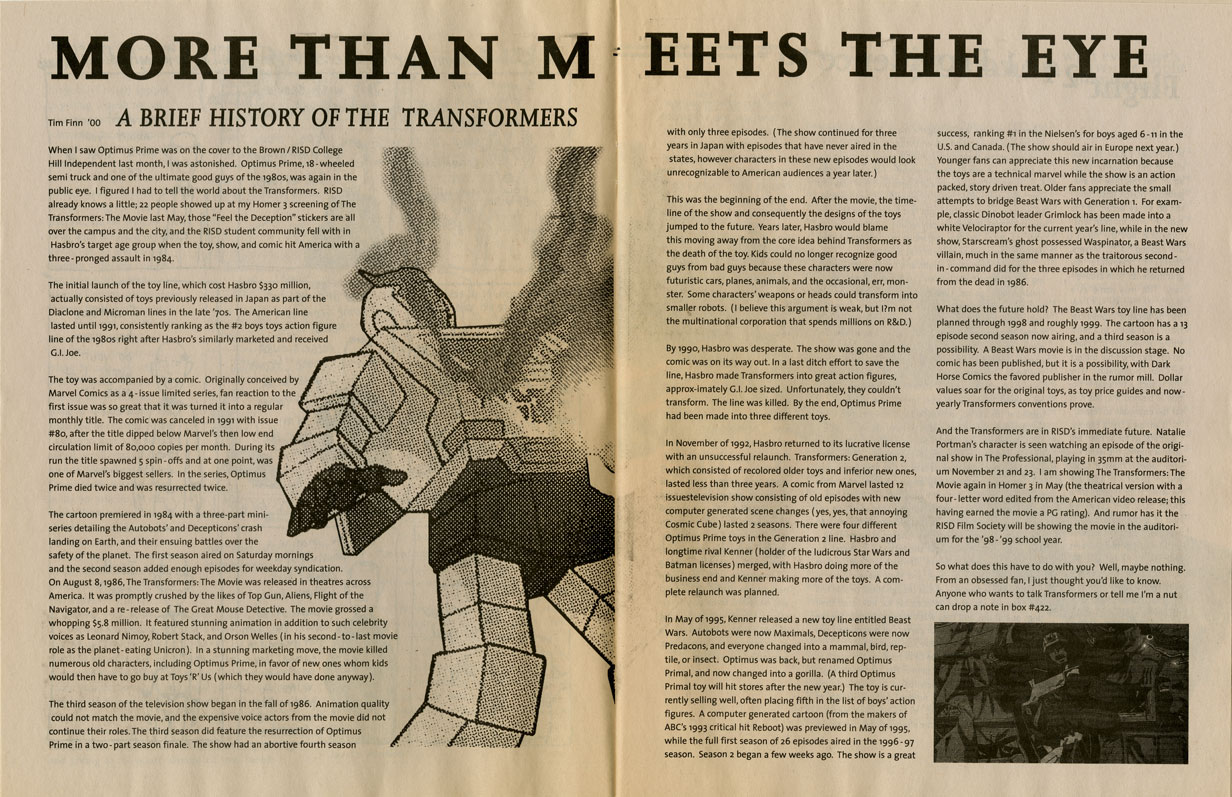
There was also a Brown-RISD newspaper, but RISD students had little to do with it.  Whereas Mixed Media was ignored, The College Hill Independent was widely read on at least one of those two campuses and it contained actual news.  In fall 1997 a cover illustration featured several 1980s personalities and pop culture characters.  One was Optimus Prime.  I was peaking in my unreasonable Transformers fandom – watching the old show on VHS, rising at six in the morning to catch the new one, attending the annual convention to sell my Transformers comic fanzine, and hiding Hasbro’s robots in my homework whenever I could.  (Or not actually hiding them.)  Since it didn’t really matter what was in Mixed Media, and the editor was always asking for submissions, inspired by that Independent cover I figured that an article on the history of Transformers wouldn’t get rejected.

It did not, and several friends responded favorably.  I was pleased to see my name in print and to spread the good word about my favorite fictional characters and their conquest of television airwaves, toy store shelves, and comic book sales charts.  And I noted that Mixed Media’s designers blew up one of the two images I provided, breaking up the staid column layout of the 2-page article.  I couldn’t help think that I had gotten away with something, that this publication that was supposed to be about RISD, and the issues facing its student artists and designers, had bent some rule in running a fluff feature on something so off-topic.

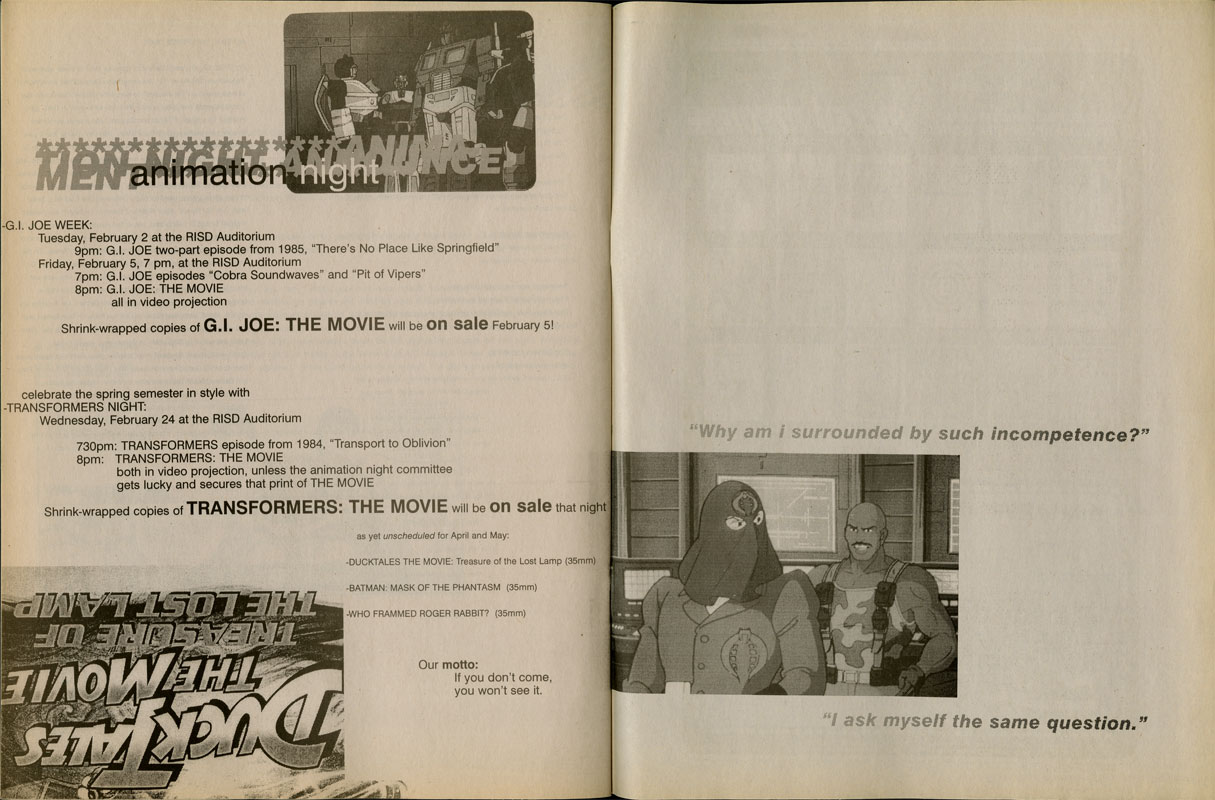
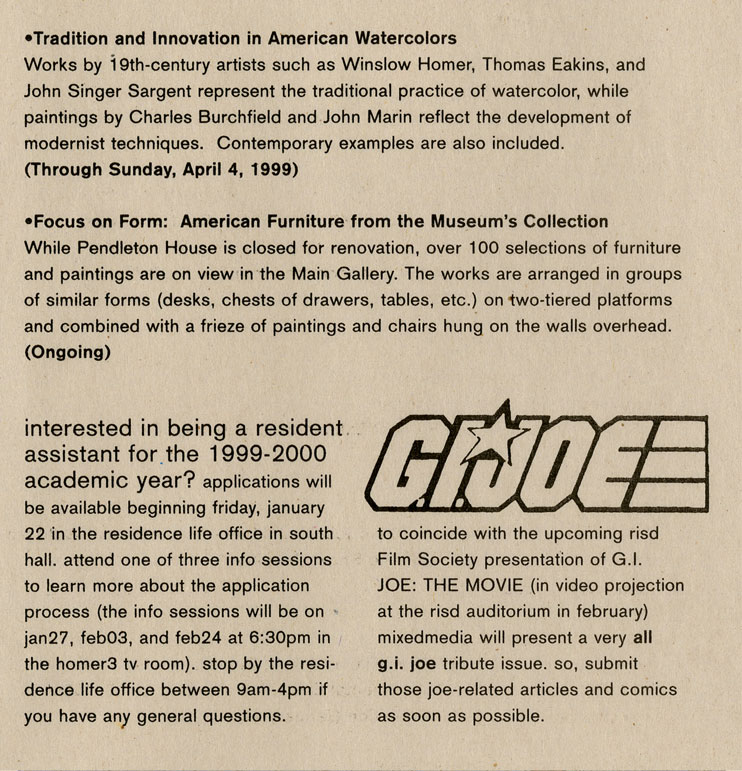
Announcements from Mixed Media v4 issue 8

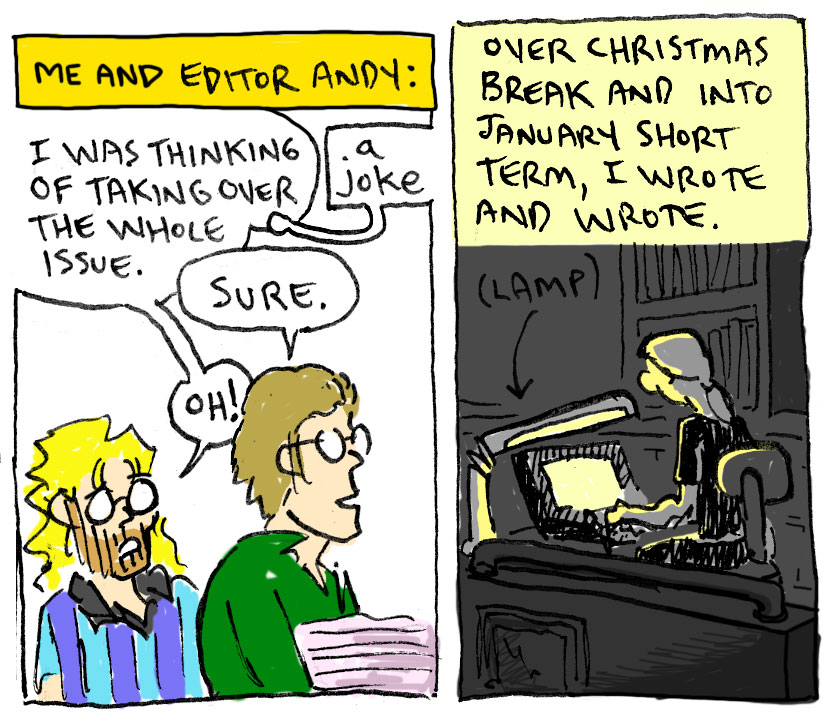
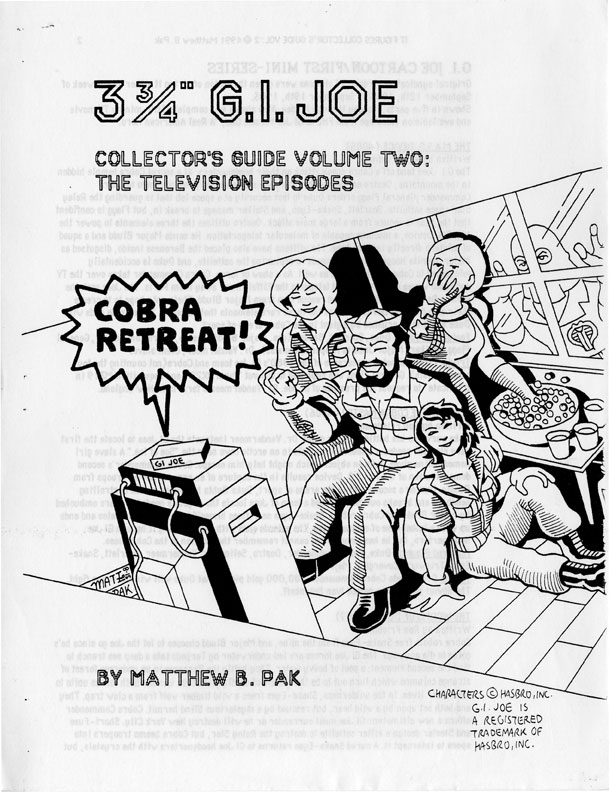
A year later, the newspaper had sunk to its lowest point.  Issues were short, content was light, and no one talked about it.  (To Mixed Media’s credit, it always looked great.  Graphic Designer Sean Deyoe used it as an ongoing experiment in layout, and started calling the publication mixedmedia or MM to refresh its identity.)  I was a junior, and I would skim each issue hoping for comics or anything spicy in the text.  This was still years before free news migrated to the internet and just as the school administration started communicating to students through e-mail.  Each student still received photocopied fliers and reminders in his or her regular postal mail box.  A senior in Film Animation Video named Andy Dill was editing Mixed Media by now, and was either distracted by his workload or losing interest in this dying rag.  Or both.  A few students thought Mixed Media had become an extension of Dill’s ego, a soapbox for him to stand on, even if no one gathered to listen.  We were friendly, but I didn’t know him well.  In November I mentioned that I was considering writing a G.I. Joe history as a companion to the previous year’s Transformers piece, and Dill was amenable.  I had seen entire issues of Entertainment Weekly given over to a single topic (like a Seinfeld episode guide), pushing out all the regular articles until the following week, and as a joke said that I might just write the whole Mixed Media.  Unphased, Dill said that was fine.  I typed all winter break, and into January, while my short-term class (the six-week one between fall and spring) bored me.  Instead of reading about Leonardo’s sketchbooks, I typed – mostly from memory and with little research – the entire history of G.I. Joe, borrowing liberally from Matthew B. Pak’s 1980s episode guide and cribbing a few bits from John Michlig’s wonderful GI Joe: The Complete Story of America’s Favorite Man of Action since I knew little about the 1960s Joe.

Matthew B. Pak’s episode guide cover. I’ve never ackowledged I cribbed from this for “Mixed Media” until now.

And this prose was building towards something else.

Sean Deyoe’s covers to the two issues preceeding my G.I. Joe one, January 1999

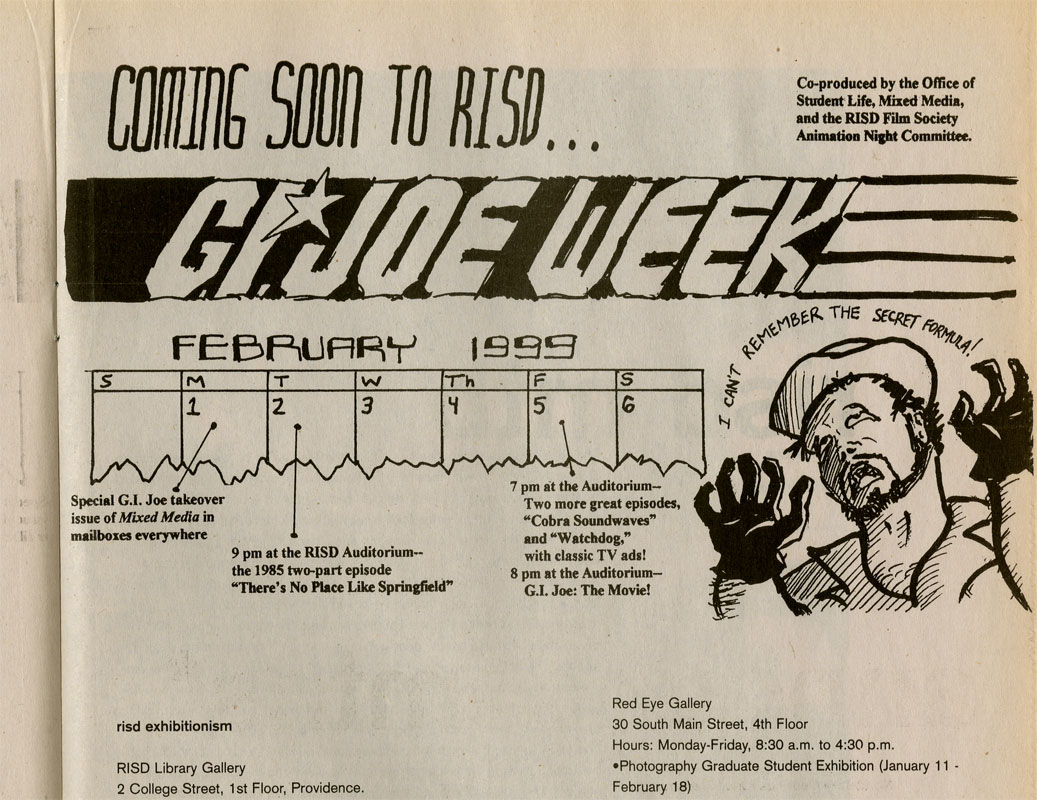
As a junior I ran Animation Night for the RISD Film Society.  This was a way to stretch our budget, as renting film prints from studios and distributors and paying projectionists all cost money.  But video projecting VHS tapes from my personal library cost nothing (public screening rights be damned).  That February I was organizing “G.I. Joe Week,” consisting of three nights of Joe-related screenings at the RISD Auditorium.  Mixed Media went to student mailboxes on Mondays, so this would be a great way to kick off this event that was really only an event in my mind.

Half-page ad in Mixed Media 4.9

How did it all go?  Check back next time to find out.

4 Comments

Filed under Prehistory

Why a book?

Welcome to the blog.  For ten years I’ve been quietly researching and writing the definitive “art of” and “making of” book on G.I. Joe: A Real American Hero.  I didn’t want to announce it because it was in process, and I didn’t want to act prematurely.  It is still in process, but now it’s time to start building up an audience and get people interested.  So a little background is in order.

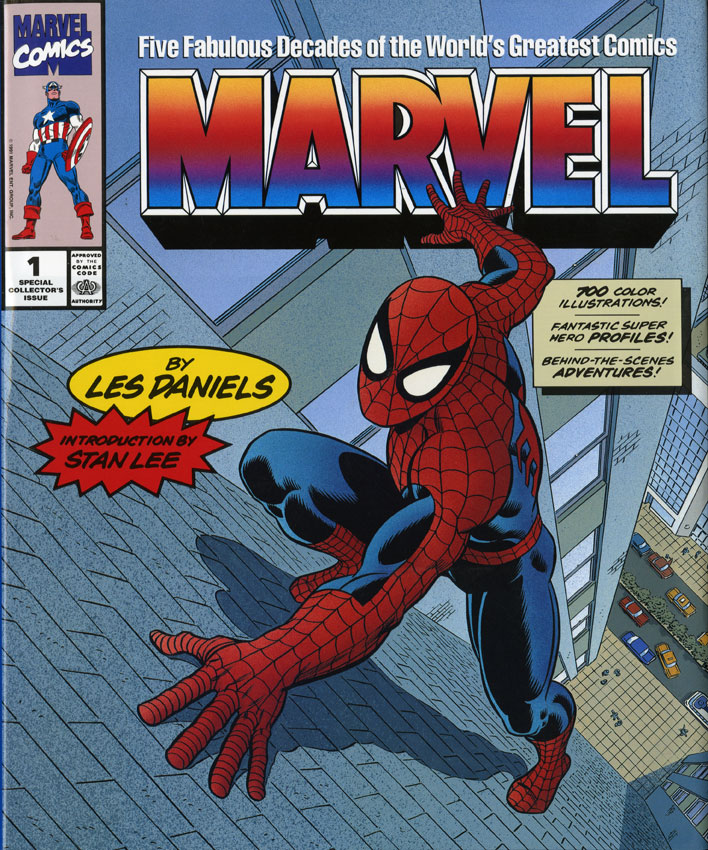
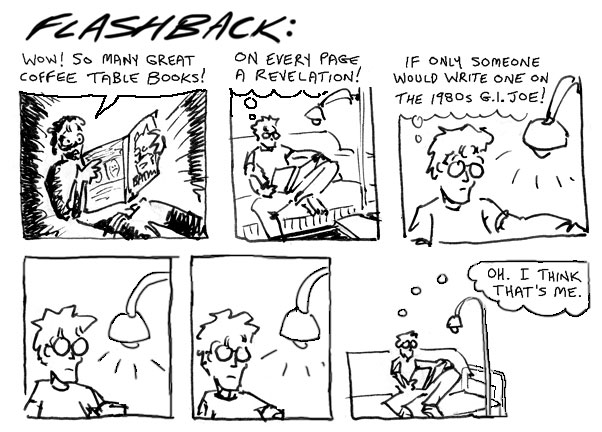
My brother and I received our first coffee table book as a Christmas present in 1991.  This was Abrams’ “Marvel: Five Fabulous Decades,” written by Les Daniels.  If you can take yourself back to a time before there were TVs for every airplane seat, movies on your phone, and instant video communication around the world, this was a big deal.  It was big, colorful, and bursting with information.  It was heavy.  I was just a kid, so sitting with the book was a physical investment.  Daniels broke down the history, characters, and personalities of Marvel Comics in an accessible way, and besides the text and the photographs, the book also reprinted four comics stories.  We were predisposed to Marvel, as we were already reading several monthlies from The House of Ideas before we met our first DC one.

Coffee table books had been on my mind even before then.  My father was (and is) a book collector, and our whole family read.  At the top of our staircase was my father’s collection of war and history paperbacks and aviation journals.  In the living room were two imposing bookshelves of his non-fiction and historical hardbacks.  On my mom’s night stand were her current run of fiction bestsellers, paperbacks that leaned towards drama, suspense, and a bit of romance.  In the guest room was the 1977 Encyclopedia Britannica.  And most importantly, on the coffee table in our family room, the room where we spent most of our time, were car and airplane magazines, and at all times, one coffee table book.  I never looked at them because I wasn’t interested in Vietnam, Korea, or WWII.  But the size and beauty of these tomes was not lost on me.

After Kevin (my brother) and I got that first book, one or two followed every year for Christmas and birthdays.  Daniels’ analogous history for DC Comics, the Reeves-Stevens’The Art of Star Trek.”  And on.

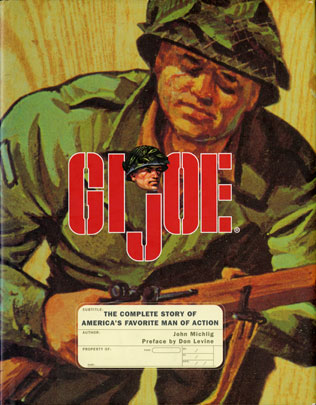
Kevin and I were playing with G.I. Joe figures and vehicles, watching the weekday cartoon, and a little later, reading the monthly comic book.  We were less involved with G.I. Joe in September 1992 when Warner Bros. and FOX teamed up for the eye-catching “Batman: The Animated Series.”  This show looked like nothing else on television – and the look is often all that gets recognition – but the writing and pacing were novel as well.  As I moved from middle school to high school, and then to college, my toy-playing turned into toy collecting.  And it was in college that a pair of books were published that would change everything:  John Michlig’sGI Joe: The Complete Story of America’s Favorite Man of Action,” and Paul Dini and Chip Kidd’sBatman Animated.”

Michlig’s is the definitive history of the 1960s and ’70 GI Joe action figures, the 12-inch ones that later made famous the term “Kung Fu Grip.”  These figures meant nothing to me, but Michlig’s book made me a fan.  With first-hand accounts and documents, eye-catching photos of production art and sculpts, plus historical context, this book makes the 12-inch Joe come alive.  And more importantly, makes me appreciate what went into creating an entirely new toy category – the action figure.  The writing is taut, and Michlig’s enthusiasm shows through without feeling cloying.

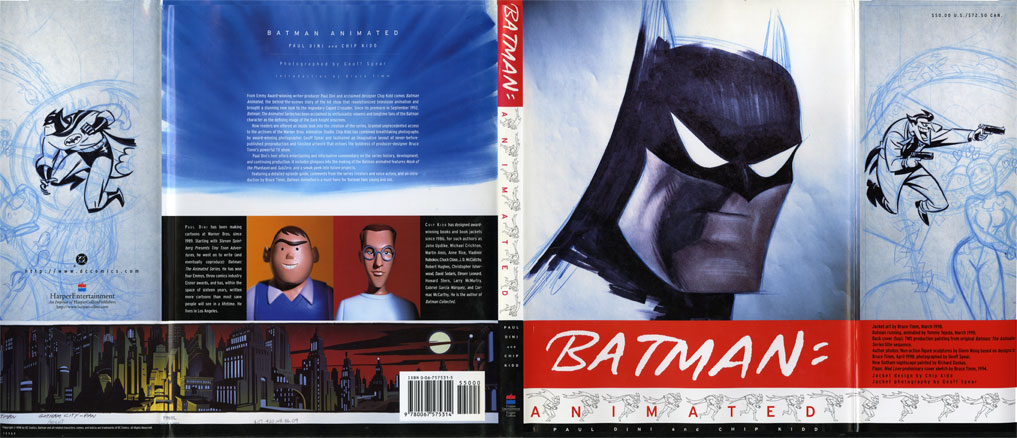
full dust jacket to "Batman Animated"

The Dini/Kidd book is striking for its design.  This could have happened even with a less aggressively laid out book since the source material is so visually novel, but “Batman: Animated” becomes its own art object for its alternating black text on white and white text on black, its arrangement of pictures and text in changing columns and grids, and the photography of Geoff Spear, who makes even a tame Kenner action figure feel like a monumental sculpture.  The only drawback is that the book leans too heavily on one artist who contributed to the TV series, but I overlook that because all the included drawings, paintings, and ephemera are so strong.

So there I was in the winter of 2000-2001, catching up on the reading for pleasure I hadn’t done in college.  I plowed through Michlig and Kidd, and thinking back to the other coffee table art books on my bookshelves still in Maryland, wondered when either of these authors might make such a book on the 1980s and ‘90s G.I. Joe.  My G.I. Joe.

But these men were a generation removed.  They wouldn’t write that book because this G.I. Joe wasn’t theirs.

And so I realized that I would have to.  Fortunately, I already had, in a fashion.  More on that next time.

6 Comments

Filed under Coffee Table Book Inspiration, Prehistory