
Having a ninja commando on the team was just the start. In 1988, G.I. Joe got a real-life samurai in the form of Budo. Here’s his action figure sculpt input sheet.
Figure art, above, by George Woodbridge. Accessory art, below, by Mark Pennington.
Having a ninja commando on the team was just the start. In 1988, G.I. Joe got a real-life samurai in the form of Budo. Here’s his action figure sculpt input sheet.
Figure art, above, by George Woodbridge. Accessory art, below, by Mark Pennington.
Filed under G.I. Joe Behind the Scenes, Toys and Toy Art
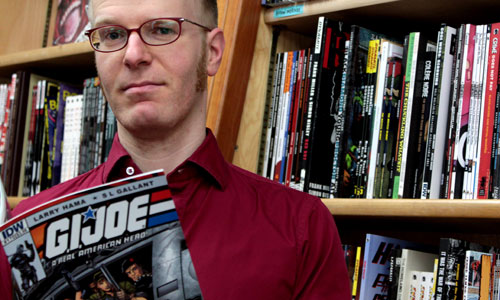
Not much touted here is the fact that I own a comic book store. It’s a recent development, and with our renovations still ongoing (shelves, paint, lights, awning, website), it’s a little harder to blog and write. On the plus side, our customers always have IDW’s full line of G.I. Joe comics and graphic novels to choose from. Both myself and the store are in this week’s issue of DigBoston, a free arts and nightlife newspaper, and I manage to give some attention to Real American Hero.

A longer version should be online in a week. Thanks to interviewer Corey Estlund, photographer Jamie Meditz, and art director Scott Murray for the kind coverage.
Filed under Back issues, Hub Comics, Reading comics
Part 1 – [2] – [3] – [4] – [5] – [6] – [7] – [8] – [9] – [10] – [11] – [12] – [13]
In our last episode, Tim stretched out this story of getting into G.I. Joe comics by also including Marvel super-hero books like Uncanny X-Men. This week he gets back to G.I. Joe. Sort of.
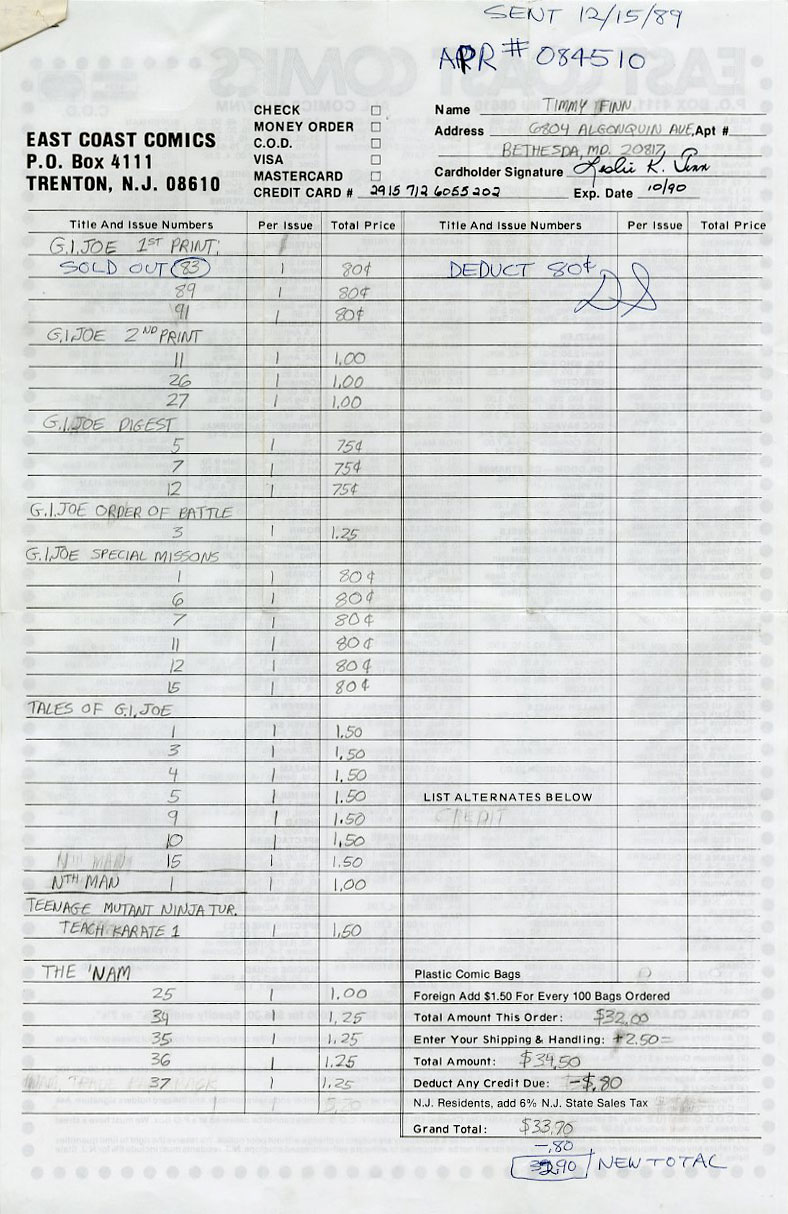
After that first mail order in the early summer when my brother Kevin and I got 11 G.I. Joe back issues for $22, we were hooked on the process. New Jersey-based East Coast Comics, the fine retailer that had filled that first order, was smart to include an updated catalog (a pamphlet, actually) with it, and some months later we gathered our pennies and plotted to fill more holes in our G.I. Joe run. At this point, the series is on issue #95 or thereabouts, so we’ve got 70 comics or reprints to track down. Several options offered opportunities to get those comics, each just uninteresting enough that I will probably blog about them individually on upcoming Fridays – finding other comic book stores, attending our first comic book convention, sampling a mail order company beyond East Coast Comics. But for today: Our second and third mail orders.
This probably doesn’t mean anything to you, but for me this image is all nostalgia: The handwriting of my 11-year old self, my mom’s signature, specific G.I. Joe gaps we were attempting to fill, the fact that I still didn’t understand what “Alternates” were – (second choices in case a comic was sold out, so East Coast didn’t have to issue credit slips), and the fact that we were trying out a new series (Nth Man, Ninja Turtles Teach Karate).
Also, memory is funny in how often it turns out to be wrong: This scan concretely places when we bought issue #36 of The ‘Nam, meaning I was incorrect a few weeks back in this very blog. I must not have bought that issue at the Montgomery Mall Waldenbooks as 6th grade began. Apparently it arrived by mail a few months later. I have no recollection of receiving this box, although I do remember thinking Solson’s TMNT book was an amateurish affair, remarkable considering how amateurish the production in Mirage Studios’ actual Teenage Mutant Ninja Turtles was. So this must have arrived right around Christmas of 6th grade. Anyway, there it is, what was probably our second ever mail order.
But let’s skip a few months ahead to spring of 6th grade. The first two mail orders have arrived quickly. Kevin and I have saved up enough money to place a big order, and with East Coast selling many issues for less than a dollar, this was not going to be 10 or 15 comics. No, this time we ordered 40 G.I. Joe back issues. It was bold, exhilarating, and nerve-wracking. Even though we were clearly comics buyers by now (Joe, The ‘Nam, Marvel super-hero books, Ninja Turtles), it’s still a transition from being boys who spent money on toys to boys who with our own money bought things to read. (Chapter books and the occasional Garfield collection were paid for by our parents.) This shift represented, in a very real sense and not just symbolically, us growing up and away from childhood. We bought toys and played with them for a few more years (me much longer than Kevin), but toys’ days were numbered the moment I bought that first Joe comic. (Except for me becoming a vintage toy collector, another topic for another day.)
My friend Will (Hi, Will), also in 6th grade with me, was becoming a comics reader as well. And comics had a certain currency in my tiny classroom. One friend talked about Wolverine. I drew a cutely terrible Batman parody in my notebook. And new G.I. Joe issues did appear each month concurrent to all this. But as the weeks went by, I got anxious about this big mail order. Why was it taking so long? Why was it taking weeks when the earlier order had only taken one? Was the package lost somewhere en route? Did East Coast abscond with our money? Was the parcel stolen from our front stoop? During lulls in class I would fantasize to Will about what it would be like to open a box with 40 comics in it. To instantly more than double the size of our collection.
The specific scenario I kept painting went like this: Arriving home one day, I’d notice our screen door propped open, even though it always closed shut on its own. Something must be in the way, something I couldn’t see from the car. We parked. I approach cautiously. Now the box is revealed: It’s eight feet tall, cardboard, sealed with packing tape. It can only be one thing. It can only be an East Coast Comics parcel bursting with comics. Literally, the box edges are no longer straight, parallel, and perpendicular, as if the comics are forcing their way out, the packing tape starting to tear, like a cartoon container for some magical energy, some tazmanian devil, some pressurized tank ready to explode. Inside the house I cut it open, but a tidal wave of newsprint pages and glossy covers, G.I. Joe comics the likes of which I’ve never known, surge out as if from a fire hose, like an avalanche, pushing me back, smothering me, the sound like the crash of beach surf!
Will and I said this to each other in a stage whisper, as I’d act it out in my seat, making the rumbly sound effect for the shower of comics. It was a vignette we’d quietly pantomime for each other, sitting in our seats during a lull in class. Will’s enthusiasm only reflected back on me, and the wait only became more difficult.
WHEN WOULD THE BOX ARRIVE?
Filed under Back issues, Reading comics
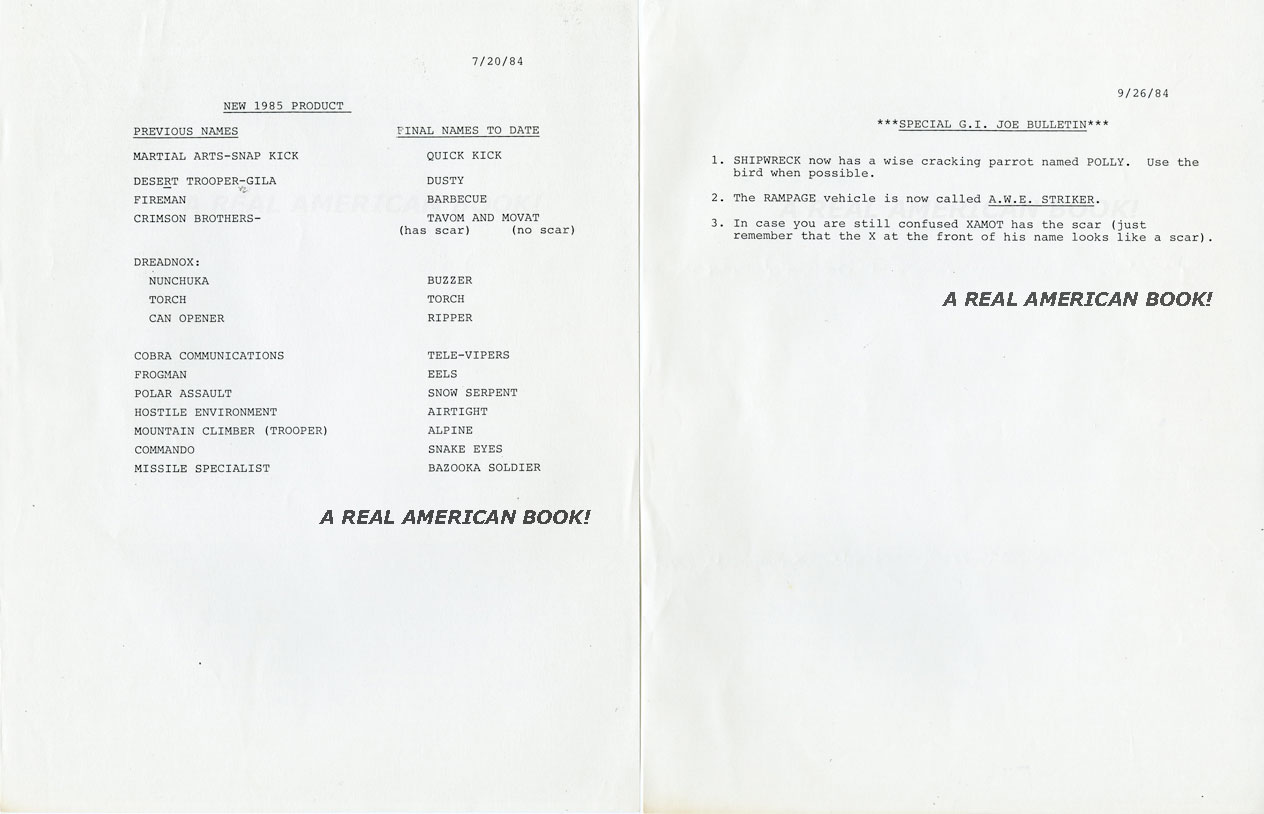
In the 1980s Sunbow Productions, based in New York but with an office in Los Angeles, oversaw production of the animated G.I. Joe cartoon. Because the show was so intensive — dozens of characters, props, vehicles, and locations, the show bible and “briefing books” were by necessity large three-ring binders filled with photocopies of model sheets, sample dialogue, photos of toys, and lists of names. All in an effort to properly and correctly feature and advertise Hasbro’s product. Today’s post is two photocopies of memos to the west coast producers and story editors, likely from Terri Gruskin in NY.
You may find posts like this — without artwork, or imagery of characters or people — to be dry. But I find such documents fascinating. In this case because it’s a reminder that the whole process was a series of revisions and rolling changes. And even though the memo is unsigned, it’s a concrete document showing a decision being made, and representing the dissemination of that decision.
Also, mid ’84 appears to be when Tomax and Xamot’s names were finalized. (Without Hasbro documents it would be unfair to call this definitive, but presumably there wasn’t a lag between the decision in Pawtucket and the directive in Los Angeles.) It’s notable that the TV ad for Marvel Comics’ G.I. Joe issue #37 (printed in spring 1985, but the ad was in the works 6 to 12 months prior) refers to them only as “evil twin brothers,” so their names were in flux while (presumably) Legal cleared them.
Filed under Animation, G.I. Joe Behind the Scenes
Not much to say about this, except that it hangs on my wall and is a wonderful piece by Ron Wagner and Bob McLeod. It’s been great to see Wagner back on G.I. Joe at IDW, and there are twenty books from Marvel and DC I wish Bob McLeod were inking. His talents are stellar, and it’s unfortunate he’s not active in the industry. Click to enlarge:
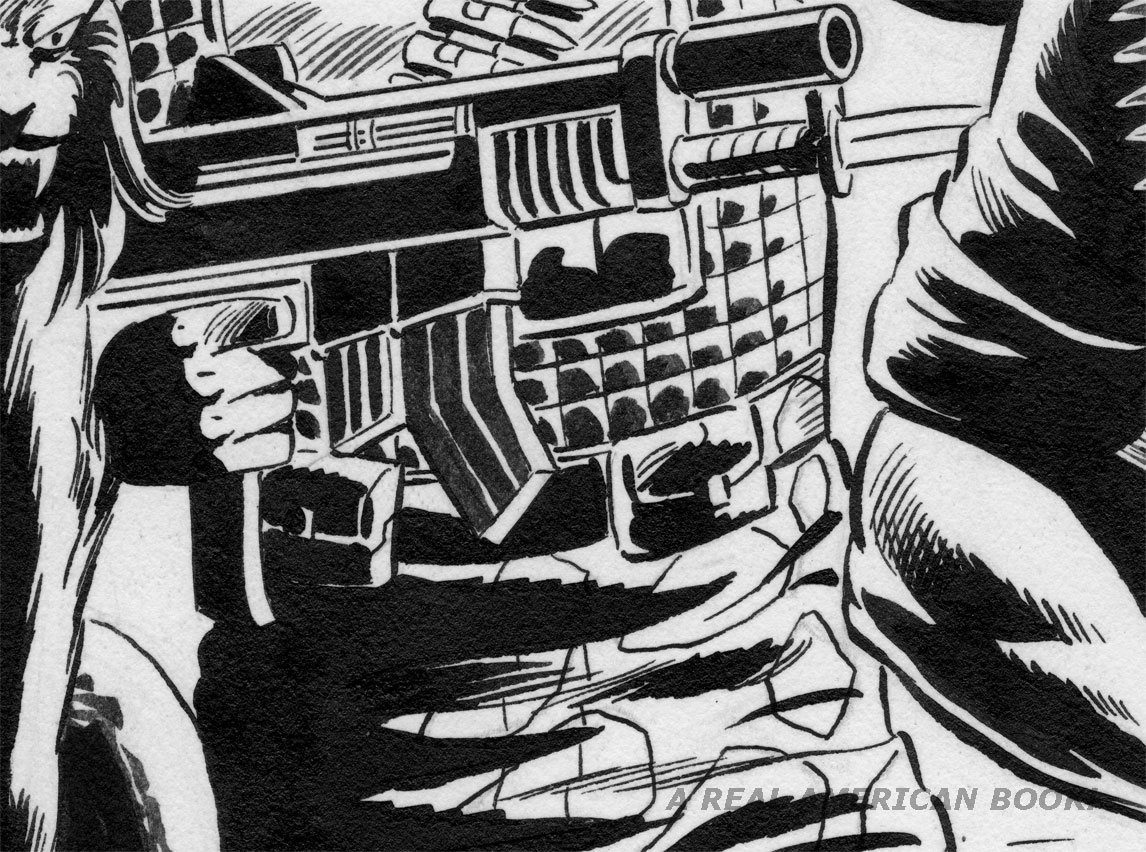
Part of the thrill of this image is that it pairs the obscure Spearhead (and his lynx, Max), who never showed up on the G.I. Joe cartoon and barely appeared in print, with the slightly higher profile Tunnel Rat and Airtight. And it’s replete with mood, and just wonderful, wonderful spotted blacks. Here’s a detail.
Here’s a great example (not from G.I. Joe) showing how much decision-making can go into inking. McLeod’s website has numerous before and after examples, some where he maintains the style of the pencil artist, others where he’s given more leeway and adds much of himself. And then another page of such examples.
Filed under Comic Books, G.I. Joe Behind the Scenes
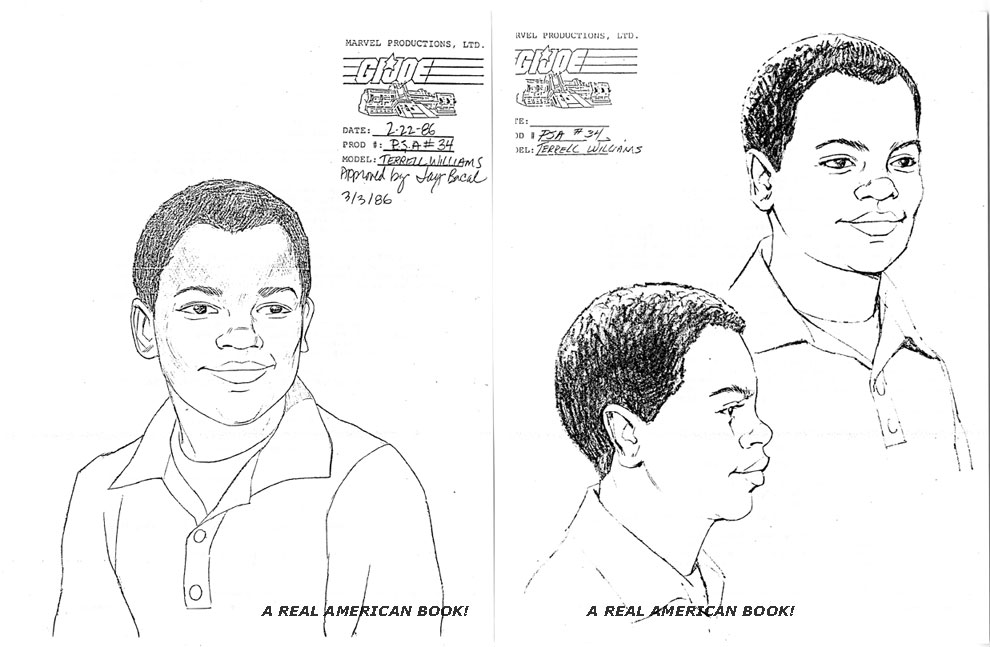
Prose recollections of my life as a G.I. Joe fan continue next week. In the meantime, to celebrate Jim Sorenson’s announcement about his book of G.I. Joe animation model sheets (I helped out a little bit), today’s post features the model sheets for the two boys in PSA #34:
Thanks again to YouTube user PSAGIJoe for uploading the original public service announcements.
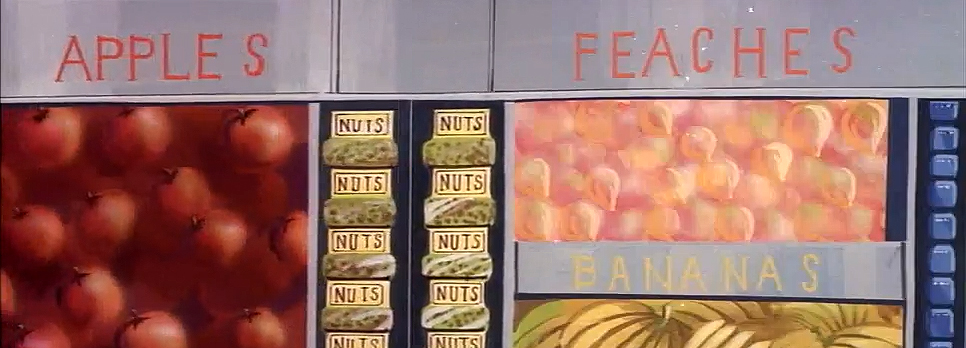
I love this one for its mild message about nutrition, rather than the more severe topics of theft, vehicular injury, and death by asphyxiation, as well its catalog of animation mistakes: the color pop on Lifeline’s backpack, the terrible animation of the trio biting and chewing, Lifeline’s ability to talk without chewing, the oddity of bumping into a special forces operative single-handedly juggling fruit while… waiting for us? Also, that weird apple vending machine thing.
Is this just a poorly designed shelf? Are those apples floating in zero G? Is it a graphic of apples printed on the front surface of an apple vending machine? It’s in no way important, but to me it strikes of the cultural divide between America and Japan (or Korea) crossed with an impending deadline. I don’t have the storyboard for this PSA, but I’ll guess that the backgrounds weren’t fully fleshed out. Photocopies went to the animators overseas, where retail stores are a little different, and some talented background painter whipped up this contraption:
Anyway, here’s Terrell Williams and “boy,” all ready for their close-ups.
They’re unsigned, so I don’t know who drew them, but looking over the list of G.I. Joe model designers, I’d guess Carol Lundberg, John Koch, or William Draut.
Filed under Animation, G.I. Joe Behind the Scenes
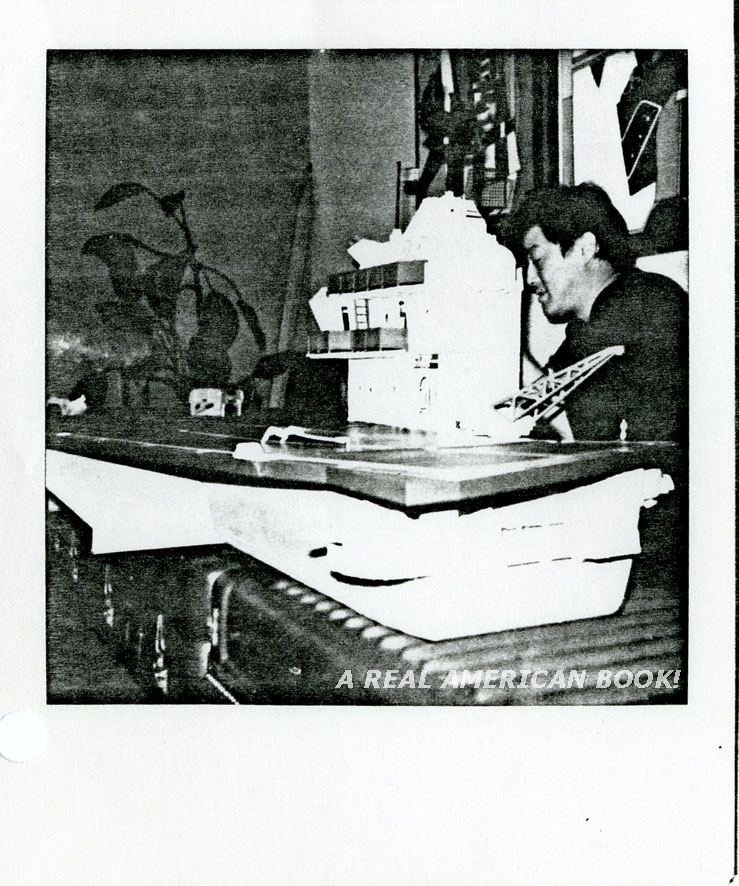
This is a fun one. Between the occasional Wizard or ToyFare article, G.I. Joe fan website, and Hama’s own Facebook page, it’s not too hard to find shots of Larry and G.I. Joe toys. It is hard to find any where the toys outsize him. But then the USS Flagg outsizes us all.
I don’t know where the original Polaroid (seen here as a photocopy) is from, but I have a lead I can look into (and should have already!), but my guess is either at Hasbro in Rhode Island or Toy Fair in New York City, February of 1986 or 1987. Probably not the Marvel office in NYC. Less interesting, but still a captured moment in time from the same series is another angle, sans Hama.
Filed under G.I. Joe Behind the Scenes, Toys and Toy Art
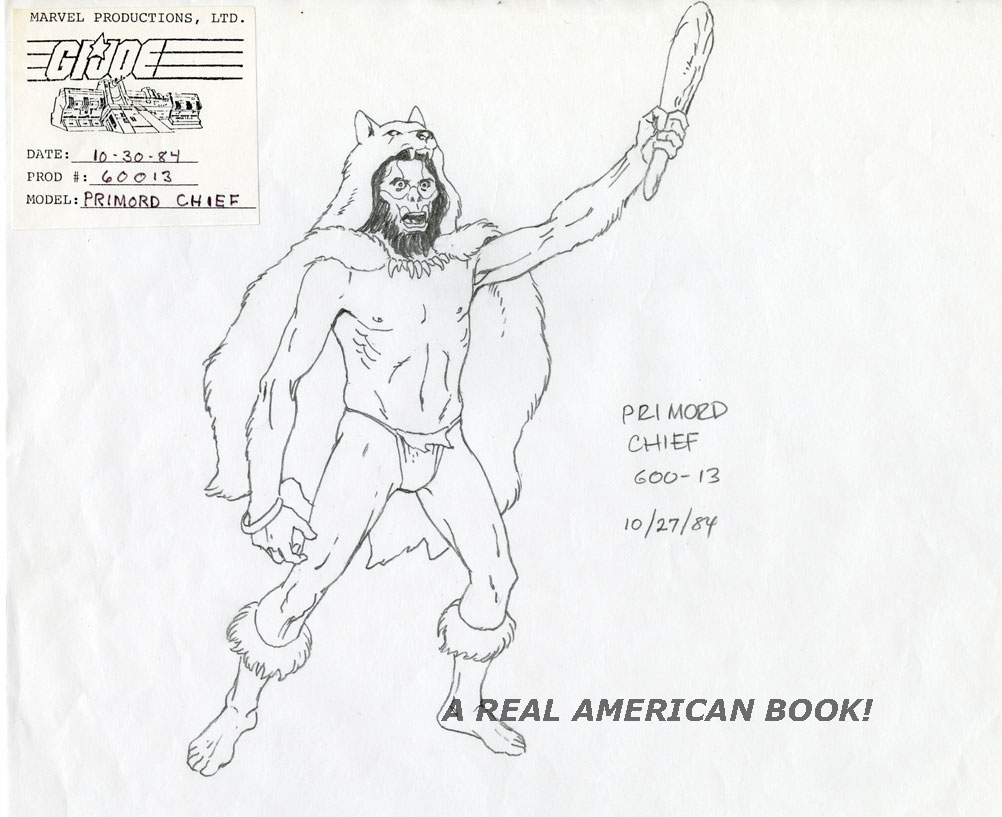
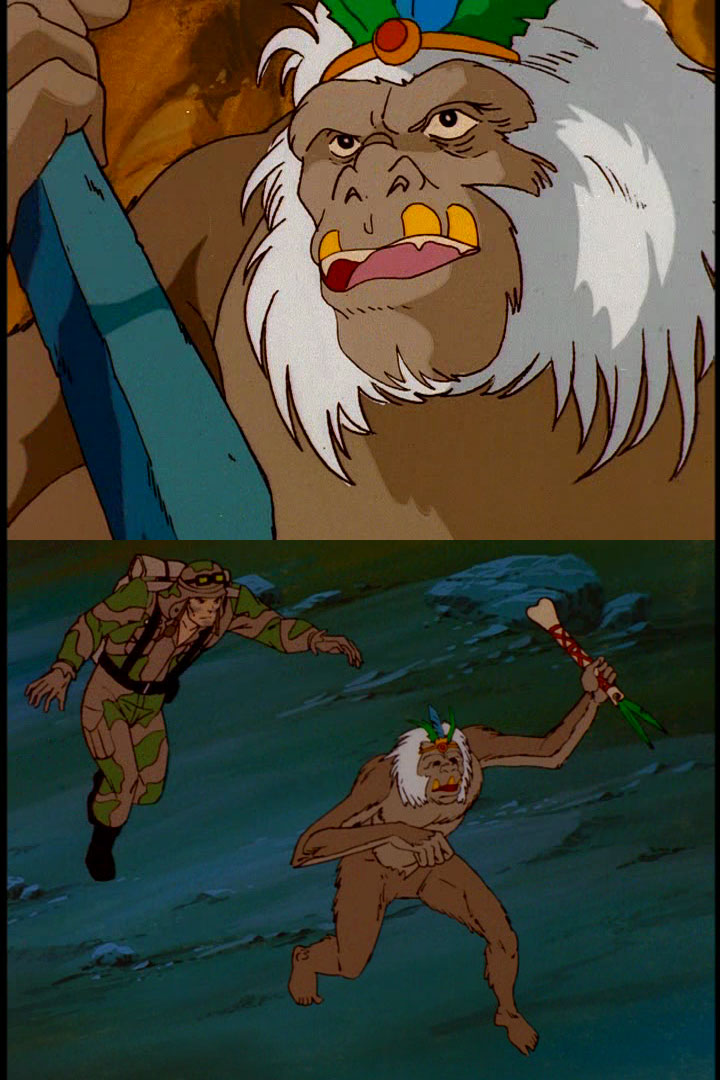
In this Ted Pedersen-written episode of G.I. Joe from 1985, “Satellite Down,” the Joes track a lost satellite to somewhere in an “unexplored region” of Africa. There they meet a tribe of primitives called Primords, who worship the satellite as a god. And Storm Shadow and Spirit fight!
Here’s Russ Heath’s original artwork (pencil on animation bond — I cropped out the punch holes) for one version, unused in the episode, for the Primord Chief.
Filed under Animation, G.I. Joe Behind the Scenes
Part 1 – [2] – [3] – [4] – [5] – [6] – [7] – [8] – [9] – [10] – [11] – [12] – [13]
In our last episode, Tim went on a tangent from describing buying G.I. Joe comics and this week the tangent expands!
The title of this series of articles refers to G.I. Joe issue #90, and how scanning just a few pages kicked off a sequence of events that turned me from a G.I. Joe fan who liked reading into a comic book collector/reader for life. And how one issue of G.I. Joe became the next one, and then the older ones, and all the newest ones, and then The ‘Nam.
But something had to bridge my brother and I into the Marvel Universe proper, since Joe and The ‘Nam were both in their own universes. Kevin and I didn’t know anything about super-heroes, which is what most of Marvel and DC Comics publish. To put this in context, it’s important to remember than in the 1980s, super-heroes had no cultural footprint. My 2nd grade sticker album had a Colossus sticker (from a junk store or a birthday party favor), but I had no idea who he was. The Superman films crashed and burned with the embarrassing Quest For Peace. The Incredible Hulk was relegated to a few made-for-TV movies that were more dramatic than super-heroic. The 1966 Batman TV series showed up in reruns some summers, but it had little effect on us. Spider-Man and his Amazing Friends was over, and we hadn’t ever watched it anyway. I didn’t pay attention to the Amazing Spider-Man newspaper strip, but if I did I would have noticed how little happens. This is still a decade and a half before Marvel’s live-action films, starting with Blade and X-Men, shook up Hollywood. It’s still years before Fox’s Spider-Man cartoon, Fox’s Batman: The Animated Series, and any live-action Batman sequels.
So rather than super-heroes plural, we only had a sense of Batman. Certainly the Batmania of 1989 was enough for our pop culture appetite, but in terms of comic books, there was no entry point. Whatever was needed to get us into DC Comics hadn’t happened yet. But in the pages of G.I. Joe and The ‘Nam were checklists and ads for other Marvel books. And the Marvel logo on the top left corner was familiar, so if we were to try out something super-heroic, it would likely be Marvel. So as 6th grade was winding down, a full year after we started G.I. Joe, Kevin led the way into the Marvel Universe, tugged by the giant gun and overwhelming coolness of this:
And what a perfect entre. The Punisher isn’t a super-hero, but he interacts with them. As a Vietnam vet, Frank Castle was the bridge to the other two comics we read – one about Vietnam and the other with occasional flashbacks to it. And again, we were boys who liked guns. The Punisher may get slammed or ignored for being a one-note vigilante book, but that’s an unfair judgment. Even the stories lacking pathos are exciting action tales, and a handful of stories from the 1980s – notably Grant and Zeck’s “Circle of Blood” and the odd Mike Baron yarn – are smart and compelling. And to my surprise, Garth Ennis’ 2004-2008 run on the character comprises some of the most satisfying comics I’ve ever read. (But they’re bloody and grim, and not for everyone.)
A month after Punisher War Journal #19, we picked up (the regular) Punisher with issue #35, which happened to be the start of a 6-part, biweekly-shipping story arc. Two months later, we took the super-hero plunge with Uncanny X-Men #268. (Which doesn’t modestly flaunt super-powers since the three spotlight characters in this one issue don’t fly or shoot eye beams.) Another two months later it was Daredevil, with issue 286. Again, another grounded hero. While Matt Murdock does have enhanced senses, he doesn’t fly and he doesn’t shoot eye beams, and his costume is as restrained as super-hero tights go. And even if he had been over the top, we were primed by now. Somewhere in there was Wolverine #24 as well, a character a friend in school had talked up. (And written a paper about.)
I don’t want to overdo it on this street-level, depowered bit. Super-heroes with fantastic powers could well have grabbed us earlier, and we would likely have accepted it. Sci-fi and fantasy were a-okay in ours books. I loved Transformers and Tron, Kevin was getting into Dungeons and Dragons, and we both liked the animated G.I. Joe: The Movie, even with its 40,000 year-old Himalayan snake man who wants to conquer Earth. Make that re-conquer Earth. But the path is worth noting, that we didn’t jump into super-heroes immediately. It probably says more about culture than us. Had we been born five years later we’d probably have been watching Ninja Turtles and Power Rangers instead of reading the black and white Turtles book and ignoring Power Rangers.
During that first year, while purchasing only 6 monthly comic book series our collection went from one comic book to more than fifty. You’ve already read about that first mail order shipment, but what was different about the next one? Tune in next week to find out!
Part 1 – [2] – [3] – [4] – [5] – [6] – [7] – [8] – [9] – [10] – [11] – [12] – [13]
Filed under Prehistory, Reading comics