
My article for TheFw is up. Read it here!
My article for TheFw is up. Read it here!

As previously mentioned here, in the mid-’80s freelance artist Dave Dorman painted fully rendered presentation pieces of characters already sketched out by figure designer Ron Rudat. These were internal-only to Hasbro, and not intended as package art or for public consumption. Even at this stage, a Joe or Cobra could still get nixed. From 1986, here is an idea for a Dreadnok that didn’t make it further. Note the misspelled name. Continue reading
Filed under G.I. Joe Behind the Scenes, Toys and Toy Art

Sorry it’s been so long since the last update! To tide you over for a few days (just a few days, I promise), Matt Dillon of Leaky Suit Brigade has just posted an interview with Andrei Koribanics, Hasbro G.I. Joe designer who drew some art I posted here a few months back. Nice work, Matt!
Filed under G.I. Joe Behind the Scenes, Toys and Toy Art
 Andrei Koribanics freelanced for Hasbro in the mid-1980s. Besides today’s Borer art, I’ve also come across a figure concept by him (that may end up in Chapter 14 of my book) and the presentation painting of Sgt. Slaughter’s Renegades (in Chapter 6). Leaky Suit Brigade has a tiny interview with Koribanics, and should have a longer one up at some point. Continue reading
Filed under G.I. Joe Behind the Scenes, Toys and Toy Art
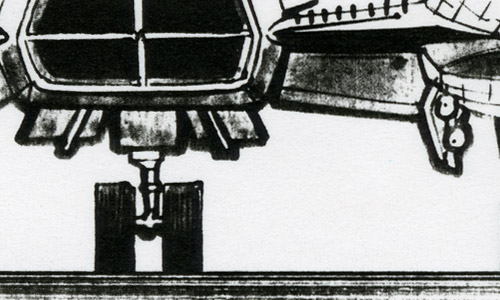
Steve Reiss attended CCS, the College for Creative Studies, before it had that name, back when it was called Society of Arts & Crafts in Detroit. It had long been a school with a reputation for vehicle design. After Reiss joined Hasbro in 1985 he was soon designing G.I. Joe vehicles, like the stunning 1986 Cobra Night Raven, based on Lockheed’s also-stunning SR-71 “Blackbird.” For your reference, here’s the real thing:
 And here are Steve Reiss’ six pages of designs, the basis for a rough, three-dimensional model.


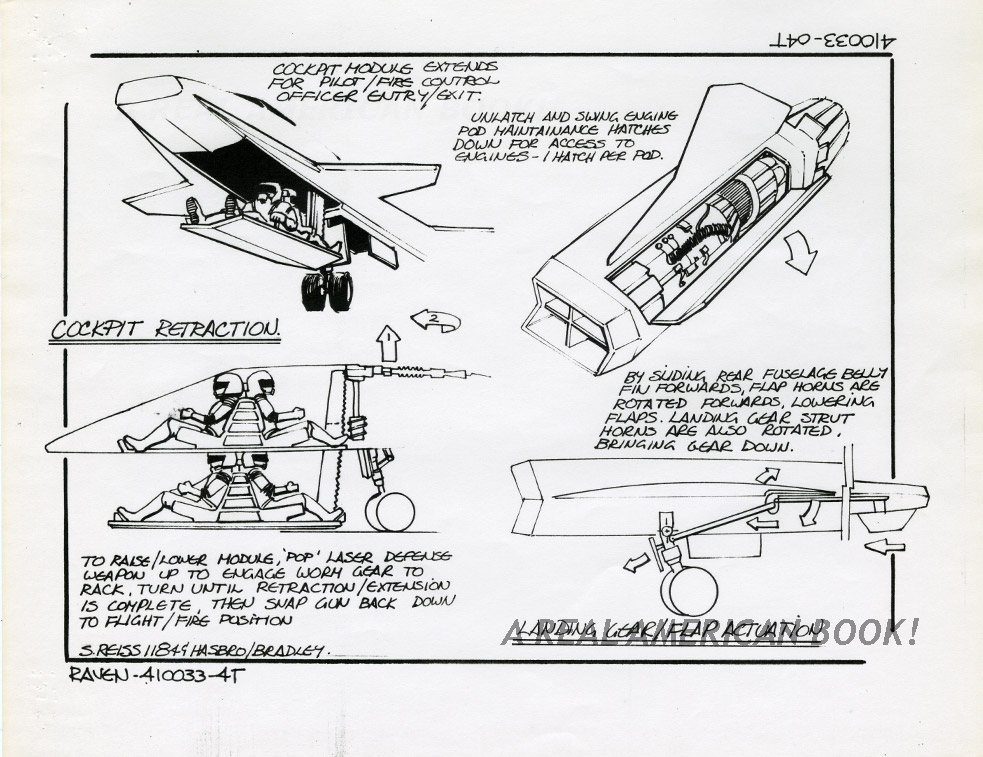
For play value, Reiss added a one-person drone that latched onto the top of the larger jet:

And here’s the parts breakdown.
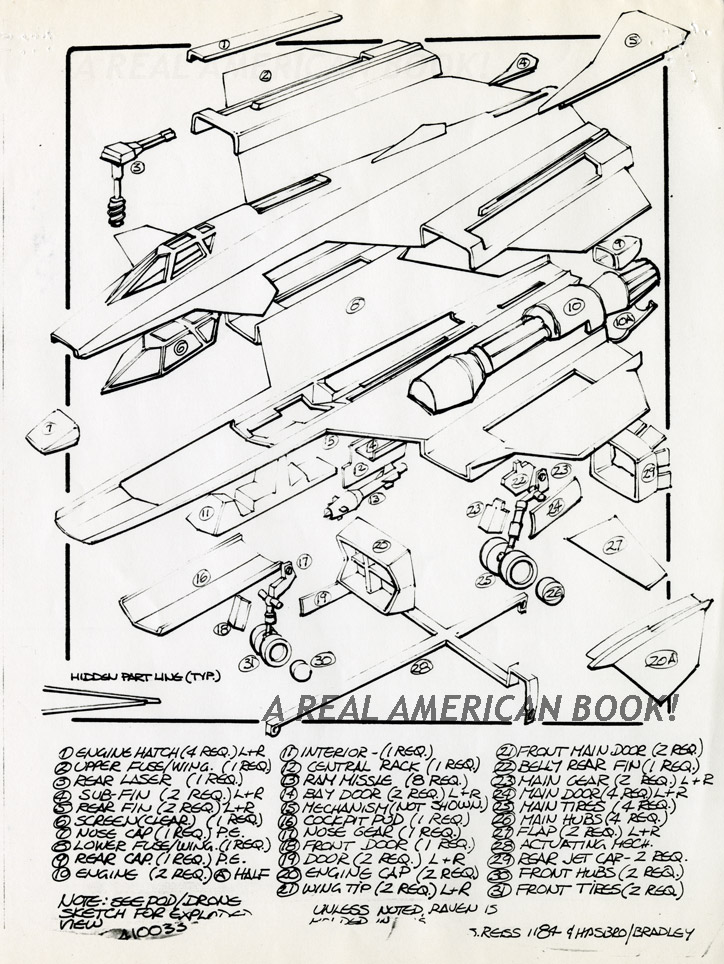
The final toy is black with opaque red accents, and the clear red cockpit windows are a lovely, extra detail. The Night Raven is also quite long, and I recall always needing two hands to support it. It’s one of the most attractive products in the entire Real American Hero product line — elegant, sleek, and aggressive.
Filed under G.I. Joe Behind the Scenes, Toys and Toy Art

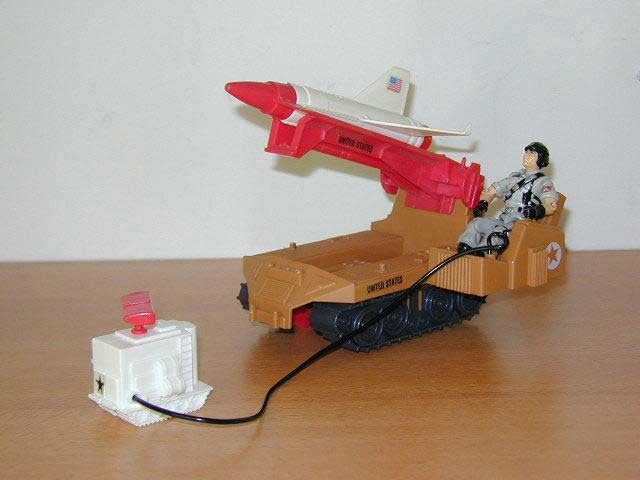
Sorry for the delay in posting. School starts and trips accrue in September. To get back into it and take a break from “The Rotten Egg” and my exciting internship today we’ve got Rich Rossi’s color rendering of a vehicle concept, the Towed Artillery Missile System, which I’ll call the TAMS for short. In all honesty I don’t know anything about it, so we’ll play the reasonable assumption game.

Drawn in ’84, it would have been pitched for ’86 or ’87. But often concepts would get shot down, only to resurface later, or inspire a later idea. In 1988 a different vehicle showed up, the similarly monikered RPV, or Remote Pilot Vehicle — boy did the names not flow for these two.
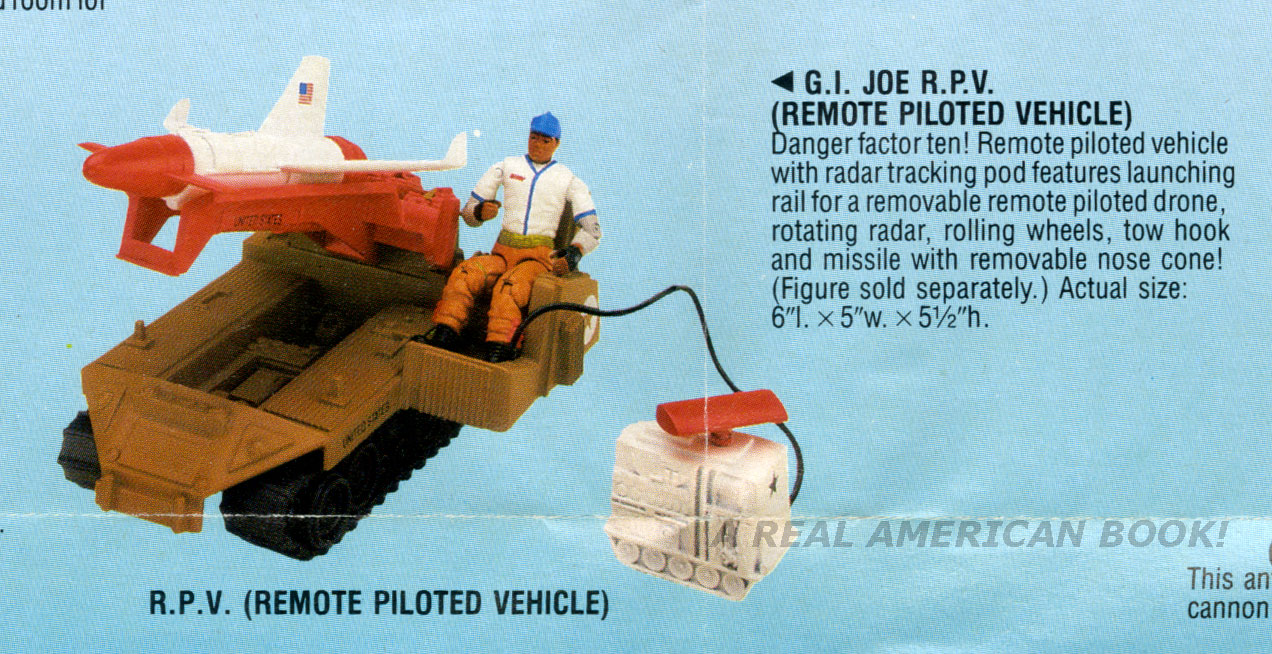
I don’t wish to draw a straight line between them, that one inspired the other, but it’s safe to say they both filled a specific price point, play pattern, and concept. But notably the TAMS seats no driver and carries no figure, even by precarious foot peg. And to further differentiate it from the RPV, by ’88 scale, detailing, and concepts were getting exaggerated and moving away from strict military realism. The structure of the TAMS more resembles the detailing on earlier vehicles like the FLAK and the ASP, shown here.
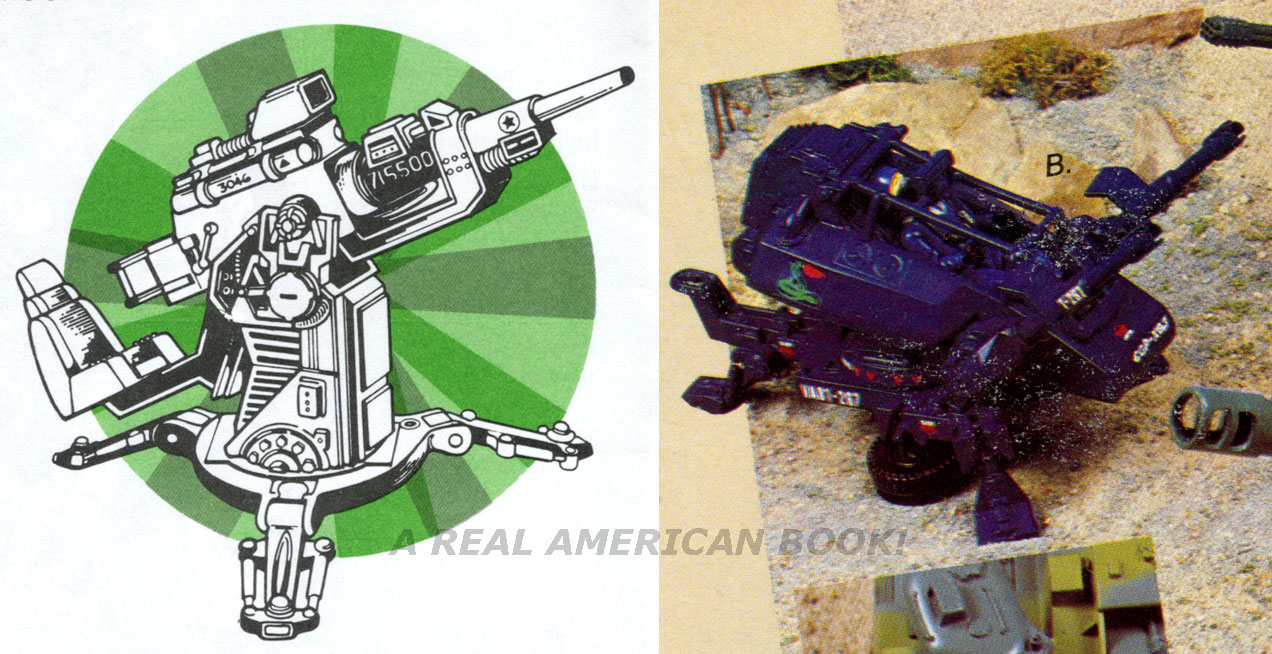
There’s a stronger sense of parts and bolts and hardware, whereas the late ’80s styling smoothed out edges and surfaces. Since these catalog scans aren’t too enlightening, here are links to much nicer photos of each, from the fine folks at yojoe: the FLAK, the ASP, and the RPV.
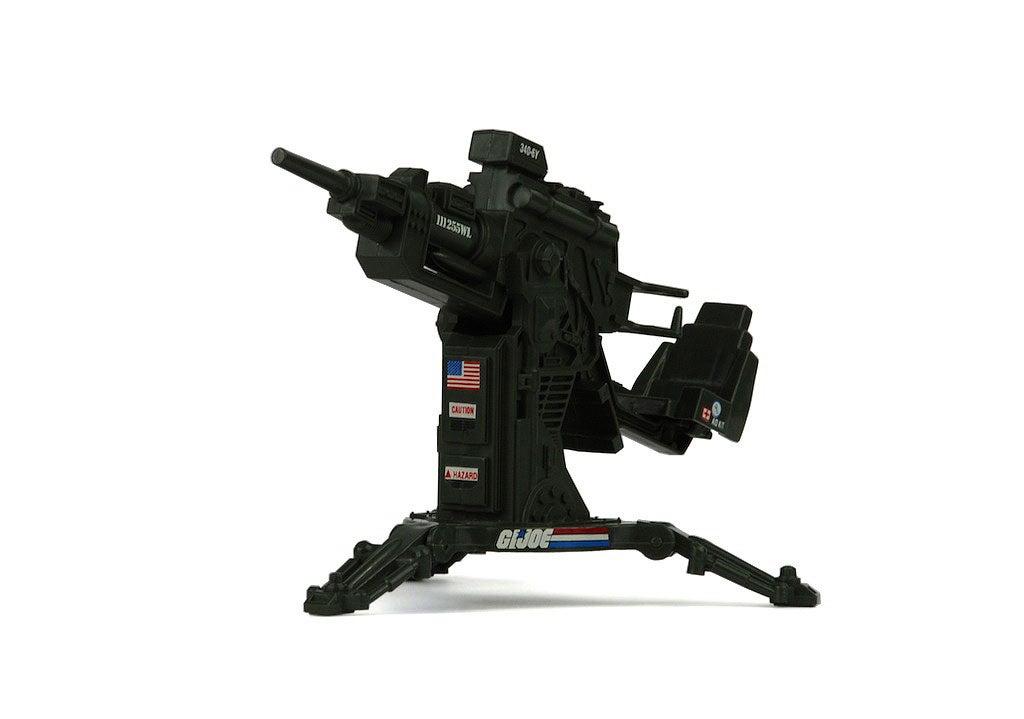
One thing’s for sure — Real American Hero had no shortage of small artillery accessories. These were great for populating a small-scale battlefield with variety, even if they weren’t as much fun as “regular” vehicles like Jeeps and tanks, or as story-driving as a headquarters playset.
Filed under G.I. Joe Behind the Scenes, Toys and Toy Art

As the Real American Hero line was winding down, Boys Toys in Pawtucket had in mind something new for late 1994. It would be bigger than 3 3/4 inches, and it would look back to World War II rather than the slightly futuristic angle G.I. Joe had carried for twelve years. Sgt. Savage and his Screaming Eagles were greatly inspired by Nick Fury and his Howling Commandos (Marvel Comics), and Sgt. Rock and the Combat-Happy Joes of Easy Company (DC Comics), so much so in fact that Boys Toys VP hired Sgt. Rock artist Joe Kubert to draw the initial designs, package artwork, and insert comic.

Joe Kubert passed away last weekend at the age of 85. Amazingly, he was still writing and drawing comics, and his work only got better with age. While the Watchmen prequels aren’t my cup of tea, I very much enjoyed the last major Rock story by Kubert, and both as a reader and retailer look forward to his upcoming Joe Kubert Presents 6-issue anthology for DC.
Filed under G.I. Joe Behind the Scenes, Toys and Toy Art

Before Cesspool became the lead villain for Cobra’s half of the 1991 Eco-Warriors subset, Kurt Groen pitched this unnamed character, a pirate oil baron.
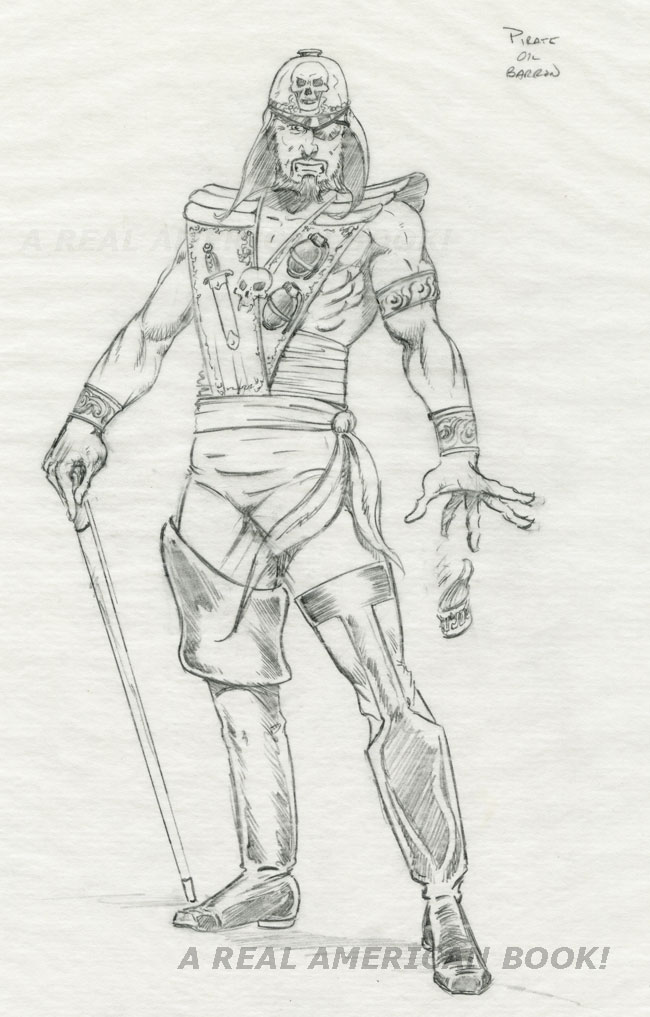
I’m not sure what he’s dropping, something with a Joe logo — a pouch? Spirit’s ponytail? Later, when Groen colored this, he added a backpack with an oil-shooting weapon, looking ahead to the water-squirting weapons that each Eco-Warrior came packaged with.
Filed under G.I. Joe Behind the Scenes, Toys and Toy Art

In 1988 Hasbro released a stunning G.I. Joe figure called Hit & Run. Here’s a not-professional photo by me for context.

No flesh tone, just green and black camo all over — his hands, his face, and his clothing. Fun fact: Hit & Run is [EDIT: one of] the only Joe[s] with whites-of-his-eyes. All other figures 1982-1994 are flesh tone plastic with a paint detail in black, brown, blonde, or red for eyebrows and retina. [EDIT: Two others have whites-of-eyes].
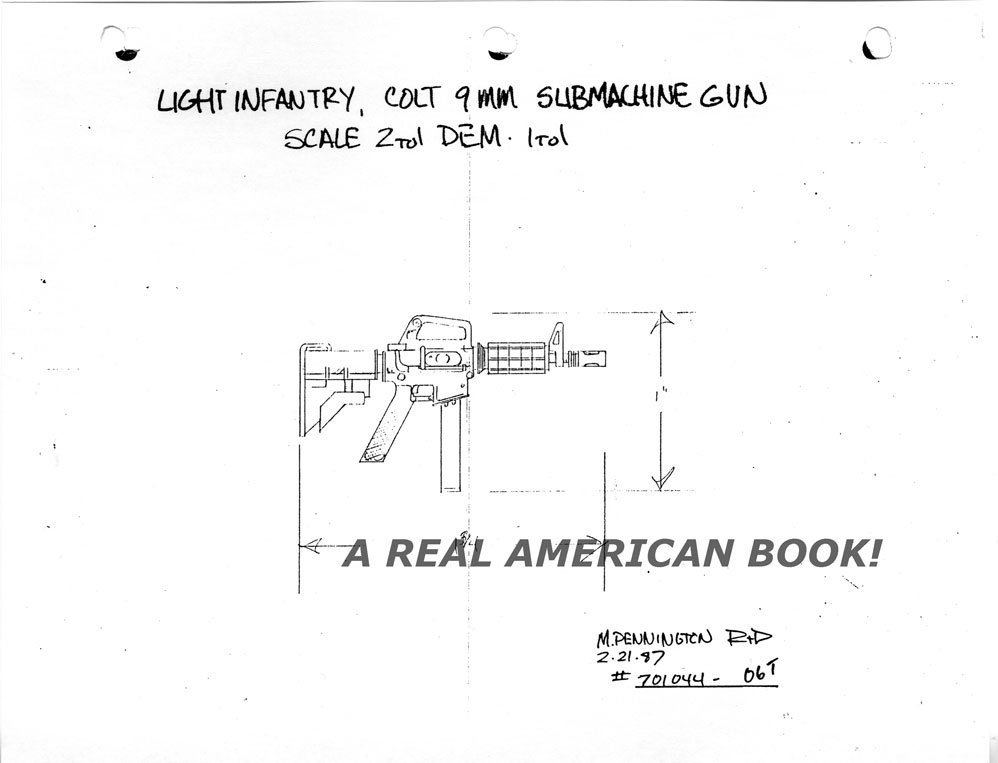
Here’s his turnaround, drawn by Mark Pennington, with machine gun, duffle bag (taking the place of a backpack), and accessories.
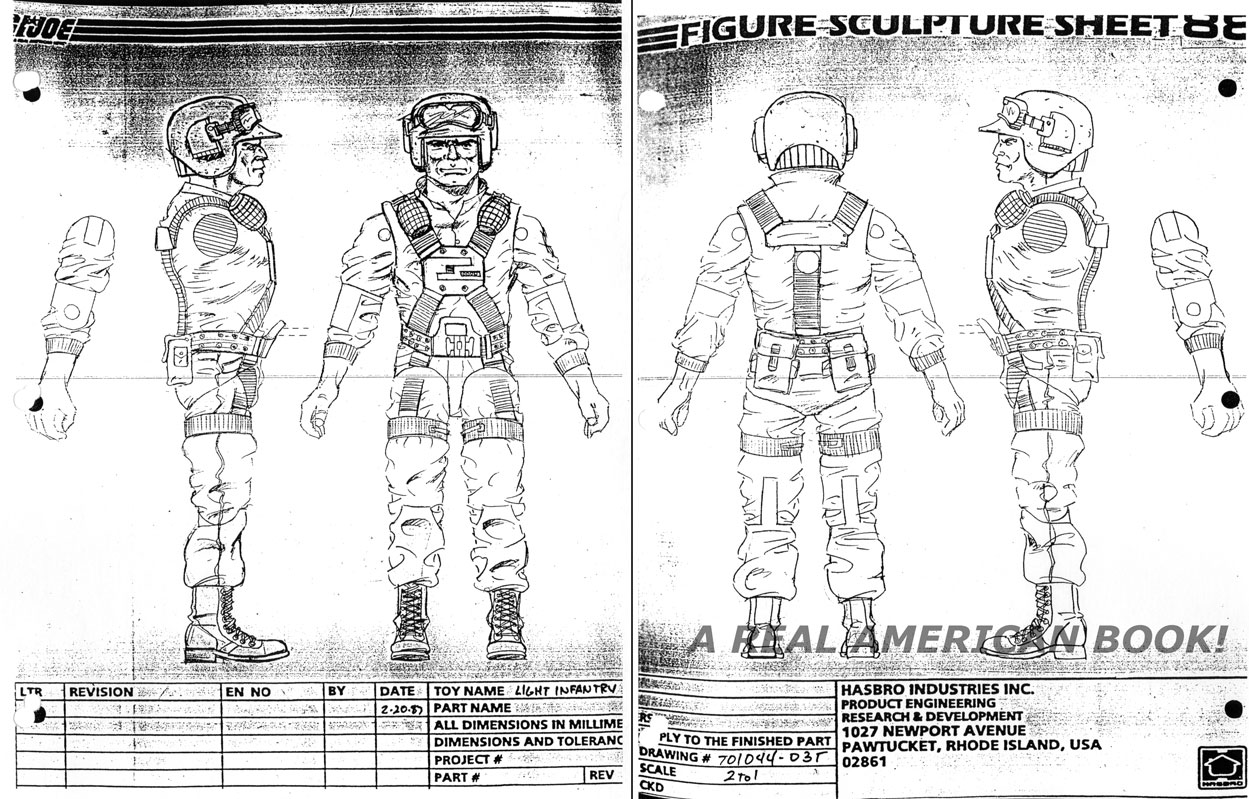


Many Joe fans know that Real American Hero ended in 1994, and the planned 1995 line was scrapped, although images of package artwork and product samples have circulated. Did you know Hit & Run was destined, in a way, for a return?
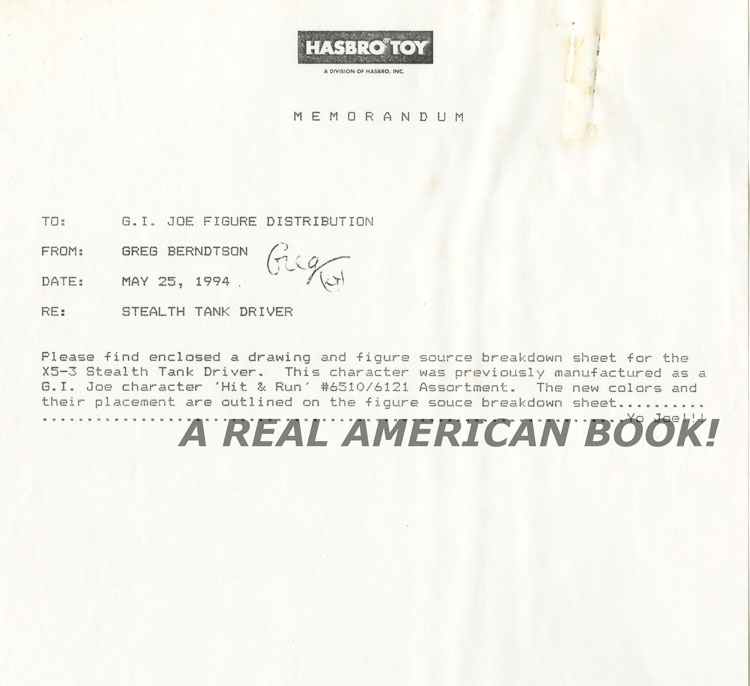
Indeed! According to this memo from Greg Berndtson, Hit & Run, whose figure was never recolored or re-released, was going to be re-used for the ’95 line as the Stealth Tank Driver! REVELATION. Here’s his turnaround.

You’ll note it’s just a photocopy of Hit & Run’s, although a few specs have changed, which I have highlighted for clarity. This looks to be early enough in the process that our new tank driver doesn’t yet have a codename, or if he does, as of June ’94 that’s happening in Marketing and Legal and the R&D guys don’t have the final name.
So what would he have looked like? Kurt Groen’s breakdown tells us, even if it doesn’t show us:

Using these codes as a guide, I’ve taken the liberty of coloring that sculpt input myself. So here for the first time ever is what the unnamed Phantom X5-3 Stealth Tank driver would have looked like:

I’ve taken a small liberty here. For clarity I used a dark grey rather than black, and I’m approximating “LT YELLOW GRN.” “IVY,” as well, but that’s less up to guessing. After the sidetracks and excesses of ’91 – ’93, the ’94 line was getting back to basics and ’95 would have only continued the trend. That it never happened has always been a little sad, although the Real American Hero line certainly surpassed all expectations by lasting twelve years. I hope you’ve enjoy this look behind the curtain at what may have been.
Fun fact: Hit & Run is the only Joe [EDIT: one of only two] with an ampersand in his name that doesn’t denote an animal companion. Law & Order was Law, the MP, and his K-9, Order. Spearhead and Max is the point man named Spearhead and his bobcat, Max. Well, that’s the word “and” rather than an ampersand, but you get my drift. Hit & Run is this guy’s whole name, ampersand-ed idiom and all.
[EDIT: Thanks to Tolan, who caught my two errors, as noted in the comments below. -Tim]
Filed under G.I. Joe Behind the Scenes, Toys and Toy Art
…And we’re back. Sorry for the radio silence. Thanks to visitors who keep clicking over here.
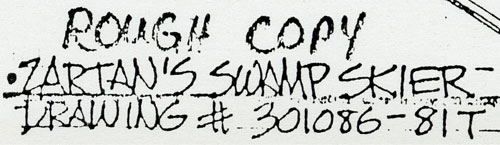
Today’s post features Zartan’s swamp skier, the Chameleon. No one ever called it by name in the TV show, and offhand I don’t recall it appearing in the comic, though if it did, it would have been around issue #25, and I don’t think anyone called it by name. Here’s Wayne Luther’s design art for it, dated September 13, 1983.

Here also is a photocopy of a photocopy of an early sample of the Chameleon. That figure looks like the HISS Driver, but I’m unsure.
 Why the HISS Driver, you ask? This photo must predate any production samples of Zartan back from China, and likely any handmade samples, so for reference, any figure was placed on the vehicle. HISS Driver debuted a year before Zartan, so one was on hand. (Or whoever it is.) These photos were sent to the TV producers, writers, and artists, and probably also the Marvel offices for comic book reference.
The water cannon was used in episode #6 of G.I. Joe, but I don’t recall ever “using” it when I played with my G.I. Joe action figures. As the Chameleon was not a robust construction, and was always falling apart, I stopped including it in my G.I. Joe games soon after getting it.
There were two TV ads for Zartan and the Chameleon. One for issue #25, all animation. Here’s the toy one, which uses some of that animation:
Filed under G.I. Joe Behind the Scenes, Toys and Toy Art


 A Real American Book!