Between posting my four JoeFest ’25 articles and starting to post my Dallas-Ft. Worth G.I. Joe ’25 articles, Alan Hassenfeld died. I did not know him, and only briefly met him twice, but he appears throughout my book, and his fingerprints are all over G.I. Joe across several decades. It felt appropriate to write something about him here. This is a place where some folks come for G.I. Joe information and opinion, though there are certainly better articles on Hassenfeld from journalists, his friends, and people who worked with him.
Today’s post has three pieces of art. All come from the 1984 “G.I. Joe Briefing Book” a thick three-ring binder of photocopies and memos that some folks writing for the Sunbow cartoon had. It was reference for all the character and vehicle names and looks, a page or two for each. Many entries start with a high-contrast black and white photocopy of some Hasbro package art, followed by a black and white photocopy of a Marvel Productions color model cel.
My last few blog posts were about toy conventions, and my next four(!) will be too, so it’s time to return to the old bread and butter of A Real American Book!, which is toy development paperwork.
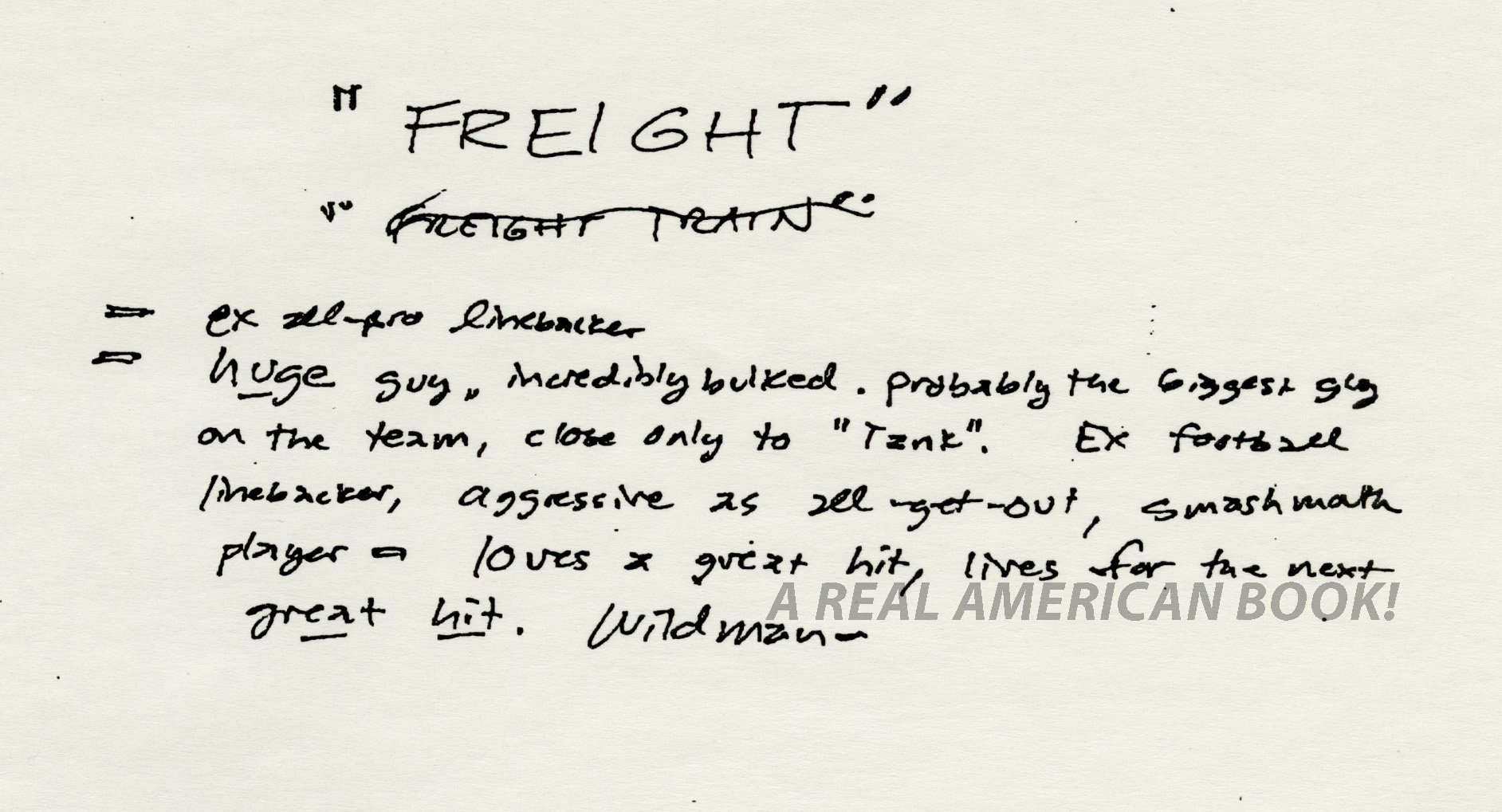
Ben Torres had drawn comics for a pair of small black and white publishers when he started freelancing as a toy designer. This was around 1994, and with the A Real American Hero line of 3 3/4-inch figures ending, I’m referring not to Hasbro in Rhode Island, but Kenner in Ohio, and what became known as GI Joe Extreme.
This image was faxed from Kenner to Hasbro’s advertising agency in October of 1994, along with other drawings at a time when Kenner’s designers, marketers, and lawyers hadn’t yet pinned down all the character names. Click to enlarge.
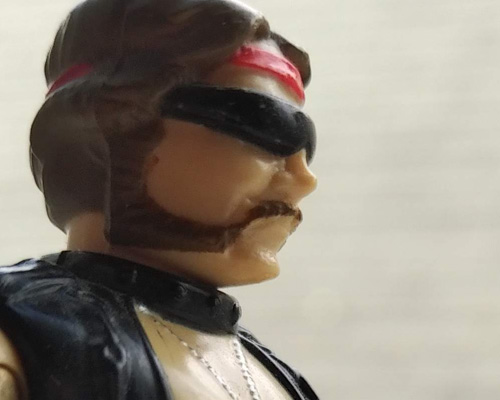
I’m unclear on who “Tank” is supposed to be. To my mind, the biggest Extreme character is Freight, and while some characters morphed in the development process, what art I’ve seen indicates a pretty linear path for each character type (the leader, the martial artist, etc). From here, Freight is pretty locked in — shoulder pads, do-rag, and everything he says in the TV series is a football reference. Here’s a production figure:
Torres continues to have a fascinating career in toys, product design, brand creation, and marketing. He briefly returned to comics in 2017 for Marvel’s Kingpin miniseries, collected in softcover that same year.
Extreme fans, please feel to make a football reference in the comments.
In the development process at Hasbro, every G.I. Joe figure that made it to retail (and some that didn’t!) got a fancy drawing or painting whereby the higher-ups could see the character as a bold, dramatic illustration. This wasn’t the package art that we all saw on toy store shelves, but rather, internal only to Hasbro. A pencil turnaround of the figure from front, side, and rear views didn’t offer enough punch, nor did a sculpt or a casting. George Woodbridge, better known for military history books and Mad Magazine, was one of the eight or so artists who created these. (He also delineated most of the 1988 turnarounds.)








 A Real American Book!